
SMILE Monovision
Our advanced Monovision treatment optimises one eye for distance and the other for near vision, providing a seamless visual experience without the need for multiple pairs of glasses.
SMILE Monovision laser treatment – treating presbyopia
From around the age of 40, many people notice their vision declining. This typically shows up as reduced near vision.
It becomes increasingly difficult to read the small print on leaflets, and reading the newspaper is often only possible at arm’s length. Near vision can become almost impossible. This so‑called presbyopia affects most people sooner or later.
At the Bányai Eye Laser Centre in Stuttgart and Karlsruhe, we offer SMILE Monovision — a laser‑assisted method to restore vision for patients who prefer not to wear glasses or contact lenses. Learn more about laser treatment for presbyopia.


What is SMILE Monovision?
The cause of presbyopia is that, over time, the eye’s lens loses its ability to adjust for both distance and near vision. This ability, which allows a young eye to switch rapidly between different distances, is called accommodation.
SMILE Monovision is a laser eye procedure that aligns distance and intermediate vision between the two eyes to compensate for this limitation. One eye is optimised for distance vision, while the other — unlike the correction for non‑age‑related refractive errors — is intentionally only partially corrected to provide good near vision. This approach is often referred to as the so‑called “Goethe view”.
The brain can then combine the two inputs into a single sharp image. As a result, reading glasses can usually be avoided. The eye optimised for near vision allows nearby objects and text to be seen again. To preserve depth perception, the difference in refractive error between the two eyes should not be too large.
Request a non-binding callback now.
Which methods are included in SMILE Monovision?
Whether your eyes are suitable for LASIK depends primarily on the type of refractive error. Unlike Relex Smile or SMILE Pro, Femto LASIK can also treat farsightedness up to +5 diopters.
SMILE Monovision LASIK falls within refractive surgery and is not limited to a single technique; it encompasses various methods.
Dr. Bányai and her team achieve the desired result with all laser eye treatments
In Monovision Femto LASIK, a very thin layer of the cornea is first cut and folded back to form a flap. The underlying corneal tissue can then be reshaped so that the eye’s refractive power is optimised.
Unlike conventional LASIK, where the flap is created with an ultra‑fine blade, in Femto LASIK the flap is made using a femtosecond laser. This allows for an even more precise flap.
The SMILE® Pro procedure is an advancement of the Femto LASIK technique. The main difference is that no large incisions are required, which preserves the surrounding corneal tissue. Initially, the eye laser creates a tiny lenticule within the cornea that is then removed. SMILE® Pro takes only about 10 seconds compared with the Relex Smile method.
An alternative for patients whose cornea is too thin for SMILE® Pro or Femto LASIK is PRK (photorefractive keratectomy) or A‑PRK (advanced photorefractive keratectomy).
These are gentle surface procedures. The refractive error is corrected using an excimer laser.
For SMILE Monovision, a refractive lens exchange (RLE) is also an option. In this procedure, we implant multifocal lenses that enable each eye to see both at distance and near.
We recommend this approach for patients for whom laser treatment is medically unsuitable or not desired.
Reviewed by Doctor-medic Liliana-Iulia Bányai
With over 50,000 successful surgical procedures, the experienced team at Bányai Neue Augen specializes in eye surgery. Thanks to ongoing professional development and training, you can be confident you are in exceptionally competent hands.
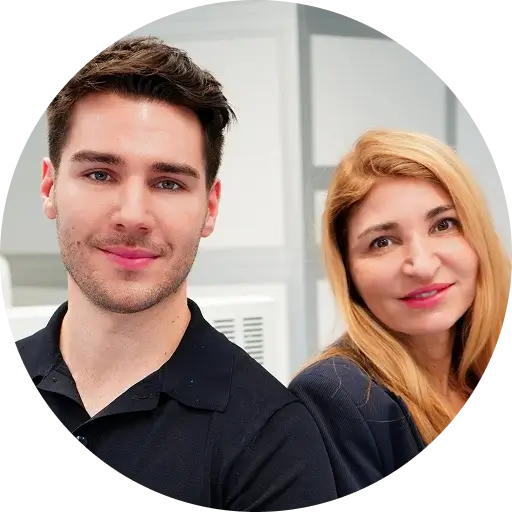
Doctor-medic Liliana-Iulia Bányai & Dr. med. Daniel Bányai
