
Correcting Refractive Errors – All Information
Refractive errors are caused by an impairment of the eye’s ability to focus light. Correct your refractive error and enjoy freedom from visual aids.
Learn more about refractive errors and how we can correct them with laser eye treatment.
Refractive errors – What exactly are they and what forms are there?
Emmetropia (from the Greek: in measure, fitting) means normal vision in ophthalmology. Another technical term is ametropia – it refers to an optically non-ideal eye, where incoming light rays are not correctly focused on the retina.
What does the term refractive error mean? A refractive error occurs when the shape or structure of the eye deviates from the norm. A refractive error can manifest in different ways. In most cases the eye’s ability to focus — its refractive power — is impaired, resulting in reduced visual acuity. This means that vision from one eye, either at distance or up close, can appear blurred. This is just one example.
The most common forms of refractive error are:
- Short-sightedness (myopia)
- Farsightedness (hyperopia)
- Corneal curvature (stabsichtigkeit, astigmatism)
The symptoms of refractive error vary depending on the type and from eye to eye. We can correct many of these refractive errors in our eye clinic in Stuttgart or Karlsruhe!

Back to a better quality of life in 4 steps
Start the suitability test
Take our non-binding online suitability test today to find out which laser procedure is right for you.
Preliminary examinations
Visit us in Stuttgart or Karlsruhe for a preliminary examination. Together we’ll find the ideal laser eye treatment for you.
Laser eye surgery
The treatment is carried out by our experienced ophthalmologists at the laser eye centre in Stuttgart or Karlsruhe and usually takes only about 20 minutes, depending on the method. Afterwards, you can enjoy your improved vision.
Follow-up
After a few days, you’ll typically have full visual acuity. Follow-up checks take place 1 day, 1 week, and 3 months after treatment.
How do refractive errors develop?
Refractive errors occur when the cornea is misshapen or the eyeball is formed incorrectly. This affects the eye’s refractive power and causes light to fall on the retina incorrectly. The brain cannot form a correct image, and the result is a blurred perception.
As a result, objects in the distance or nearby objects appear blurred and are difficult to detect.

Treatment methods for refractive errors
There are treatment methods to manage or eliminate the different types of refractive errors. The goal is to enable you to see sharply again. Glasses or contact lenses are always only a temporary solution for clear vision.
If you notice signs of ametropia or any eye condition in your eyes, it is advisable to consult an optician or ophthalmologist for an examination. Thanks to state-of-the-art procedures, refractive errors can now be corrected, and diseases that were previously untreatable or only partially treatable can often be healed.
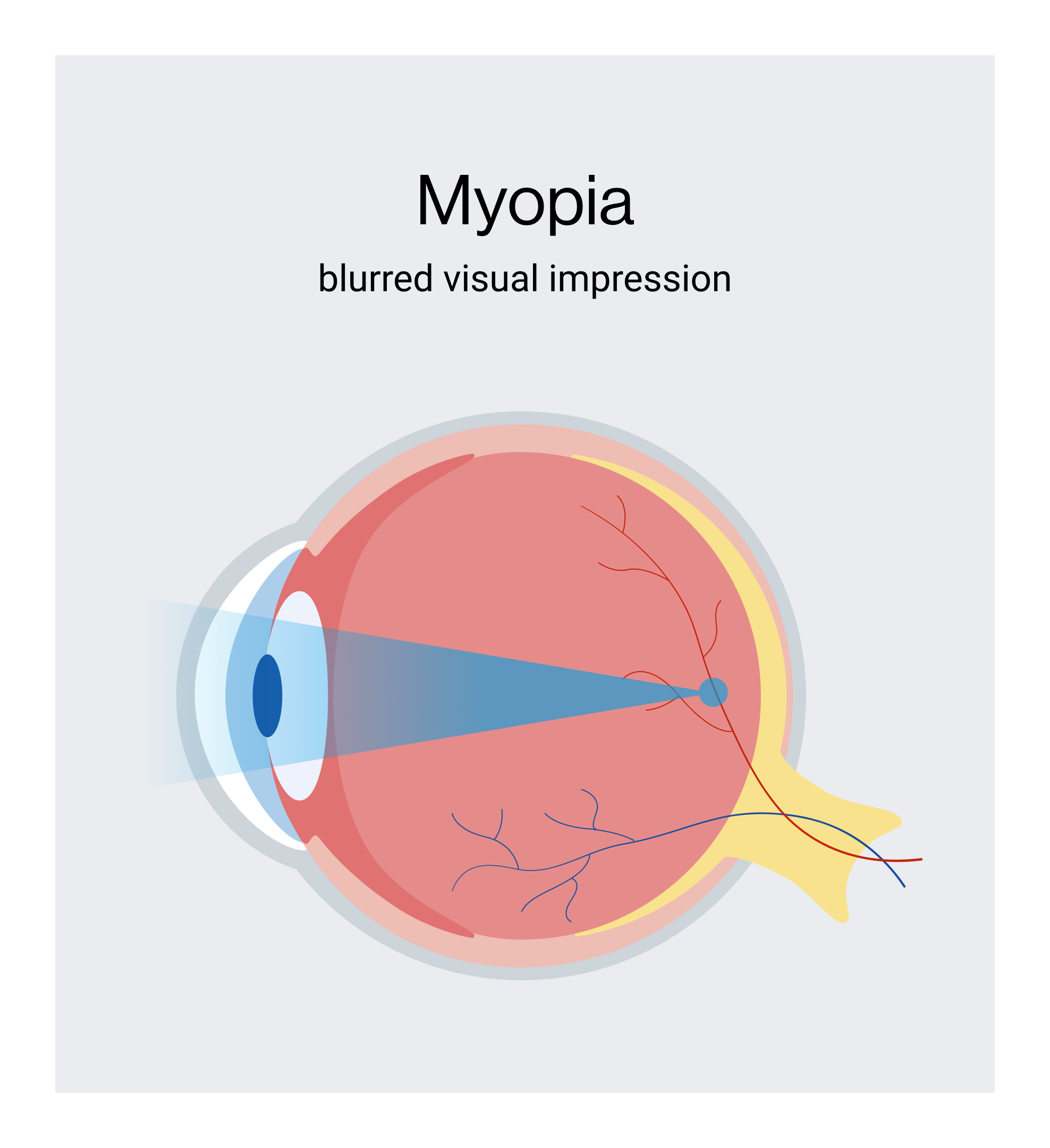
What is myopia?
Compared to a normal-sighted, healthy eye, the eyeball is too long in people with myopia. The beams focused by the cornea and lens meet in front of the retina. Therefore, sharp vision is only possible at short distances. Objects in the distance are perceived as blurred. This visual defect is called myopia or short-sightedness. You can have laser treatment for short-sightedness!
A promising treatment method for correcting myopia is the innovative and highly precise SMILE® Pro laser procedure. The proven Femto-LASIK method is also a possible approach.
In our laser eye centres in Stuttgart and Karlsruhe, we treat myopia and adjust the eye’s refractive power with these laser methods up to -10 dpt. For higher dioptres we use a lens implant. Even after laser eye surgery for myopia, glasses or contact lenses may still be needed temporarily to see sharply.
What is corneal curvature (astigmatism)?
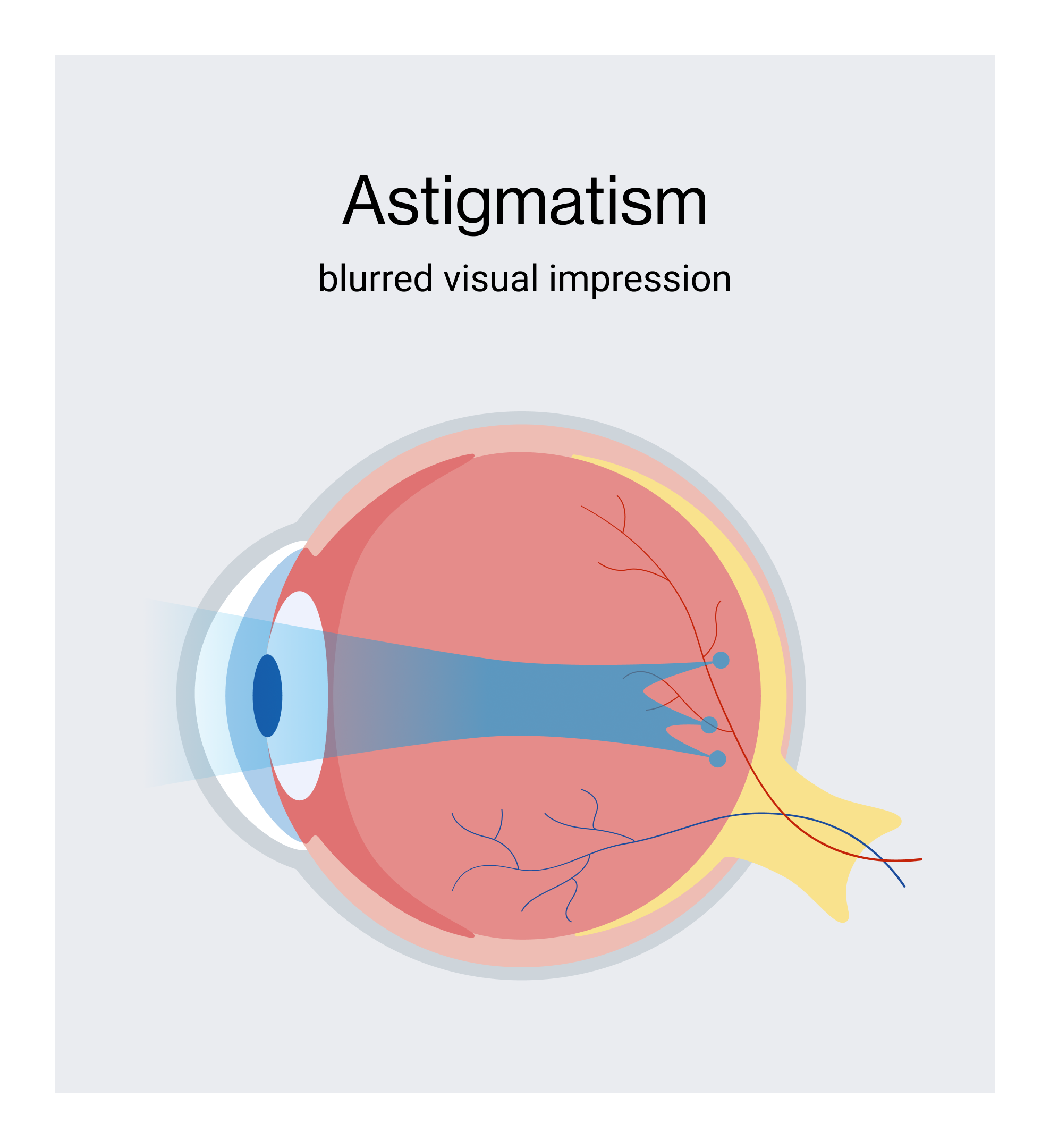
Unlike myopia and hyperopia, this is not about the length of the eyeball, although corneal curvature often occurs together with short- or long-sightedness. It is nonetheless a refractive error. Corneal curvature is also called stabsichtigkeit or astigmatism.
The cause is an uneven shape or surface of the cornea itself. Because the refractive power is altered, light beams cannot be correctly focused or refracted. Light rays do not form a single point on the retina. A corneal curvature (astigmatism) can be treated with SMILE® Pro or Femto-LASIK laser treatments.
We correct the refractive error known as astigmatism with laser methods up to 5 dpt. Above this level we implant a lens implant. If you decide to stop using glasses or contact lenses to see clearly, you should consider laser correction. With laser treatment, the cornea’s refractive power is precisely adjusted so that vision and visual acuity are optimised.
How does presbyopia develop?
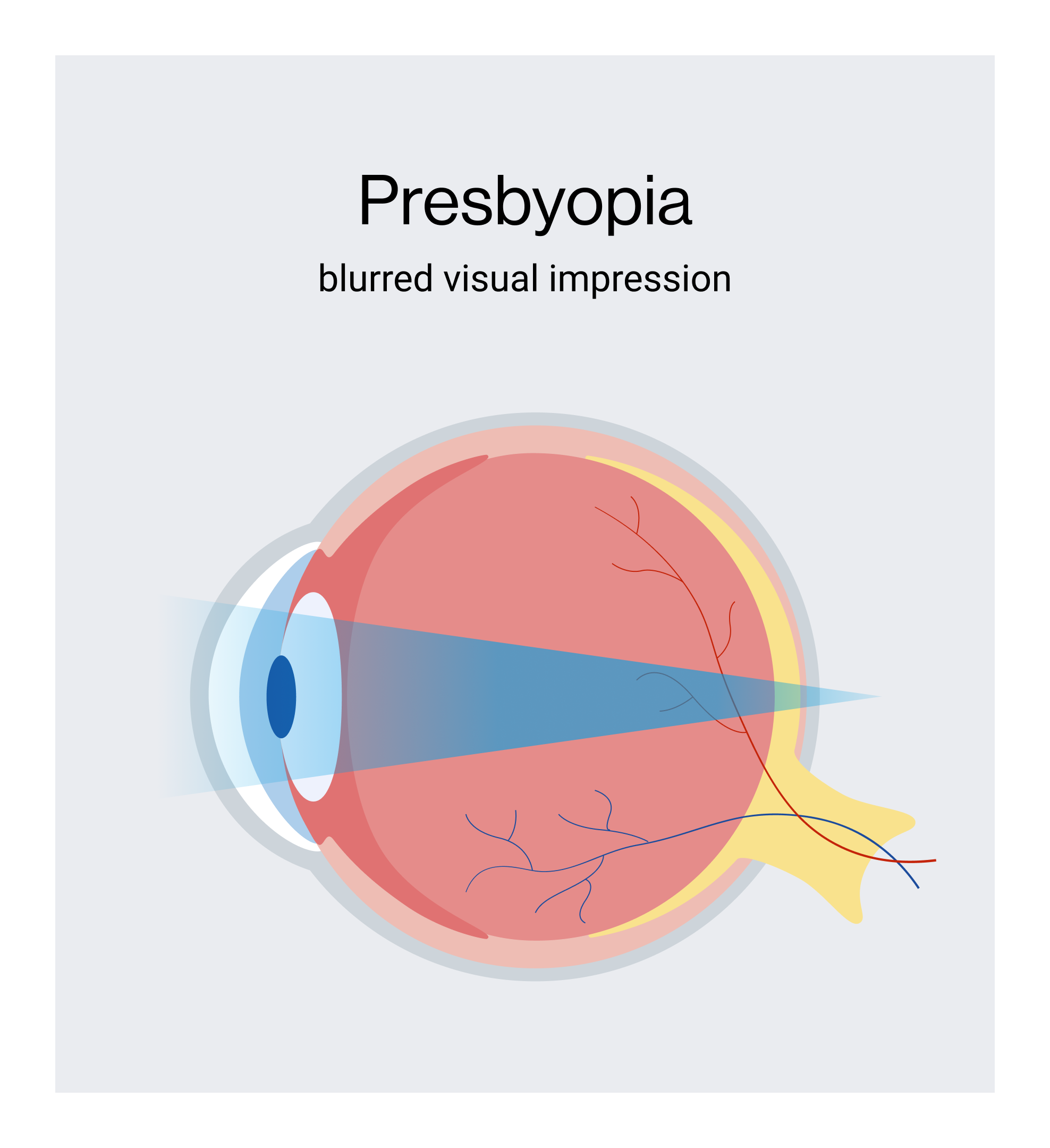
Presbyopia is not a congenital refractive error. At around age 45 — with increasing age — the eye’s lens begins to harden in everyone.
With presbyopia the lens loses flexibility and can no longer adjust to near objects (the ability to accommodate decreases — the lens’s refractive power is reduced). Again, light rays fall incorrectly on the retina and no sharp image is produced.
Patients affected by presbyopia typically wear progressive (varifocal) glasses, while people with normal vision may use simple reading glasses.
A permanent correction for ametropia or presbyopia can be achieved with the Presbyond procedure, a special variant of Femto-LASIK, or by implanting an artificial lens (an intraocular lens). You can have your presbyopia treated with laser.
Higher-order refractive errors (aberrations)
In addition to the common refractive errors — myopia, hyperopia and astigmatism — there are so-called higher-order refractive errors. These can also impair vision in one eye or both eyes.
Despite correction with visual aids, the affected eye often does not achieve normal, full vision. There are also usually deficits in contrast sensitivity and night or low-light vision. With topography-guided LASIK we are able to correct these aberrations.

Frequently asked questions about refractive errors
Yes and no. Glasses can help with a curved cornea, but only temporarily. To correct the corneal curvature, you should have it lasered.
With nearsightedness, objects in the distance appear blurred.
With farsightedness, also called hyperopia, it is the opposite: near objects appear blurred.
The cost of laser treatment for refractive errors depends on several factors: the type of refractive error you have and which laser procedure or eye surgery is suitable for you. You will receive exact details in a personal consultation and after your initial examination. You can view our prices in advance on our costs page. We also offer interest-free installments over 24 months.
Reviewed by Doctor-medic Liliana-Iulia Bányai
With over 50,000 successful surgical procedures, the experienced team at Bányai Neue Augen specializes in eye surgery. Thanks to ongoing professional development and training, you can be confident you are in exceptionally competent hands.

Doctor-medic Liliana-Iulia Bányai & Dr. med. Daniel Bányai
