Contact lenses – tips for symptom-free wearing of Doctor-medic Bányai

Contact lenses are a practical alternative to glasses. They are very comfortable to wear and guarantee clear visibility even in peripheral areas.
Due to the large variety, almost all refractive errors can now be corrected with the small lenses. Contact lens wearers can therefore always benefit from a sharp view, not only in everyday life, but also during sports.
In the following article, we will introduce you to the visual aid in more detail and explain its properties, areas of application and possible problems with contact lenses. You can also find out why many people get their eyes lasered today.
Which is better, daily lenses or monthly lenses?
The two most popular types of contact lenses are daily lenses and monthly lenses.
While monthly lenses can be worn for up to a month, you should replace daily lenses daily with a fresh pair.
Both monthly lenses and contact lenses for daily replacement are now made of hydrogel or silicone hydrogel, whereby daily lenses are usually thinner and thus more flexible. The modern material not only provides you with moisture and comfort, but also makes handling incredibly easy.
Since the lenses have to be changed regularly, the price often plays an important role for contact lens wearers. If you wear the contact lenses daily, monthly lenses are the cheaper option for you. Day lenses, on the other hand, are more worthwhile if you like to switch between lenses and glasses.
Especially if you have sensitive eyes, hygiene and care of the visual aid are of elementary importance. Since daily disposable lenses are individually packaged in sterile packaging, they are always clean and easy to use. Nevertheless, even monthly lenses with the right care can be a simple and hygienic alternative.
Alternative two-week lenses
Would you like to combine the best of both contact lenses? Then 2-week lenses may be just the thing for you. As the name suggests, these are exchanged every two weeks. The big advantage is that they feel comfortable until the end of the gestation period, as a fresh pair is used every two weeks.
Which contact lens is right for me?
Since not everyone tolerates contact lenses equally well in everyday life, it is important to consult an ophthalmologist or optician to select and adjust the lenses.
With regard to contact lenses for children, it is usually advisable not to test the first lenses until the age of 14. In principle, however, there is no prescribed minimum age from which children may wear contact lenses. It is first and foremost important to be able to use the contact lenses, which requires a little practice and dexterity as well as maintaining the necessary hygiene standards in the application.
Whether you have opted for contact lenses for the first time or just adjusted your vision, new lenses require a certain amount of time to get used to. How long it takes for your eye to adapt to the contact lenses depends individually on your sensitivity and the fit of the lens
So that you can tolerate the visual aid optimally, not only the correct handling is of great importance, but also the selection of the contact lens fluid. Be sure to talk to your advisory contact lens specialist about this.
How long does a contact lens last, how often do I need to change it?
While hard contact lenses are no longer usable after up to 18 months, soft contact lenses should be replaced after about 1 year . If the contact lenses are closed, pay attention to the expiration date on the package.
In general, you should have your eyes checked regularly in order to replace old lenses with new ones if the diopter number changes. With thorough care and adherence to the control and replacement intervals, you can use your contact lenses without worry for the recommended wearing period.
In general, however, the more often you change the contact lenses, the healthier it is for your eyes.
Types of contact lenses
There are many types of contact lenses. Whether for nearsightedness (myopia), farsightedness (hyperopia), in case of corneal curvature (astigmatism, astigmatism) especially for dry eyes or in case of presbyopia. Progressive contact lenses can be identified by the addition of the name Multifocal.
Various manufacturers (such as Biofinity, Air Optix, Acuvue Oasys, Bausch and Lomb, Biomedics or Biotrue) produce the right plastic lens for almost every eye and every customer requirement. There is a wide range of products such as dailies aquacomfort plus or Air Optix Hydraglyde (for very dry wearing conditions) or dailies total (for intensive use of digital devices), Air Optix night and day (for uncomplicated 24-hour use), Biofinity Toric or SofLens Toric (for corneal curvatures) and Freshlook Colorblends (coloured lenses).
There are not only differences in terms of wearing time and material, the oxygen permeability of the individual visual aids also varies greatly.
Even children or people with high dioptres can now wear contact lenses every day.
Contact lenses are also already available at quite reasonable prices, whereby you should always seek advice from your optician or ophthalmologist as to which manufacturer and which product is suitable for you.
The right choice of lens, as well as the right care product, can determine wearing comfort and compatibility right from the start and thus contribute to an optimal correction result.
Soft contact lenses
Soft contact lenses are made of flexible material and therefore adapt wonderfully to the shape of the cornea. Since they are slightly larger than dimensionally stable lenses, soft contact lenses have a stable fit and offer a high level of wearing comfort.
- Good spontaneous compatibility, especially with “contact lens beginners” and sensitive eyes
- Suitable for correction of farsightedness AND NEARSIGHTEDNESS
- Can easily be worn alternately with glasses
- The type of contact lens must be in harmony with the wearer’s cornea
- Attention: Many soft lenses are less oxygen permeable than dimensionally stable contact lenses
Dimensionally stable contact lenses = hard contact lenses
Dimensionally stable contact lenses (also called hard contact lenses) are made of oxygen-permeable plastics. They are smaller than soft contact lenses and are often better tolerated.
- Good oxygen availability
- Exact correction through individual production
- Good correction of astigmatism (corneal curvature) possible
- Long wearing life due to good oxygen supply, modern materials and robustness
- Long service life of 1 to 2 years
- Fewer deposits on the lenses
- Longer acclimatization time due to an initial foreign body sensation when blinking
- Limited use, as they can slip more easily than soft ones (less suitable for fast sports and some professions)
Multifocal lenses
Are you looking for an alternative visual aid to your progressive spectacles? Then bifocal or multifocal contact lenses can be a very good option for you.
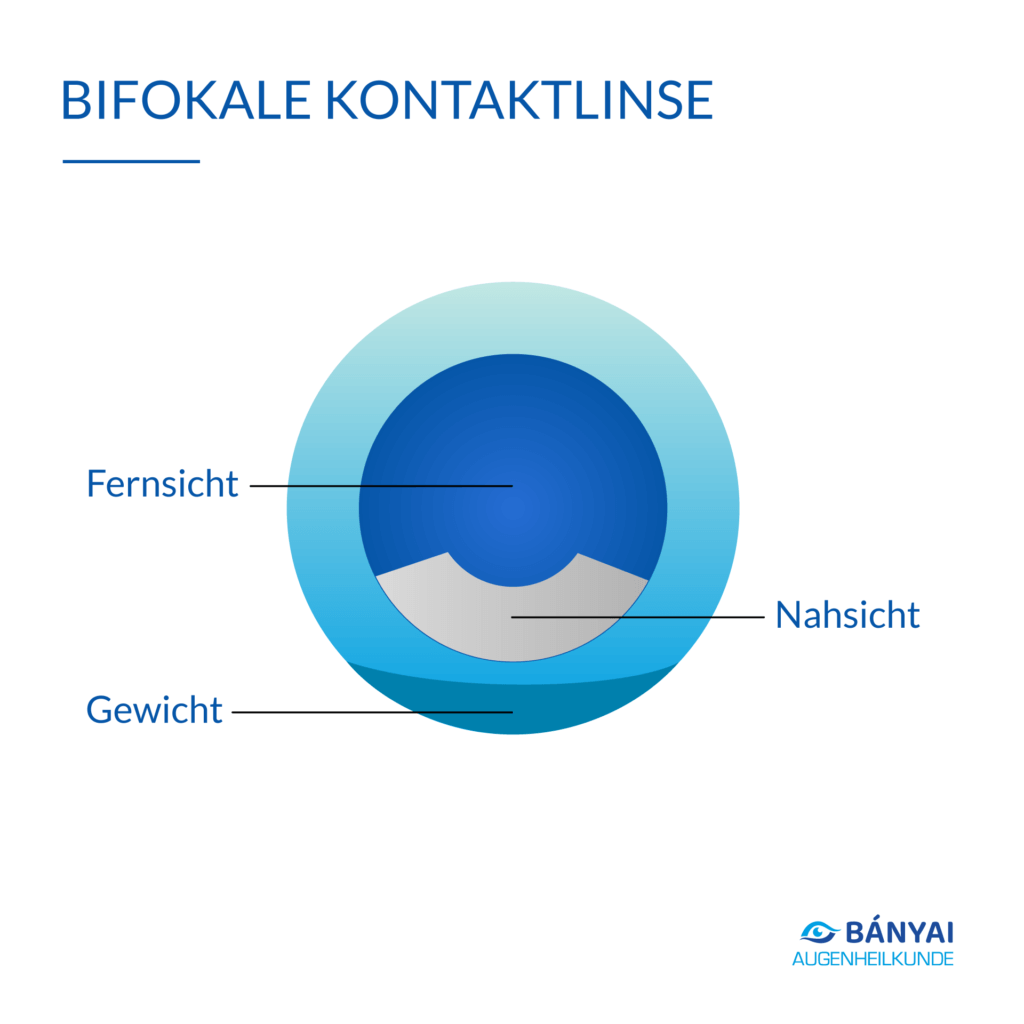
Bifocal lenses cover the field of vision for both distance and proximity. They can be arranged either on top of each other or in circles.
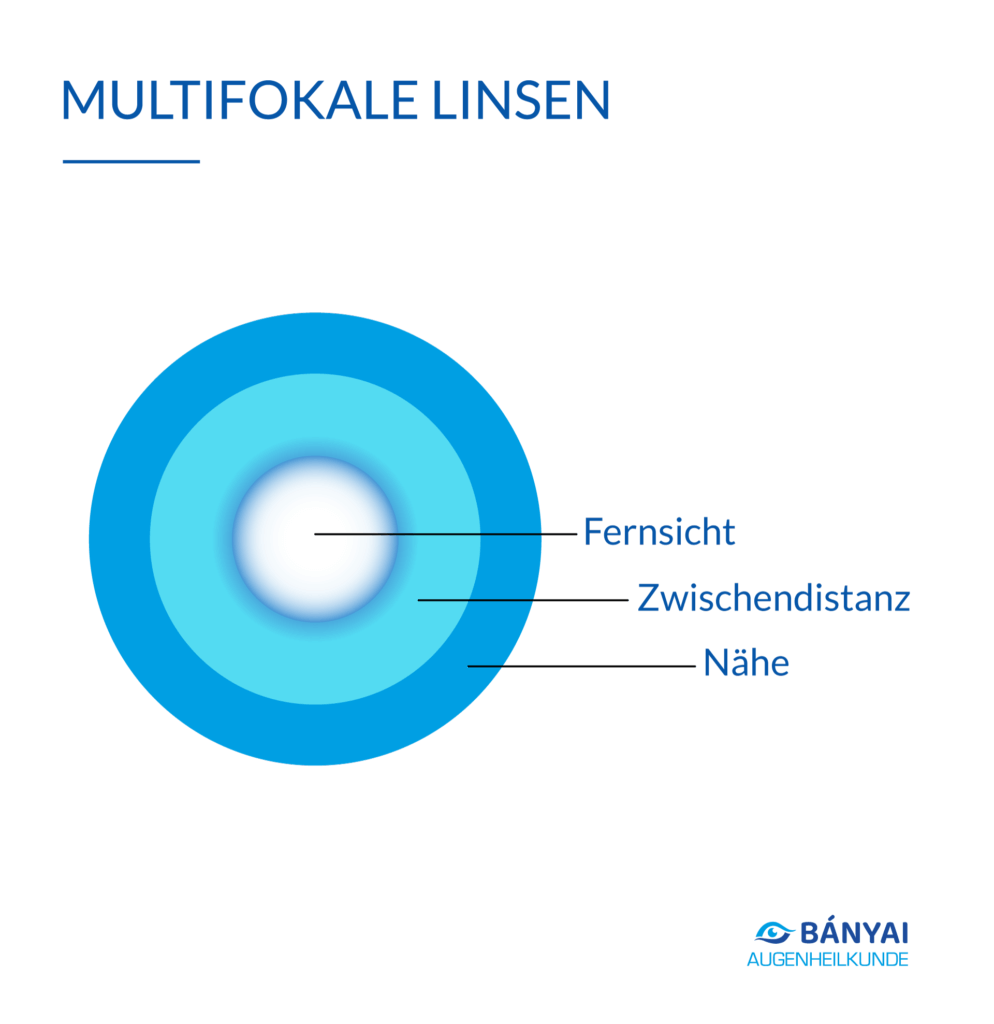
Multifocal lenses have several prescriptions that glide from inside to outside or from top to bottom.
Both systems convince with more advantages than disadvantages:
- To correct presbyopia
- Wearers can choose between hard and soft contact lenses
- Depending on personal preference, available in the form of daily disposable lenses, 14-day disposable lenses, monthly disposable lenses and annual disposable lenses
- More expensive, since the manufacture and adaptation of progressive contact lenses are more complex than with other vision aids
- Hygiene and care are no more complex than with other lens forms
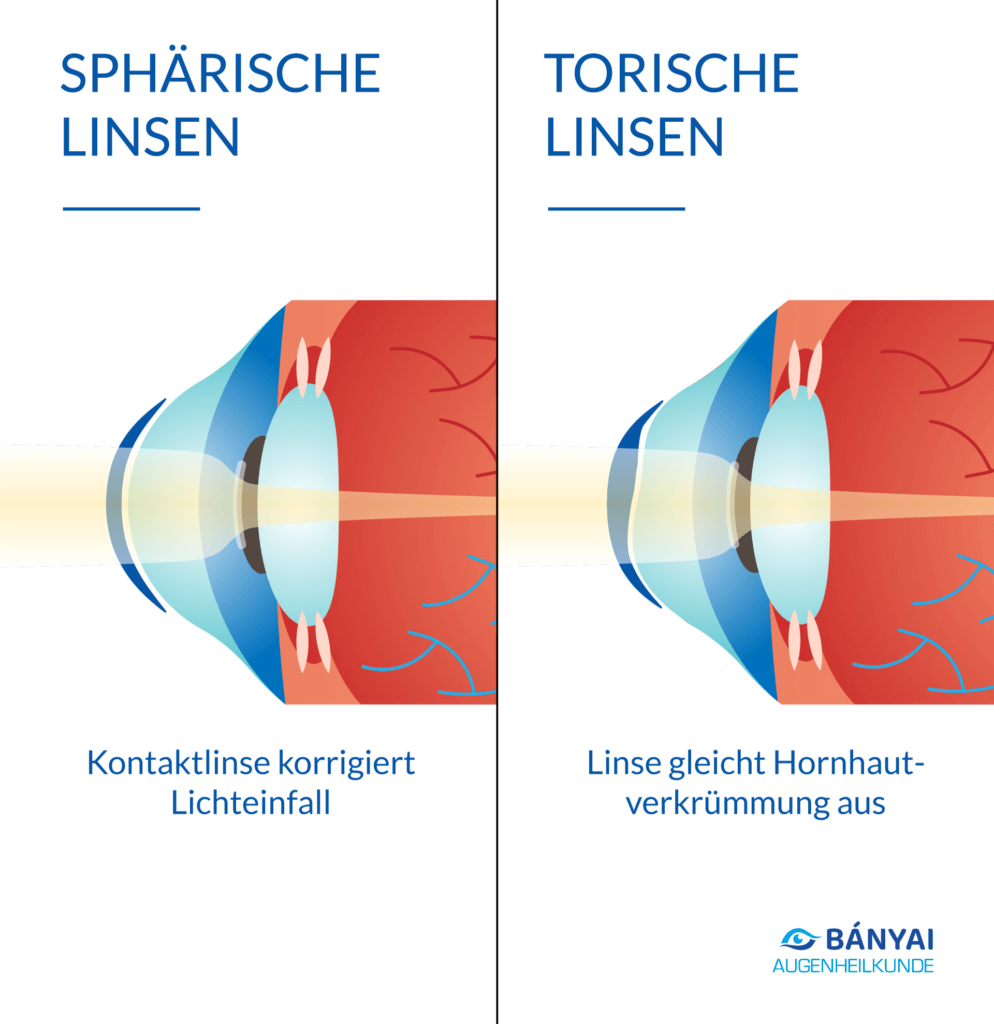
Spherical Lenses
Spherical contact lenses are able to focus or diffuse light rays in such a way that a sharp image is produced on the retina again despite existing defective vision. For a long time, they were the only models to correct refractive errors. To this day, they are still the most commonly used.
However, despite their wide range of uses, they are not always the best choice. Due to their partially inadequate optical quality, the lenses can cause imaging errors that provoke blurred vision. Since this phenomenon only occurs with spherically shaped optical lenses, opticians also refer to it as spherical aberration.
It is not possible for the eye to focus all beams at the same time, since the beams incident in the region of the curved lens edge are refracted differently than in the axial region. This leads to a blurry picture.
The advantages of spherical lenses are:
- Wide range of applications: For correction of myopia and farsightedness, presbyopia or corneal curvature
- Suitable for every lens wearer: dimensionally stable or soft, available as daily lenses, monthly lenses or annual lenses
Laser Eye Center in Baden-Württemberg
Visit our laser eye centre in Karlsruhe or Stuttgart. Ophthalmologist Doctor-medic Bányai is an experienced specialist in the field of refractive surgery in Germany. Together with her team, she offers you the highest expertise and comfort to correct your visual impairment safely and successfully.