
Glasses or contact lenses for presbyopia? Dr. med. Bányai explains

Should you choose glasses or contact lenses to correct presbyopia? Often it’s a matter of personal preference, though sometimes other factors play a role. However, you shouldn’t lose sight of what’s really important: that you can go about your daily life as little hindered as possible by presbyopia and by the visual aid itself.
To help you achieve this, we’ve summarized the most important information and considerations to keep in mind when deciding between contact lenses and glasses.
Glasses or contact lenses – which is better suited to your lifestyle?
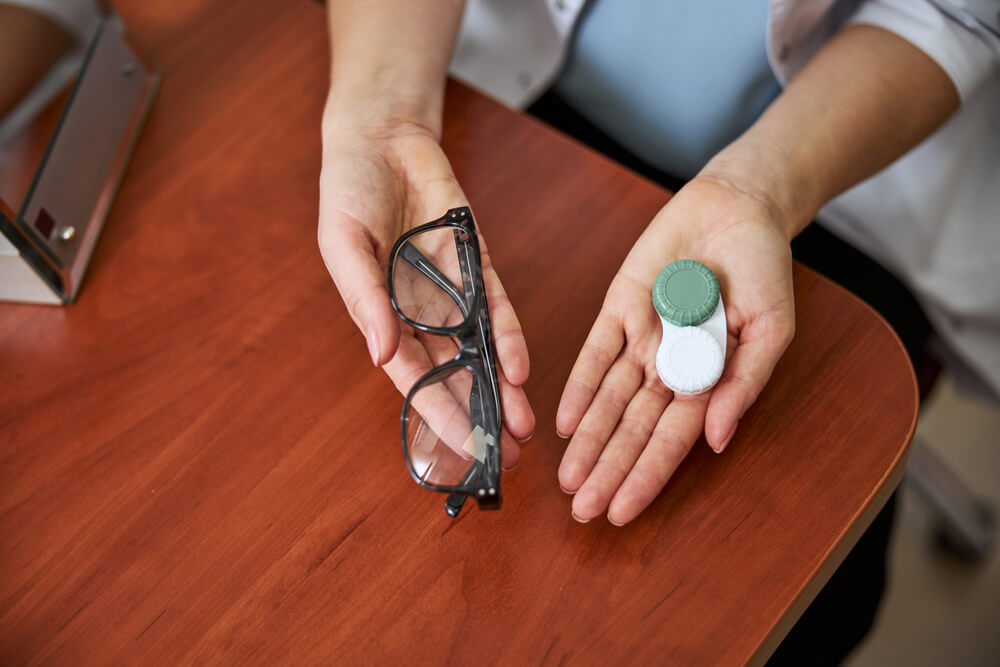
Whether you should choose glasses or contact lenses for presbyopia depends largely on your lifestyle and on the compromises that you are willing to make with the respectivevision aid. Both options offer effective ways to correct presbyopia, but they differ in comfort, maintenance and adaptability.
Advantages and disadvantages of wearing glasses for presbyopia
Glasses for presbyopia are probably the most common first step. Options include reading glasses, progressive glasses, or bifocals.
Their main advantage is simplicity: they offer an uncomplicated solution for people who cannot tolerate contact lenses or who prefer to avoid the required maintenance. In addition, glasses do not require direct contact with the eye and are easy to put on and take off.
This is particularly necessary with traditional reading glasses, which would interfere with distance vision. However, there are also disadvantages. Glasses can impose limitations when switching between near and distance vision. With rapid shifts of gaze, the eyes may become fatigued, and the field of view is restricted by the lenses.
Some people also find glasses annoying during sports or leisure activities. Nevertheless, for many, glasses remain the first choice for presbyopia because they are easy to use and effectively correct vision.
Common glasses for presbyopia are:
- Reading glasses (single-vision glasses)
- Bifocal glasses
- Trifocal glasses
- Progressive glasses (Multifocal glasses)
Note that the glasses you can buy at a drugstore, for example, usually fall into the category of reading aids and are not intended to permanently compensate for presbyopia if they are not perfectly adapted to the wearer.
Pros and cons of contact lenses for presbyopia
Contact lenses for presbyopia offer an attractive alternative and can be especially beneficial for active people. Multifocal contact lenses can address different ranges of vision, allowing you to see clearly both near and far. A more natural field of vision without bothersome spectacle frames is a major advantage. Contact lenses correct refractive errors directly on the eye and enable excellent visual acuity.
But contact lenses require more care. Daily cleaning and careful handling are necessary to minimize the risk of infections. Some people cannot tolerate contact lenses because of dry or sensitive eyes. They can also cause vision problems if handled improperly. Therefore, professional fitting and advice from an ophthalmologist or optician are essential.
Options for contact lenses for presbyopia:
- Monofocal lenses (one eye is optimized for distance vision, the other for near vision)
- Bifocal and multifocal lenses (progressive lenses)
- Combination of glasses and lenses (especially if nearsightedness and presbyopia occur together: the distance vision is still corrected with lenses; reading is then done with reading glasses)

Glasses vs. contact lenses: comfort and everyday practicality
In addition to pure vision correction, comfort and ease of use in everyday life play a major role in the decision to opt for glasses or contact lenses. You should also keep maintenance requirements and handling in mind – so we will now go into these points in more detail.
Comfort and everyday use
The right visual aid can minimize vision problems as you age and reduce eye strain. Glasses are comfortable to wear and require little or no adjustment time. Contact lenses, however, take some practice to insert and remove but can provide sharper vision and a wider field of view.
Your lifestyle and habits should be taken into account when choosing. If you do a lot of sports or lead an active lifestyle, you could benefit from contact lenses. For others, simply wearing glasses is sufficient to ensure good vision.
Care and handling
Contact lenses require careful handling and maintenance. Daily cleaning with specialized solutions is necessary to prevent eye diseases. Insertion also requires practice, as does removal. In addition, a contact lens can slip out of place or even fall out completely.
Glasses are easier to handle and require less maintenance. However, they can fog up or get in the way, which can be inconvenient in certain situations. In addition, people often forget or misplace their glasses.
Contact lenses or glasses for presbyopia – also dependent on other vision problems
It should also be borne in mind that presbyopia does not necessarily occur on its own, but there may already be present refractive errors. Vision impairments such as presbyopia and farsightedness occurring together must also be taken into account in treatment. But first to the core of the problem: what are the causes of presbyopia, and how does presbyopia manifest in everyday life?
Core of the problem: Aging process of the lens of the eye
With age, the eye’s lens loses elasticity – a natural process that reduces the eye’s ability to accommodate. As a result, close objects can no longer be seen clearly. The primary factor in presbyopia is this aging process, which mainly affects near vision.
Between the ages of 40 and 65, presbyopia gradually worsens. During this time, you should expect your vision to deteriorate by about +0.5 dioptres every five years, and your corrective prescription will need to be adjusted accordingly. With contact lenses, this adjustment is less expensive because the initial costs are significantly lower than, for example, for progressive glasses. Nevertheless, presbyopia still entails costs.
Consider nearsightedness, farsightedness and astigmatism
If, in addition to presbyopia, you also have farsightedness, nearsightedness, or astigmatism, the choice of visual aid can become more complex. Glasses can be fitted with special lenses that correct several vision problems at the same time – in most cases, progressive lenses are recommended.
Contact lenses are also available in versions that correct nearsightedness, farsightedness, and astigmatism. Ask your ophthalmologist or optician about your options and the expected outcome.
Cost comparison: glasses or contact lenses?
It’s hard to say because with both contact lenses and glasses you can be economical, but you can also spend a lot of money.
Multifocal lenses cost about 30 to 50 euros per month, i.e. between 360 and 600 euros per year (plus cleaning and care products). A pair of reading glasses is a one-time purchase of about 100 to 500 euros, whereas progressive glasses can easily cost more than 1,000 euros. It also depends on how often you want to replace your glasses.
In any case, treatment for age-related vision decline will incur costs. It may therefore be worthwhile to explore alternatives for correcting presbyopia.
Modern solutions and alternative treatments
The patients who come to my practice have usually already tried glasses or contact lenses, often both. Many then tell me that they are fed up with their glasses or contact lenses, no longer tolerate them well, or simply want to see clearly again without aids – as they did when they were younger.
Over the past few years, ophthalmology has developed various laser treatments to correct the eye’s refractive power and preserve clear vision into old age. At Bányai Neue, our experienced surgeons employ innovative techniques and state-of-the-art equipment to provide you with a long-term solution for presbyopia.
On the one hand, there is the actual laser eye surgery, in which we use PRESBYOND®. In this procedure, one eye is optimized for distance vision, the other for near vision. The brain then forms a sharp image at different distances.
In addition to this method, we also offer refractive lens exchange (RLE) as an eye surgery option. In this procedure, we replace the eye’s natural, rigid lens with artificial multifocal lenses.
In addition, this procedure can prevent or treat cataracts, which are caused by clouding of the eye’s natural lens that is removed during the operation.
Through careful examinations, we can determine which procedure is most likely to provide the best results for you.
During a personal consultation, you will have the opportunity to discuss all your concerns, questions, and wishes. In this way, we want to help you enjoy a freer, more carefree everyday life.
Whether at our eye laser centre in Stuttgart or in Karlsruhe, you will benefit at both locations from an experienced team, state-of-the-art technology, and a treatment plan tailored to you. We take the time to work with you to find the best solution for your vision and quality of life.