
Dry eyes, what to do? Doctor-medic Bányai enlightens

Dry eyes are also known as “sicca syndrome” or Sjögren’s syndrome. They occur when the physiology and anatomy of the surface of the eye are disturbed. As a result, the cornea and conjunctiva of the eye are insufficiently wetted with tear fluid. The protective film of the tear fluid is lost and the eyes dry out. Because this can damage the surface of the eye in severe cases, the symptoms should not be ignored.
Dry eyes are characterized by burning and itching, redness, fatigue or heaviness of the eyelids. Other symptoms include increased sensitivity to light as well as a feeling of grains of sand or foreign bodies, which often causes them to shed tears. When opened for the first time in the morning, the eyelids may be sticky and cause pain.
What really helps with dry eyes?
Dry eyes can usually be treated easily and well, which should also be done in case of troublesome symptoms. In some cases, the inadequate lacrimal fluid or the change in the tear film can cause damage to the surface of the eye. However, this is essential for eye health and vision.
The tear film has several tasks:
- Smoothing of the eye surface so that the light on it refracts evenly and a clear view is given.
- Providing the cornea with moisture, oxygen and nutrients.
- Lubricant for the eyelids so that they can move over the cornea and conjunctiva.
- Protective function due to the flushing out of germs and foreign bodies as well as from wind, cold and heat.
- Antibacterial effect due to anti-microbial components.
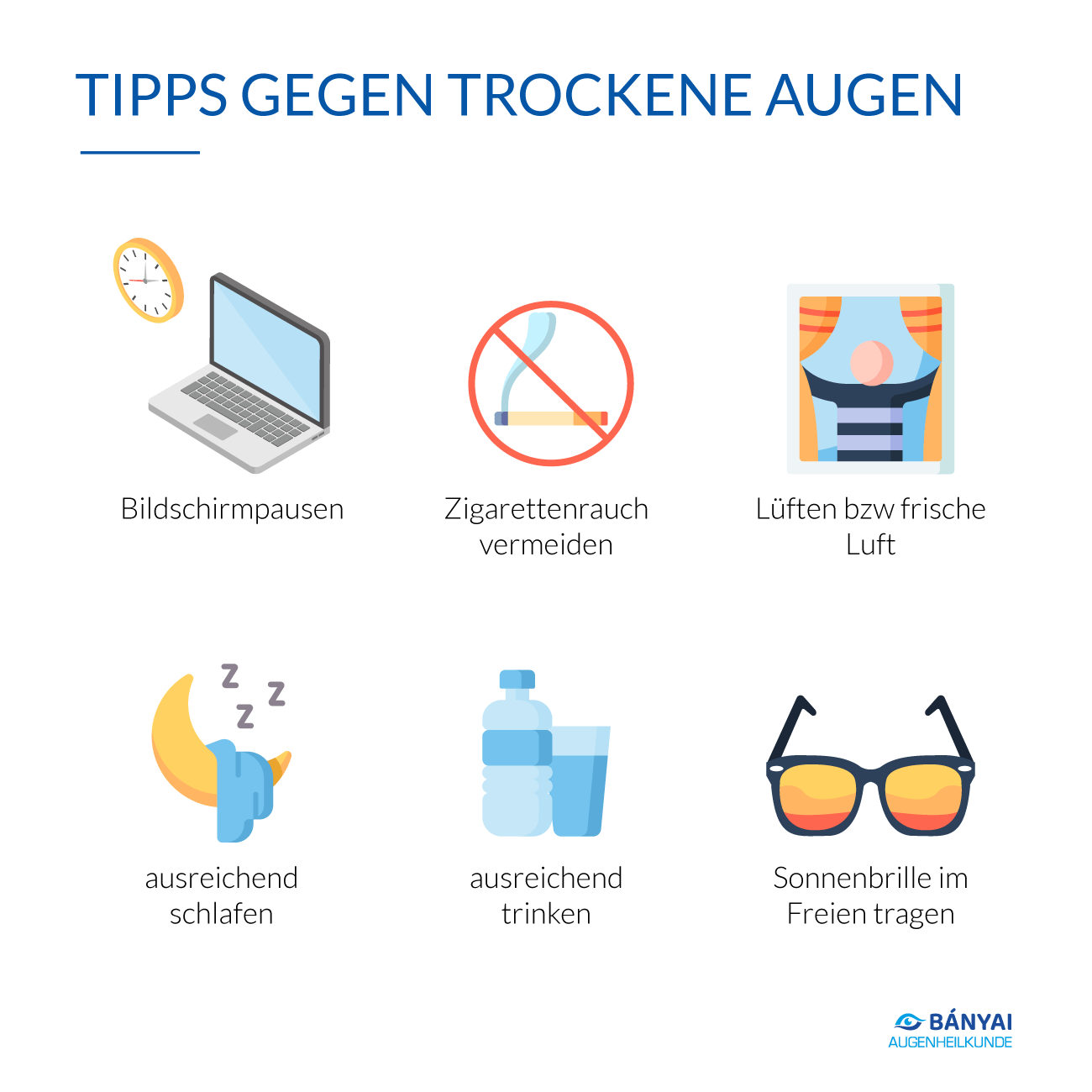
So that the tear film balance is maintained and the eyes do not dry out, there are some simple everyday tips and home remedies:
- Avoid draughts: Switch off ventilation and air conditioning systems as much as possible.
- Schedule regular screen breaks from computers, smartphones, and tablets and get some fresh air instead.
- Pay attention to the room air humidification, especially in the heating months.
- Get enough sleep.
- Avoid cigarette smoke.
- Eat accordingly: Drink enough and consume enough vitamins and omega-3 fatty acids.
- Care of the eyelid edges: Avoid rubbing and blink instead.
- Wear sunglasses outdoors in case of light sensitivity.
Using eye drops/sprays or gels can also prevent dry eyes. In the case of prolonged use, the products should be of high quality (e.g. free of preservatives) and the use should be discussed with the doctor.
Eye drops for dry eyes
With dry eyes, many reach for eye drops, which are also called “artificial tears“. They replace the missing tear fluid or restore the balance of the tear film. Tear substitutes are also available in other forms of administration than drops, e.g. as gels, sprays or ointments.
More viscous treatment agents are mostly used at night, as they can temporarily impair vision.
Eye drops or other tear replacements can be purchased over-the-counter at the pharmacy. Most preparations contain hyaluronic acid, which moisturizes the eyes and relieves irritation. Especially in the case of prolonged use, products without preservatives should be used, as they can also damage the eyes.
It is best to discuss which eye drops to use and to what extent with your eye doctor.
E-EYE treatment
E-eye treatment is particularly suitable for those suffering from Sicca syndrome, in which the tear fluid evaporates too quickly. Responsible for this is a disturbed meibomian gland function, which is located on the edge of the eyelids. Under normal circumstances, they release an oily, lipid-containing fluid that combines with the tear fluid. If the glands are disturbed, not enough lipids are secreted, causing the lacrimal fluid to evaporate faster and the eyes to dry out as a result.
During the eye treatment, the nerve fibres of the Meibomian glands can be reactivated. In this treatment, patients are placed on their eyes with specially made eye mask bowls. The lower eyelid is creamed with a special hydrogel. The E-EYE device then emits five light pulses to the lower eyelid from the inside out. As a result, the Meibomian glands are stimulated and secretion production is stimulated again.
The treatment generally comprises three sessions. Depending on the severity of the Sicca syndrome, more are necessary.
The treatment is painless and also suitable for contact lens wearers. If you are interested, please ask the specialists at Bányai Ophthalmology.
Causes of dry eyes
The causes of dry eyes are diverse. Dry eyes can be traced back to the constitution and amount of tear fluid, to diseases, medications, environmental pollution, everyday life or physical conditions such as the functionality of the Meibomian glands.
Digital Burden

An everyday life without computers, tablets and smartphones is unthinkable today. However, the eyes suffer greatly from the digital strain, as they are exposed to greater effort through concentrated reading. The eyelids blink less often, which causes the tear film to tear open earlier, evaporate faster and the eyes to dry out.
Dry and burning eyes due to long screen work are also called office eye syndrome . Nevertheless, younger people are also affected, and not only those who work on a screen.
Environmental factors
External influences include, on the one hand, dry heating air, air conditioning, draft/ventilation or even cigarette smoke, as these dry out the tear film.
On the other hand, dust particles, exhaust gases, fine dust, etc. circulating in the air can cause very fine foreign bodies to get onto the protective film of the surface of the eye, which can cause irritation and infections.
Surgeries on the eye
Although laser treatments on the eyes allow the correction of defective vision, cataracts or other eye diseases, many patients experience dry eyes and short-term blurred vision in the regeneration phase. The tear film production is out of balance due to the procedure, which is why post-treatment with moisturising or nourishing eye drops is indispensable for sufficient wetting.
Diseases & Medications
There are some diseases whose symptoms include dry eyes:
- Eye disorders (e.g. eyelid misalignments)
- Thyroid disorders such as Graves’ disease and Hashimoto’s thyroiditis
- Parkinson’s disease
- viral or bacterial infections
- Skin disorders such as neurodermatitis or rosacea
- Autoimmune diseases such as rheumatism, scleroderma and diabetes mellitus.
Taking medication can also lead to dry eyes, such as:
- Anti-baby pill
- Beta blockers (for cardiovascular diseases, hyperthyroidism, migraines)
- Anticholinergics (for colic or chronic bronchitis)
- Antihistamines (for allergies)
- Antidepressants
- Ergotamine (for migraines and cluster headaches)
- Neuroleptics (= psychopharmaceutical)
- Reserpine (for high blood pressure)
- Diuretics (for hypertension and water retention)
- Trihexyphenidyl (in Parkinson’s disease).
Most of these drugs interfere with tear film homeostasis, causing the eyes to dry out.
Sometimes nutrient deficiencies can also cause eye dehydration, such as a vitamin A deficiency. Furthermore, deficiencies in omega-3 and omega-6 fatty acids, vitamins B2, B6, B12, C, E and zinc can also contribute to dry eyes.
Glasses & Contact Lenses
If a defective vision is compensated for with the wrong visual aid, the eyes suffer greatly. Wearing contact lenses in particular promotes the development of dry eyes. In healthy eyes, the lenses float on the tear film; in a dysfunction, it tears through the lens, causing the lens to rub the surface of the eye. Red eyes can develop.
Glasses are more suitable for sensitive eyes; however, inappropriate diopter strength can also lead to dehydration of the eyes due to overexertion.
Hormonal changes
Hormonal fluctuations often lead to wetting disorders of the eyes. Since the changes are mostly due to estrogen, women are affected more often than men. Especially during pregnancy and menopause, the lacrimal glands produce less fluid. The composition of the tear film changes – it becomes thinner and tears open faster.
Age
With increasing age, the mucous membranes dry out more and more. Tear film production is limited and some medications or age-related diseases can also lead to dry eyes. Older people are therefore more likely to be affected by Sicca syndrome than younger people.
Furthermore, appetite decreases with age, which means that some people do not eat or drink enough. Due to a lack of fluid or nutrient supply, it is not possible to produce enough tear fluid, which means that the necessary moistening of the eyes is missing.
How the tear film protects the eye
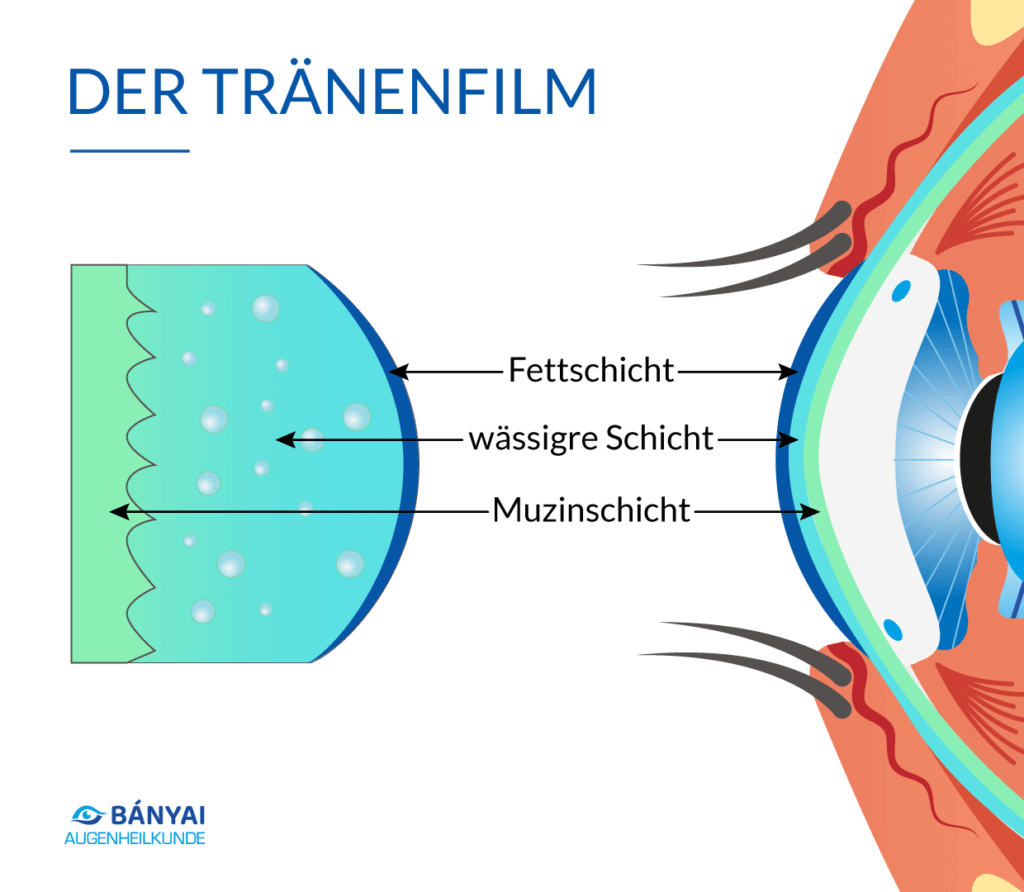
The surface of the eyes is formed by the conjunctiva and cornea and covered by the tear film. This consists of three layers:
- Mucin layer
- Aqueous layer
- Fat Layer
Each layer has its own functions.
- The mucin layer adheres to the conjunctiva and cornea, smoothing the cell surface so that the aqueous layer can adhere.
- The aqueous layer provides moisture.
- The fat layer is located on the watery layer and slows down the evaporation of the eyes.
Through the blink of an eye, the liquid film is distributed over the eyelid edges on the surface of the eye.
The tear film protects the eye from small foreign objects such as germs, dust or allergens, but also from wind and blowers. With the tear fluid and the blink of the eye, foreign bodies can be neutralized and flushed out.
Another essential task of the tear film is to moisturize and nourish the cornea and conjunctiva.
If there is too little tear film or the quality/composition of this is not optimal, the eye cannot be adequately protected from external factors and from dehydration. In this case, tear replacement therapy can provide a remedy.
How to prevent dry eyes
Avoid draughts, air conditioners and blowers. Nevertheless, ensure adequate room ventilation and humidification (such as through a humidifier). The humidity should be between 40 and 60 percent.
You should interrupt long screen working hours with regular breaks, preferably in the fresh air, with UV-protective sunglasses.
Drink enough water and nourish your body with a versatile and varied food selection.
Contact lenses should not be worn for too long. After or before wearing them with an unpreserved, isotonic saline solution made specifically for contact lenses, they should be thoroughly cleaned.
Alternatively, you can also use moisturizing eye drops from the pharmacy so that the eyes do not dry out.
When to see a doctor for persistently dry eyes?
If you suffer from Sicca syndrome for a long time and feel a feeling of pressure, you should definitely consult a doctor. Dry eyes have many causes that only ophthalmologists can correctly identify.
There are a few ways in which the amount of tears, the composition and quality of the tear film, the corneal surface and the eyelid position can be examined:
- The amount of tear fluid of the eye is measured in the Schirmer test using a filter paper strip in the conjunctival sac.
- To measure the tear-opening time, the tear film is stained with fluorescein. Under a slit lamp, it can then be observed how long it takes for the tear film to tear open after a blink.
- The lipid content of the tear film can be measured using various devices.
- The conjunctiva and cornea are examined for inflammation. (conjunctivitis)
In order to rule out other diseases underlying dry eyes, blood and hormone tests are also necessary in some cases. Depending on the diagnosis, you will then receive individually tailored follow-up treatments, medications or drops.
What are other common eye problems?
- Burning
- Gluing
- Eye pain up to eye migraine
- Weakening of the connective tissue (“lacrimal sacs”)
- Stye
- Inflammation of the edge of the eyelid
- Irritated eyes with itching (herpes on the eye)
- Sensitivity to light
- Tearing eyes or increased tear production
- Blurred vision
- Squinting
- Redness of the eyelids (eye twitching)
- Dry eyes after surgery
- Constant pressure on the eyes
- Red eyes and/or inflammation of the conjunctiva
- Eye secretion
- Yellow Eyes
Laser eye surgery in Baden-Württemberg
For eye problems such as nearsightedness, farsightedness or presbyopia, laser eye surgery in Karlsruhe and Stuttgart offers an effective, permanent solution. At Bányai Neue Augen, we rely on proven and innovative laser techniques that are individually tailored to your visual needs.