
What to do if the reading glasses are no longer sufficient?
Do you have problems reading despite reading glasses? With age, many people notice that their reading glasses no longer bring the desired effect. The fonts blur even at normal reading distance. What to do if the reading glasses are no longer sufficient? This question is often asked, and the answer depends on the type of deterioration and the alternatives available.
When do reading glasses no longer suffice?
Presbyopia, also called presbyopia, affects almost all people from a certain age. The lens of the eye loses its flexibility over time, making it increasingly difficult to see objects in close proximity.
Many people use reading glasses at this stage. However, over the years, vision continues to deteriorate, and the glasses, which initially helped well, are no longer sufficient.
My experience as an ophthalmologist shows that many patients notice after some time that the reading glasses, which were perfect a few years ago, no longer offer the same support. This is because presbyopia worsens over time and the strength of the glasses once prescribed is no longer sufficient.
Additional visual impairments
In many cases, it’s not just presbyopia that affects vision. Patients who already suffer from nearsightedness, farsightedness or corneal curvature often find that their reading glasses no longer fully correct these additional visual defects. This leads to a double burden, in which the glasses do not work optimally either near or far.
How do I know if the reading glasses are too weak or too strong?
“Wrong” glasses are manifested by various symptoms. If the reading glasses are too weak, you need to keep the book or newspaper further away from your eyes to see clearly. This often leads to eye pain and fatigue. However, if the glasses are too strong, you may experience headaches, dizziness, and blurred vision in the distance.
Many of my patients report these problems and initially think they need new glasses. In fact, adjusting your vision regularly is crucial to ensure the best possible vision correction.
Is incorrect glasses harmful to the eyes?
There are many misconceptions about whether incorrect glasses can permanently damage vision. In fact, incorrect glasses can cause unpleasant symptoms such as headaches and overexertion in the short term, but they do not lead to permanent deterioration of vision.
As an ophthalmologist, I still recommend having a regular eye examination to ensure that the glasses or contact lenses have the right strength. Wearing the wrong pair of glasses can make everyday life difficult and significantly affect the quality of life.
What are the alternatives to reading glasses?
If the reading glasses are too weak or you want to get rid of the glasses, there are several options. Contact lenses can be used without surgical intervention and vision can be corrected by a single treatment using modern laser procedures.
Contact Lenses
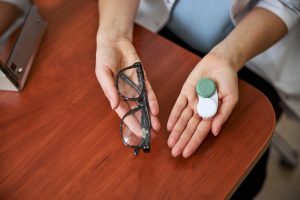
A popular alternative to reading glasses is contact lenses, especially multifocal lenses, which correct for both near and far. Patients prefer contact lenses because they offer them more freedom of movement and comfort.
There are different types of contact lenses: soft lenses that are comfortable and easy to wear, as well as dimensionally stable lenses that allow sharper vision but require a longer acclimatization period.
Laser treatments
Modern laser treatments such as PRESBYOND ® or Monovision offer a permanent solution for presbyopia. With PRESBYOND®, the vision of both eyes is adjusted to adjust the dominant eye for distance and the non-dominant eye for proximity. This allows sharp vision without glasses or contact lenses.
The SMILE Monovision process combines the advantages of proven smile technology with Monovision technology. In this procedure, a small lenticle (lens-shaped tissue disc) is precisely detached from the cornea with a femtosecond laser and removed through a tiny incision. Combined with monovision, a technique that optimizes the dominant eye for distance and the non-dominant eye for proximity, both presbyopia and other vision defects can be effectively corrected.
Numerous patients have already benefited from these procedures in my practice – both at the Laser Eye Center in Stuttgart and at the Laser Eye Center in Karlsruhe. The freedom to see clearly without glasses or contact lenses is a key benefit for many. You can read more about this in the experience report with PRESBYOND ®. Hitradio Antenne1 Moderator Nico Auer accompanied Thomas during the laser treatment and captured all the emotions. After the operation, Thomas was no longer dependent on glasses.
Lens replacement
If presbyopia is very advanced or laser treatments are out of the question, lens replacement may be a sensible option. This procedure replaces the eye’s natural lens with an artificial lens that remains in the eye for life.
This method is especially popular with older patients who want to permanently correct their vision. The artificial lens ensures that presbyopia and other visual defects such as farsightedness or corneal curvature are corrected at the same time.
Next steps – when reading glasses are no longer sufficient
If the reading glasses are no longer sufficient, they do not have to be worried. There are suitable ways to correct your refractive error. If you opt for a permanent correction using a laser, it will first be determined which method is suitable for you.
Choosing the right method depends, among other things, on age, eye health and your general state of health. A comprehensive investigation is the first step in determining which option is best for you.
You can also test online in advance using an eye laser aptitude test to see if you are suitable for laser eye treatment.
In my practice, I address the individual needs of my patients and advise them in detail in order to make the best possible decision. Many of my patients are relieved to learn that there are more options than just reading glasses.
FAQs
How often do I need to adjust the vision of my reading glasses?
The vision should be checked every 1-2 years to ensure that the glasses still fit optimally.
Are laser treatments suitable for everyone?
Not every defective vision can be corrected by means of a laser. A thorough investigation will help to find out. Alternatively, a lens exchange can also be made in order to achieve a permanent correction.
Is it harmful to wear glasses that are too weak or too strong?
Incorrect glasses can lead to headaches and overexertion in the short term, but they do not permanently damage the eyes.
Can I wear contact lenses permanently?
Yes, multifocal contact lenses are a good alternative to glasses and can be worn in the long term.
All the information you need about laser eye surgery – delivered directly to your email inbox!
Follow us