
Farsightedness: 7 symptoms that usually occur according to Doctor-medic Bányai

Many people suffer from farsightedness, but they do not know exactly what it is and what symptoms occur. This blog post explains the different symptoms of farsightedness, from the first signs to farsightedness with multiple diopters. The first signs of farsightedness are mainly blurring and distortion problems when seeing at a distance.
It also explains how farsightedness can be treated and which treatment method is most suitable. Although glasses or contact lenses help temporarily, laser eye surgery is a sustainable solution for long-term improvement of visual acuity and correction of defective vision.
In this blog, we explain in detail what you need to know about the symptoms and treatment options of farsightedness and when you should see an ophthalmologist.
What is farsightedness explained briefly?
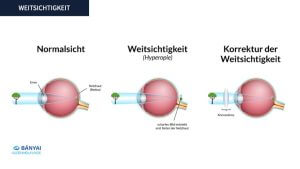
What exactly is farsightedness? Farsightedness is a type of defective vision, since there is a disproportion between the length of the axis and the refractive power of the lens or the eye. In this case, the eye (the eyeball) is too short in relation to the low refractive power of the incident light rays, so that the image formed behind the retina becomes blurred and blurred. An eyeball that is too short is also called axis hyperopia.
Farsightedness Symptoms – Which ones occur?
Persons suffering from farsightedness cannot see near objects clearly, and the eyes must tighten in distant vision. As a result, the ciliary muscle is constantly stressed, which often causes headaches.
Symptoms of farsightedness can range from mild discomfort to severe vision impairment. The first symptoms can be headaches and tiredness when reading, which arise due to the constant effort of the eye to see near objects sharply. Mild to severe eye pain can also be a sign, as well as burning eyes. Farsightedness and nearsightedness (myopia) can already occur in young people and children.
As farsightedness progresses, it can become more difficult to see small details nearby, especially with printed text. In addition, it can also become more difficult to detect objects in the distance. In the case of farsightedness with several diopters, the person concerned has severely impaired vision and many everyday activities are made difficult or impossible.
If you suffer from farsightedness (also called hyperopia and hypermetropia), you are not alone: according to the American Academy of Ophthalmology, more than 200 million people worldwide suffer from this condition.
The 7 symptoms of farsightedness at a glance
These 7 symptoms usually occur with farsightedness.
- Headache
- Eye pain
- Fatigue
- burning eyes
- Conjunctivitis
- close objects are perceived blurred
- Letters become blurry when reading
How quickly does farsightedness worsen?
As a rule, farsightedness does not deteriorate very quickly. Most people do not notice a deterioration until they are a few years older. Visual acuity decreases with age and farsightedness worsens.
In most cases, however, farsightedness is only a minor problem and can be corrected by wearing progressive lenses or contact lenses.
In rare cases, however, farsightedness can also worsen more quickly. This is the case, for example, if a certain eye disease is present. Wearing strongly magnifying or strongly reducing lenses can also worsen farsightedness at an accelerated rate.
Why do you suddenly become farsighted?
Farsightedness is an indication that the eye muscles are no longer strong enough to focus on nearby objects. This may occur due to aging or other factors.
Farsightedness can also be caused by a disease such as cataract.
How does farsightedness occur?
In most people with farsightedness, the eyeball is shortened, which causes the focal point to shift backwards and light rays to be focused behind the retina in one point. This type of farsightedness is usually congenital and also known as axis hyperopia. Simply explained, the refractive power and interplay of the eye (vitreous, cornea, lens, retina) is too low to transmit close objects as a sharp image.
However, there is also a rarer variant of farsightedness, refractive hyperopia. In this case, the refractive power of the cornea and eye lens is too weak, so that light rays are also bundled behind the retina and astigmatism (intentionality) occurs as a further refractive error of the eye in combination. In ophthalmology, this is also referred to as strong farsightedness.
Presbyopia is a natural result of the aging process. With increasing age, the adaptability of the eye, called accommodation, decreases and it is no longer possible to focus objects at close range. The elasticity of the lens decreases and the refractive power of the lens is too low to see near objects sharply. Farsightedness and presbyopia are two different types of visual impairment, but they have similar symptoms.
What can be done about farsightedness?
Fortunately, there are treatment options for farsightedness. Glasses or contact lenses temporarily help to improve vision and increase comfort. However, spectacle lenses and contact lenses are not permanent solutions. You can only avoid the visual defect by adjusting the visual acuity. In most cases, collector lenses, also called plus glasses, are chosen for farsighted people. These are bent outwards (convex).
Laser eye surgery is required to permanently correct the condition and to be able to see clearly again without visual aid. The eye laser modifies the cornea of the eye in a certain way to adjust the refractive power of the eye so that it can focus sharply on nearby images – which is not usually possible in people with hyperopia.
Laser eye surgery is nowadays very safe and effective – but you should always seek the advice of a specialist such as Doctor-medic Bányai before starting such treatment. Questions such as when you can laser long-sightedness can be answered so quickly.
In the case of laser treatment for long-sightedness, there are two proven methods, femto-lasics and ICL lens. Both methods promise a long-term correction of farsightedness. Many farsighted people nowadays choose laser eye surgery as their preferred method of treatment.
Conclusion
In view of all these factors, our recommendation is: If you believe you suffer from farsightedness or are already farsighted, it is best to consult an ophthalmologist or ophthalmologist immediately. Your ophthalmologist will perform examinations or determine your refraction. There you will be given eye drops to perform an accurate eye test.
A professional look at your problem will help you find out which treatment method is best for you – whether glasses or contact lenses or through laser eye treatment such as in Karlsruhe or Stuttgart – so that you will soon be able to see clearly again!
As parents, pay attention to your children, because even at a young age, a defective vision can develop. Even with normal vision, a regular check-up with the ophthalmologist is recommended.
FAQs
What are other eye diseases and vision disorders?
Other eye diseases are cataracts (glaucoma) causing problems with the intraocular pressure and the aqueous humor has to be aspirated, cataracts lead to a disguised vision up to blindness, corneal curvature, forms of squinting (inward squint), conjunctivitis
What is farsightedness still called?
Farsightedness or farsightedness is also referred to as:
- Hyperopia, hypermetropia
- Overview, overview