
Farsighted – Meaning, Cause, Treatment

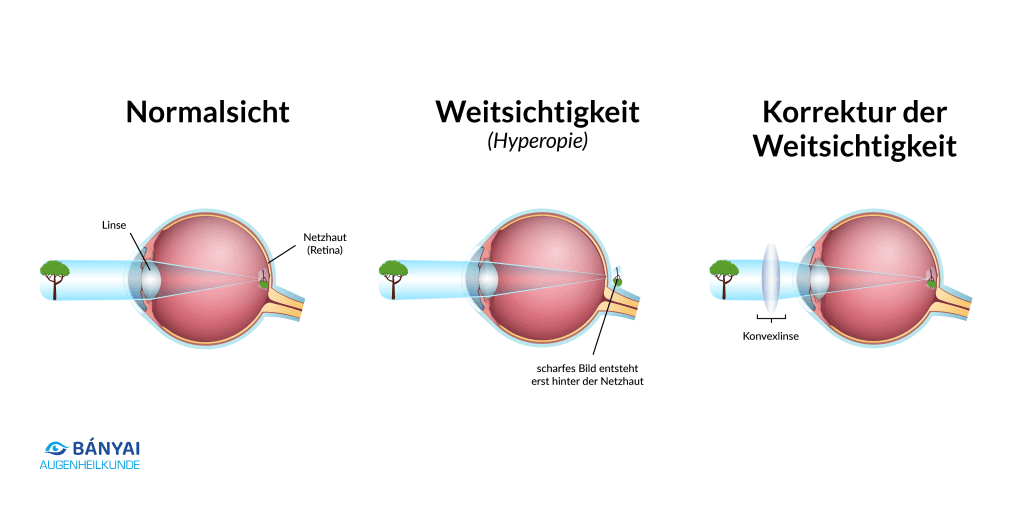
People with farsightedness (also called hyperopia or hypermetropia) have difficulty seeing near objects clearly – while seeing at a distance often works well at first. The cause is usually an eyeball that is too short or the refractive power of the eye is too low, which means that the image is not created directly on the retina, but behind it.
In order to compensate for visual acuity, farsighted people usually need contact lenses or so-called plus lenses (convex spectacle lenses), which correctly shift the focal point back onto the retina and thus enable a clear image.
Farsightedness as refractive error – the symptoms
The symptoms in farsighted people are blurred vision and headaches after prolonged reading or writing. Eye fatigue, double vision, and photosensitivity are other signs of budding farsightedness.
If you are farsighted and do not have this defective vision treated, this error can lead to visual disturbances, which can hinder everyday life and can also cause accidents. Therefore, sufferers should follow the advice of their doctor and inform themselves about the correction of farsightedness. The options are as follows: glasses, contact lenses and eye lasers.
Farsighted – what are possible causes?
Farsightedness can be due to various factors, such as age, genetic predisposition, physical exertion, excessive screen consumption, or smoking. Each of these influencing factors can contribute to an increase in farsightedness, so it is important to be aware of them and take the appropriate measures.
What are the treatment options for farsightedness?
Farsightedness is a defective vision that causes nearby objects to appear blurry. The treatment of farsightedness can be corrected with the help of corrective glasses or contact lenses.
For a sustainable result, refractive surgery is the most modern form of treatment. There are various laser eye treatments such as LASIK, Femto-Lasik, PRK and Lasek and ICL lenses, which are implanted behind the rainbow skin in addition to the body’s own lens. Which method is used is decided after individual measurements and in-depth consultation.
Laser eye treatment for farsightedness is a very effective treatment method. It can help improve visual acuity and reduce the need for contact lenses or glasses. The results are mostly long-term and often completely free of complications. As a rule, vision aids are no longer required after laser eye surgery.
However, it is important that patients are only treated by experienced doctors in order to keep the risks of unwanted side effects as low as possible. In our laser eye center in Stuttgart and Karlsruhe, we will be happy to advise you personally on the treatment options that are right for you.
Read more: