
Diopters: what do they mean and what value is normal?

The term “dioptres” inevitably stumbles upon anyone who has ever dealt with their visual acuity and possibly suffers from a diagnosed refractive error. Diopters describe the refractive power of lenses and indicate how much they can refract light in order to focus it correctly on your retina.
The diopter value is not only important in diagnostics, but also has very practical effects on the treatment of refractive errors – be it the manufacture of a visual aid or the choice of an eye laser treatment.
But what exactly are diopters? How do you calculate them, and what diopter value is normal? We will explore these and other questions in this article.
Diopters – a definition
A diopter (dpt for short) is a unit of measurement used to express the optical power of a lens or curved mirror. The diopter is defined as the reciprocal of the focal length in meters.
D= 1f
For example, if a lens has a focal length of one meter, its optical power is 1 diopter. A lens with a shorter focal length has more diopters because it can refract light more sharply and focus faster.
This unit of measurement is also used in ophthalmology or optics – to indicate the refractive power of the eye or lens in the eyeball. It forms the basis for determining the vision of the human eye and, if necessary, determining what a treatment should look like. This can concern the strength of the lenses of reading glasses or progressive spectacles, but also a possible method for laser vision loss.
Which diopter value is normal?
The optimal diopter value for the eye is 0. This enables 100% sharp vision both at close range and at a distance.
However, not every slight deviation from this theoretical ideal value is problematic: from a deviation of 0.5, treatment can be useful; with a significantly higher diopter value (usually above +/- 1), however, one no longer speaks of a slight refractive error – this is where action should be taken.
0 dpt – normal vision
0 to +/-1 dpt – slight refractive error
+/-1 to +/-5 dpt – moderate refractive error
+/-5 dpt or higher – severe refractive error
Determine diopter values
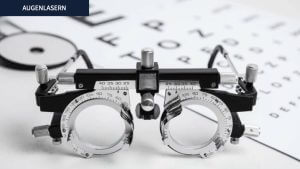
Dioptric values are determined by an eye test performed by an ophthalmologist or optician. A refractometer and various lens strengths are used to measure how much the lens has to refract the light in order to produce a sharp image on the retina.
The test involves reading letters at different sizes and distances to determine the exact visual acuity. The diopter values determined indicate which correction by glasses, contact lenses or eye lasers is necessary to ensure optimal vision.
Diopter values and prescribed lenses
When you visit an ophthalmologist or optician, they use an eye test to determine how many dioptres your eye needs to adjust your visual acuity to a normal-sighted eye. The numbers on your prescription or eyeglass passport represent the diopters needed to focus the light on your retina and allow you to see clearly with optimal vision.
Good to know at higher diopter values: Here it may be that you have to assume a different value for the prescribed visual aid, depending on whether you use glasses or contact lenses.
Understanding the prescription: SPH, Cylinder and Axis
Of course, it is above all up to the optician to read your eyeglass prescription and to suggest an appropriate visual aid. Nevertheless, many people are interested in what values such as SPH, CYL or AXIS mean on your prescription – reason enough to explain them in a nutshell.
The SPH value (spherical value) indicates the strength of the spherical correction necessary to correct your refractive error. It is measured in diopters (dpt). A negative SPH value indicates nearsightedness (myopia), while a positive SPH value indicates farsightedness (hyperopia). This value determines how much light must be refracted to produce a sharp image on the retina.
The cylinder value (CYL) indicates the strength of the correction for astigmatism (corneal curvature). Astigmatism is caused by an uneven curvature of the cornea, which leads to blurred vision. The cycl value can be positive or negative and shows how much the lens has to refract the light in a certain direction to correct the distortion.
The axis indicates the direction of astigmatism and is measured in degrees, on a scale from 0° to 180°. This value indicates the angle at which the astigmatism must be corrected. The axis value is only relevant if a CYL value is also specified in the eyeglass prescription, as it determines the exact orientation of the cylinder correction.
An eyeglass prescription may also include additional values such as the addition value (add), which indicates the strength of the near correction for varifocal spectacles or reading glasses. This value is particularly important for presbyopia.
Diopters and vision problems
Most vision problems result from the eye’s inability to correctly focus light on the retina. This problem is usually due to the shape of the eye. Defective vision, the manifestation of which is indicated by this refractive power, are:
- Myopia (nearsightedness): If there is a minus sign in front of the diopter number, this can express nearsightedness. If you are nearsighted, distant objects will appear blurry. This condition is caused by your eye being too long or the cornea too curved so that the light is focused in front of the retina. Glasses or contact lenses for myopia have negative diopter values.
- Hyperopia (farsightedness): Far-sighted people see distant objects better than near ones. This occurs when the eye is too short or the cornea is not sufficiently curved, focusing the light behind the retina. Glasses or contact lenses for hyperopia have positive diopter values (e.g. +3 diopters).
- Astigmatism (corneal curvature): This occurs when the curvature of the cornea is uneven and can lead to blurred vision at all distances. Astigmatism correction lenses are specially designed to compensate for the irregular shape of the cornea.
- Presbyopia: Presbyopia can affect many people throughout their lives because it results from the natural aging process of the eye lens. With this visual impairment, the ability to accommodate deteriorates, so that sharp vision becomes increasingly difficult, especially at close range.
Why consider laser eye treatment?
While glasses and contact lenses are effective solutions, they are only temporary aids that need to be updated regularly. Laser eye treatment can provide a permanent solution by correcting the refractive error at its source – the cornea. This procedure adjusts the shape of the cornea to ensure that light is focused directly onto the retina, potentially completely eliminating the need for corrective lenses.
Laser eye treatment can correct a number of diopters and allow many people with myopia, hyperopia and astigmatism to achieve very good visual performance. The following reasons speak in favour of laser eye treatment:
- Long-term solution: Unlike glasses or contact lenses, laser eye treatment permanently adjusts the cornea by addressing the underlying problem of your vision problems.
- Cost-effective over time: Although the initial cost may be higher than glasses or contact lenses, this can save you money in the long run, as vision aids become unnecessary in most cases.
- Lifestyle benefits: Get rid of the daily inconvenience of glasses or contact lenses. Enjoy activities such as swimming, running and other sports without worries.
Eye lasers for refractive errors – up to how many dioptres can this be?
Eye lasers can correct defective vision in a wide diopter range. In myopia, values up to -10 diopters can usually be treated, while hyperopia can be corrected up to +5 diopters. Astigmatism can be corrected up to about 6 dioptres.
However, the exact limit depends on the individual corneal thickness and shape. Before laser treatment, a detailed preliminary examination is necessary to determine the suitability for the procedure and to ensure the best results.
Lens replacement may also be considered as an alternative to laser eye surgery. Although this is not one of the classic laser eye procedures, it is also suitable for people with thin corneas or severe refractive errors.
Eye laser methods – depending on dioptres and defective vision
Various modern methods for correcting refractive errors are available at Bányai Neue Augen. These procedures are specially tailored to different diopter values and visual impairments:
SMILE® Pro – The SMILE® Pro procedure is a minimally invasive method that is particularly used for myopia and corneal curvature. It is suitable for myopia up to -10 diopters and astigmatism up to 5 diopters. This procedure does not require flap creation, which keeps the cornea stable and shortens the regeneration time. It is well suited for patients with thin corneas and reduces the risk of dry eyes after surgery.
Femto-LASIK – Femto-LASIK is a precise and safe method for correcting nearsightedness up to -10 diopters, farsightedness up to +5 diopters and astigmatism up to 5 diopters. This method uses a femtosecond laser to create a thin corneal flap. The underlying tissue layers are then formed with an excimer laser to correct the refractive power of the eye.
PRK/LASEK – These methods are alternatives for patients with thin corneas. They are suitable for nearsightedness up to -6 diopters, farsightedness up to +2 diopters and astigmatism up to 4 diopters. PRK and LASEK remove the top layer of the cornea and form the underlying layer to correct the defective vision.
PRESBYOND® Laser Blended Vision –PRESBYOND ® has been specially developed for the treatment of presbyopia. PRESBYOND® combines the advantages of LASIK technology with a special correction technique that allows individual adjustment. One eye is optimized for the middle and near range, the other for the far range. Both eyes correct the intermediate area here. The brain then combines the two images into a sharp visual impression.
Lens replacement – Refractive lens replacement (RLE) replaces the natural lens with a multifocal or monofocal artificial lens. This method is particularly suitable for patients with high refractive error or thin cornea for whom laser treatments are out of the question. Lens replacement provides permanent correction of refractive errors and is also a proven solution for presbyopia and other refractive errors.
Bányai Neue Augen offers these advanced procedures in their modern centers in Stuttgart and Karlsruhe in order to provide patients with individually tailored treatment and the best possible results.
Take the next step
Are you curious whether you are suitable for laser eye treatment?
FAQs
How much diopter value is normal?
A normal diopter value is 0, which means that no vision correction is required and the eye focuses light correctly on the retina. Deviations from this ideal value indicate defective vision, which can be corrected with glasses, contact lenses or laser eye treatment. Values between 0 and +/-0.5 diopters are often considered low and may not require correction.
What does the diopter number say?
The diopter number indicates the strength of the necessary vision correction. A negative value (e.g. -2 diopters) means nearsightedness, where distant objects appear blurry. A positive value (e.g. +3 diopters) indicates farsightedness, where nearby objects are blurred. The diopter value indicates how much a lens must refract the light to produce a sharp image on the retina.
Is minus 2 diopters a lot?
Minus 2 diopters are considered moderate myopia. People with this value have difficulty seeing distant objects clearly, while near vision is usually less impaired. This strength usually requires wearing glasses or contact lenses to ensure clear distance vision.
What does 4 diopters mean?
A value of +4 diopters indicates medium to high farsightedness, where nearby objects appear blurry. Conversely, a value of -4 diopters indicates moderate to severe nearsightedness, where distant objects are blurred. In both cases, correction through glasses, contact lenses or laser eye treatment is necessary to enable clear vision.