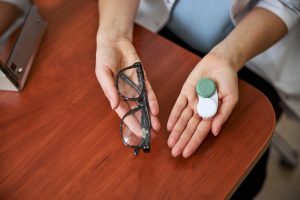

Presbyopia simply explained
Presbyopia, also called presbyopia, is a natural change in the eye that usually occurs from the age of 40. Many people notice with increasing age that they have difficulty seeing near objects clearly.
In this post, we explain what presbyopia is, its causes and symptoms, and how it can be diagnosed. You will also learn everything about laser presbyopia and the treatment options at Bányai Neue Augen. We compare presbyopia with other visual impairments to better understand the differences in presbyopia and other visual impairments and provide an overview of the different correction options such as glasses, contact lenses and modern laser treatments. We also take a look at the special laser eye treatments for farsightedness offered by Bányai Neue Augen.
What is presbyopia?
Presbyopia, also known as presbyopia, is a refractive error that occurs with age. In contrast to the visual problems of nearsightedness or farsightedness, which are often caused by the shape of the eyeball, presbyopia results from a loss of the elasticity of the eye lens and a reduced ability to accommodate, i.e. adapt to near and far vision. This ability of the eye allows it to focus sharply on objects at different distances.
At a young age, the eye lens is flexible and can easily change its shape to see sharply both at a distance and nearby. Over the course of life, the lens hardens and loses this flexibility, which can make it difficult to clearly see nearby objects. This makes everyday activities such as reading, looking at price tags, or working on the computer more strenuous.
Presbyopia is a gradual process, typically occurring from the age of 40 and gradually worsening. Although it is a natural consequence of the aging process, there are numerous ways to correct visual acuity and make everyday life easier by correcting presbyopia. These include glasses, contact lenses and various laser treatments that adjust the refractive power of the lens and allow sharp vision at close range.
Causes – what promotes presbyopia?
Presbyopia is caused by the natural ageing process of the eye. Over time, the lens of the eye loses its elasticity, making accommodation more difficult. This loss of flexibility makes it harder for the eye to focus on nearby objects, while there is often a clear view for the distance area.
An essential factor for presbyopia is the hardening of the lens. While the lens is flexible and clear in young people, it becomes stiffer over time and loses its ability to deform. This impairs the ability of the ciliary muscle to curve the lens and thus focus the near point. The near point, i.e. the closest point that the eye can still see clearly, moves further and further away, which increases the reading distance and makes near vision difficult. The far point, on the other hand, often remains almost unchanged.
In addition, the ciliary muscle plays an important role in accommodation. Over time, this muscle weakens, which further impairs the ability to accommodate (adapt to near and far vision). This causes the eye to function well in distance vision, but requires correction in near vision.
General eye diseases can also affect the course of presbyopia. Conditions such as cataracts or other age-related changes can additionally impair the clarity of the lens, which increases the symptoms of presbyopia. On the other hand, it is not clear which risk factors generally favour the development of presbyopia. However, early onset of this visual impairment may be related to conditions such as diabetes or multiple sclerosis.
These age-related changes in vision can hardly be prevented, but regular eye examinations and suitable visual aids can improve visual acuity and make everyday life easier.
Detecting presbyopia – typical complaints and symptoms in everyday life
Presbyopia is manifested by various symptoms that affect everyday life. Typically, it is difficult to see nearby objects clearly. Affected people often notice that when reading a book or looking at price tags, they have to keep the text further away from their eyes in order to be able to see it clearly. This leads to an increased reading distance and eye strain during close-up work.
Changing distances, as is usual between distance vision and vision at close range, are more difficult. Activities such as reading, writing or working on the computer become more strenuous and can lead to headaches and fatigue. These symptoms result from overexertion of the eye muscles, especially the ciliary muscle, which tries to compensate for the lack of accommodation of the hardened lens.
It is important to take these symptoms seriously and consult an ophthalmologist to obtain appropriate vision aids such as reading glasses or progressive vision glasses that are specifically tailored to the needs of presbyopia. In addition, special eye laser procedures for presbyopia may be considered.
Visual impairments in comparison: myopia, farsightedness, corneal curvature and presbyopia
It is important to know the differences between nearsightedness (myopia), farsightedness (hyperopia), corneal curvature (astigmatism) and presbyopia in order to correctly interpret the signs of the onset of presbyopia.
Short-sightedness (myopia): If you notice that distant objects such as road signs or signs appear blurry while you can easily see nearby objects, you may be suffering from short-sightedness. Typical situations in which this visual defect is noticeable are driving at night or recognizing distant faces.
Farsightedness (hyperopia): Farsightedness is noticeable when you have difficulty seeing near objects such as books or cell phone fonts clearly, while distant objects remain sharp. If you have to keep the text further away from you while reading or working on the computer in order to clearly recognize it, this indicates farsightedness.
Corneal curvature (astigmatism): Corneal curvature, also called astigmatism or intentionality, manifests itself through blurred vision both at a distance and nearby. The reason for this, as the name suggests, is a faulty curved cornea, so that the light, as soon as it enters the eye, is not refracted correctly and results in a blurred image on the retina.
Presbyopia: Presbyopia usually occurs from the age of 40. If you find that reading at a normal distance becomes increasingly difficult and you need reading glasses to see small fonts clearly, this could be a sign of presbyopia. This age-related visual impairment often manifests itself in the fact that you can no longer see objects in the vicinity clearly, although distance vision is still good.
To determine exactly which visual impairment is present, it is advisable to carry out an eye test at the ophthalmologist. He can determine whether it is nearsightedness, farsightedness or presbyopia and recommend the appropriate corrective measures such as glasses, contact lenses or laser treatments.
Diagnosis of visual impairment: How it occurs and what it means
The ophthalmologist makes the definitive diagnosis of vision impairment as part of an examination. An autorefractometer automatically measures the refractive power of the eye and provides an initial estimate of the required dioptres (dpt). A vision test determines visual acuity for near and distant objects and helps determine the best spectacle lenses or contact lenses. The near point is measured to determine how well the eye can focus near objects.
For patients, the diagnosis means that they will be increasingly dependent on vision aids as they age. Age-related vision loss progresses over time, which requires regular adjustments of the visual aids.
Treatment options for presbyopia
There are various approaches to the treatment of presbyopia (presbyopia) that can be divided into non-surgical vision aids and surgical procedures.
Glasses and other visual aids for presbyopia
Multifocal contact lenses
Multifocal contact lenses offer multiple fields of vision for near, mid and far vision, making them a flexible solution for people who don’t want to wear glasses. These multifocal lenses allow a clear view at all distances and are particularly convenient for active people.
Progressive glasses
Progressive glasses are specially designed glasses that combine different areas of vision on one lens. They allow a seamless view from the near range over the middle range to the far range. These glasses are ideal for everyday use and provide an easy solution for presbyopia.
Reading Glasses
Reading glasses are an easy and inexpensive way to improve near vision. They are particularly useful for reading and other close-up work. Many people use simple ready-made glasses in addition to their normal distance glasses.
Refractive surgery for presbyopia
Artificial lenses (RLE)
Refractive lens replacement (RLE) is a surgical procedure in which the natural lens is replaced by a multifocal or accommodative artificial lens. These lenses allow the eye to focus at different distances, reducing the need for reading glasses. RLE is particularly suitable for patients who are not candidates for LASIK or PRK.
Laser treatments
Various laser treatments such as LASIK, PRK and SMILE can be used to correct presbyopia. These procedures change the shape of the cornea to improve the refractive power of the eye. A special technique known as monovision corrects one eye for near vision and the other for far vision. This method requires an adjustment time but provides a permanent solution.

Laser presbyopia: methods, procedure and costs at Bányai Neue Augen
At Bányai Neue Augen, several advanced methods are available to effectively treat presbyopia – here is an overview:
Lens replacement
In refractive lens replacement (RLE), the natural lens is replaced by an artificial lens. These lenses allow clear vision at different distances and are particularly suitable for patients who are not eligible for laser treatments.
SMILE® PRO MONOVISION
SMILE®PRO Monovision is a minimally invasive technique that corrects one eye for distance vision and the other for near vision. This method requires some time to settle in, but provides an effective solution for presbyopia up to a certain age. However, the intermediate area cannot be corrected here.
PRESBYOND®
PRESBYOND® Laser Blended Vision combines the benefits of LASIK technology with a special technique for correcting presbyopia. This method optimizes one eye for distance vision and the other for far-sightedness. Both eyes are adjusted by a wave profile to the intermediate distances, such as dashboard, PC, etc. The brain can produce a sharp image from these two visual impressions.
The cost of laser eye surgery for presbyopia at Bányai Neue Augen starts at 990 euros per eye and varies depending on the chosen method and individual needs. However, flexible financing options, including a 0% installment over 24 months, are available to facilitate the move to a more independent life.
The treatments are carried out in the modern centres in Stuttgart and Karlsruhe. A detailed consultation helps to find the best eye laser method for individual requirements and to discuss all costs transparently.
Start free laser eye aptitude test
FAQs
What are the symptoms of presbyopia?
As with many other diseases, there are different symptoms of presbyopia. However, some clearly indicate presbyopia:
- In order to be able to read in a relaxed way, you need a brighter environment, i.e. more light than normal.
- Headaches usually occur as a result of eye strain.
- Tired eyes
- If you want to read something sharply, it is more likely to be held at a distance from the body. Focusing at close range, on the other hand, is difficult. This is just as true when reading a book as it is when reading the price tags in the supermarket or when writing a text message on your smartphone.
Why do you become farsighted in old age?
With age, the lens of the eye loses elasticity. At a young age, it can flexibly deform to adapt to different distances. This process – the so-called accommodation – enables sharp vision both near and far.
From about 40 years, however, the elasticity of the lens decreases, so that the eye can no longer focus sufficiently on nearby objects. This natural aging process is called presbyopia. Affected people often notice this when reading or working on the screen: they have to keep texts further away to see them clearly.
Glasses, contact lenses or modern procedures such as laser treatments and lens implants can help to improve vision again.
Can one become presbyopian despite laser eye treatment?
Yes, you can become presbyopian despite laser eye treatment. The LASIK procedure, for example, does not protect against presbyopia. Therefore, this procedure is no longer used in patients around and from the age of 45. If you have any further questions, just contact us and we will clarify them in full.
How quickly does presbyopia worsen?
Roughly speaking, presbyopia worsens by +0.5 diopters (dpt) to +1 diopters (dpt) every five years.
When does presbyopia stop?
Presbyopia is fully developed from about the age of 65 and then usually no longer increases.
How much does it cost to treat presbyopia?
The cost of treatment for presbyopia starts at 990.00 euros per eye. The exact price will be clarified during the personal interview as part of a detailed investigation.
Does the health insurance company take over the laser in case of presbyopia?
In most cases, health insurance companies do not cover the costs, as the correction of the eyes, especially presbyopia, is not a medically necessary treatment.
What can be done about presbyopia?
There are several options for treating presbyopia in ophthalmology: progressive vision glasses, multifocal contact lenses, laser treatments such as PRESBYOND ® and SMILE® Monovision as well as refractive lens replacement with multifocal artificial lenses.
Is presbyopia a refractive error?
Yes, presbyopia is a form of refractive error caused by the natural aging process of the lens of the eye. As we age, the lens loses elasticity, affecting vision for nearby objects. Since this is a possible consequence of the natural aging process, it is not referred to as an eye disease.
What glasses do you need for presbyopia?
Reading glasses or progressive vision glasses are often used for presbyopia. Reading glasses are specifically designed for near vision correction, while progressive lenses offer different fields of vision for near, mid and far vision, enabling seamless vision at all distances.
Does smoking affect presbyopia?
Yes, smoking and presbyopia are linked, as smoking can speed up the natural aging process of the eyes. It increases the risk of eye diseases such as cataracts, which occur along with presbyopia and impair visual acuity.
What foods are good for the eyes in old age?
A healthy diet, rich in vitamins A, C, E and omega-3 fatty acids, can support eye health and delay age-related damage, as the risk of eye diseases such as cataracts, macular degeneration and presbyopia increases with age.
All the information you need about laser eye surgery – delivered directly to your email inbox!
Follow us