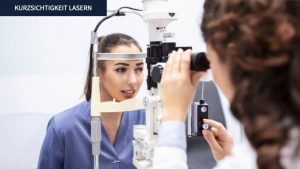

Short-sightedness (myopia) simply explained

Short-sightedness, also known as myopia, is one of the most common vision problems worldwide. It affects millions of people and causes distant objects to appear blurred while nearby objects remain sharp. This refractive error can significantly impair daily life, from difficulty reading street signs to problems at work or school.
In this post, we explain what short-sightedness is, what causes it and what its symptoms are, how it can be diagnosed, and what risks and treatment options are available. We also look at the latest developments in laser eye surgery and offer practical tips for those affected.
What is myopia?
Nearsightedness, also known as myopia, is a refractive error in which distant objects appear blurred while near objects are seen clearly. This refractive error occurs when light is focused in front of the retina instead of directly on it. The main causes are an eye that is too long or excessive refractive power of the eye, particularly the cornea and the lens.
Nearsighted people have reduced distance vision but see nearby objects clearly. For example, people with myopia have difficulty recognizing distant objects such as street signs.
An ophthalmologist can diagnose myopia and recommend appropriate corrective options, such as glasses or contact lenses, to improve vision and ensure a clear, sharp image. There are also various laser treatments for the long-term treatment of myopia.
Types of short-sightedness
Short-sightedness can be divided into different types and degrees of severity. Here are the main types:
Refractive myopia: It is caused by an excessively strong refractive power of the cornea or lens, which focuses light in front of the retina. This type can be exacerbated by various eye diseases.
Axial myopia: This form occurs when the eyeball is too long, causing light to be focused in front of the retina. It is often hereditary and is more common in people who are severely nearsighted.
The severity of myopia is measured in diopters (a unit of refractive power) and is classified as follows:
Mild nearsightedness: less than -3 diopters; this condition slightly impairs vision of distant objects
Moderate nearsightedness: between -3 and -6 diopters; people with moderate nearsightedness have significant difficulty seeing objects at a distance
Severe nearsightedness: more than -6 diopters; people with severe nearsightedness have considerable visual impairment and rely heavily on visual aids
Causes of short-sightedness
Short-sightedness can arise for several reasons. Both refractive myopia (in which the eyeball is too long) and axial myopia (in which incorrect refraction of light by the cornea or the eye’s lens is the cause) can stem from different factors. Among the most important are:
Genetics
Short-sightedness often runs in families. If one or both parents are short-sighted, their children have an increased risk of developing myopia.
Eye diseases
Certain eye diseases and conditions, such as cataract or keratoconus, can affect the eye’s shape and refractive power and cause short-sightedness.
Near work
Intensive near work, such as prolonged reading, writing, or using digital devices, can strain the eyes and contribute to the development or worsening of nearsightedness. This can lead to so-called school myopia, especially in children and adolescents.
Environmental factors
A lack of daylight and spending too much time indoors can also contribute to the development of myopia.
An ophthalmologist can diagnose the underlying causes of myopia and recommend appropriate corrective and treatment options, such as corrective lenses or refractive surgery. It is important to have regular eye examinations to detect and treat possible eye diseases at an early stage.
Detecting Myopia – Symptoms, Measurement, and Diagnosis
Short-sightedness, or myopia, can present with various symptoms. A typical sign is blurred vision when viewing distant objects, while near objects remain clear. This refractive error can lead to overexertion of the eyes, causing headaches and eye strain. People often squint to compensate for reduced visual acuity; this “blink face” (from the Greek myōps) is also the origin of the term myopia.
The measurement and diagnosis of myopia are performed during an eye examination by an optician or ophthalmologist. Visual acuity is assessed using various tests, including a distance-vision test in which the patient must identify letters or symbols at different distances.
The degree of myopia is measured in diopters (D), a unit that indicates the refractive power of the lens. By measuring the diopter value, the ophthalmologist can prescribe the necessary correction in the form of glasses or contact lenses. These visual aids are designed to compensate for the eye’s refractive error and provide clear vision. The diopter value must also be taken into account to determine whether laser eye treatment is possible.
Why short-sightedness is on the rise worldwide
Short-sightedness is already an extremely common visual impairment: In Germany, for example, around 25% of the population is affected.[1] However, studies suggest that the number of people suffering from short-sightedness will continue to increase.
For example, one study predicts that by 2050 half of the world’s population will be affected by myopia. The causes cited include environmental factors such as diet, lifestyle habits (limited time spent outdoors), and genetic factors. The study also points to high-pressure education systems and the intensive use of digital devices as contributing factors.[2]
[1] Source: Short-sightedness
[2] Source: Myopia

Nearsightedness vs. Farsightedness vs. Astigmatism: An Overview
Nearsightedness, farsightedness, and astigmatism are the most common types of refractive errors. Depending on the type of refractive error, different symptoms may occur, and each requires different treatment.
Short-sightedness (myopia) occurs when the eyeball is too long or when the refractive power of the cornea or lens is too strong. This causes light to be focused in front of the retina rather than directly on it. People with short-sightedness have difficulty seeing distant objects clearly, while nearby objects appear sharp. The most common symptoms are blurred distance vision, eye strain, and headaches.
Farsightedness (hyperopia) occurs when the eyeball is too short or when the cornea or lens has insufficient refractive power, causing light to be focused behind the retina. This results in blurred vision for near objects, while distant objects may appear clear. People with farsightedness often experience eye strain, headaches, and difficulty focusing on close objects.
Corneal curvature (astigmatism) is caused by an irregular shape of the cornea that scatters light in different directions. This results in distorted or blurred vision at all distances. People with astigmatism have difficulty seeing both near and distant objects clearly. Astigmatism can occur in combination with myopia or hyperopia.
Below is an overview of the possible causes and symptoms of these refractive errors:
| Refractive error | Causes | Symptoms |
|---|---|---|
| Short-sightedness (myopia) |
|
|
| Long-sightedness (hyperopia) |
|
|
| Astigmatism (corneal curvature) |
|
|
Risks of short-sightedness
In addition to reduced visual acuity, nearsightedness can sometimes cause serious problems, especially in people with a high degree of nearsightedness. A major risk is retinal detachment: an elongated eyeball can stretch the retina, which can lead to detachment and, if untreated, to blindness.
Severely short-sighted people also have an increased risk of glaucoma, in which elevated intraocular pressure can damage the retina. In addition, cataracts often develop earlier in short-sighted people than in those with normal vision; with cataracts the lens becomes clouded and vision is impaired. Furthermore, macular diseases such as myopic maculopathy can severely affect central visual acuity.
Regular check-ups with an ophthalmologist are therefore essential to detect and treat these eye diseases at an early stage.
Treatment for short-sightedness
There are various treatment options to correct myopia and provide sharp vision. The most common method is wearing contact lenses or eyeglasses with concave (diverging) lenses. These lenses correct the eye’s refractive power and ensure that light is focused on the retina.
Another option is refractive surgery. Procedures such as LASIK and SMILE® Pro change the shape of the cornea to correct the eye’s refractive error, thereby permanently correcting myopia. These methods are particularly effective for moderate to high myopia and offer a long-term solution.
Regular eye examinations are important for determining the appropriate treatment and monitoring your visual acuity. Discuss the best options with your ophthalmologist for your specific needs to achieve optimal correction of your nearsightedness and ensure sharp vision.
Also note that even after treatment for short-sightedness, an eyeball that is too long can still cause problems.
Possible laser procedures: laser treatment for short-sightedness in Stuttgart and Karlsruhe
At Bányai Neue Augen, several advanced laser treatments for short-sightedness are available. Here are the main methods we offer in our laser eye centers in Stuttgart and Karlsruhe:
SMILE® PRO
SMILE® PRO (Small Incision Lenticule Extraction) is an innovative technique used to correct myopia and astigmatism. The procedure is performed through a tiny incision in the cornea, through which a small lenticule is removed, altering the eye’s refractive power. This method, suitable for corrections up to -10 diopters, offers a rapid recovery and has only a minimal impact on corneal stability.
Femto-LASIK
Femto-LASIK is a proven method for correcting short-sightedness, long-sightedness, and astigmatism. A femtosecond laser is used to create a thin flap in the cornea, which is then folded back to the side so the underlying corneal tissue can be reshaped with an excimer laser. This method is highly precise, offers a rapid recovery, and provides a high degree of safety. It can also treat myopia up to -10 diopters.
LASEK & A-PRK
These two methods, Laser Epithelial Keratomileusis (LASEK) and Photorefractive Keratectomy (PRK), are alternatives to LASIK for patients with thinner corneas. In both procedures, the outermost layer of the cornea is removed and the underlying layer is reshaped with an excimer laser.
At Bányai Neue Augen, all these procedures are performed using state-of-the-art technology and extensive experience. We offer a personalized consultation to determine the best laser eye procedure for each patient’s needs.