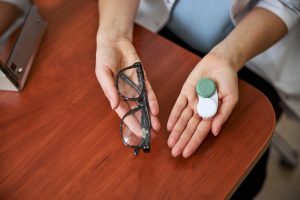

What to do about presbyopia and nearsightedness? Doctor-medic Bányai explains

When presbyopia develops in someone with nearsightedness, several visual ranges are affected at once. Myopia impairs distance vision, while presbyopia makes near vision blurry. Therefore, presbyopia and nearsightedness must be treated together to improve visual acuity at different distances.
In this article, you will learn what concrete steps you can take if presbyopia develops in addition to nearsightedness.
Can nearsighted people become presbyopic?
The short answer: Yes, even people who are nearsighted can become presbyopic as they age. Nearsightedness, or myopia, means the eyeball is too long or the refractive power of the lens is too strong.
The result: light is focused not on the retina but in front of it. This causes distant objects to appear blurry, while nearby objects are seen clearly.
However, the cause of presbyopia does not lie in the length of the eyeball. Rather, the eye’s lens loses elasticity with age, reducing its ability to accommodate.
This ability of the eye to adjust to different distances (accommodation) is a prerequisite for clear near vision.
Presbyopia, or age-related long-sightedness, is a natural process that occurs in everyone, regardless of any pre-existing refractive errors. As a result, people who are short-sighted may develop vision problems not only for distance but also for near vision over the course of their lives.
Effects on short-sightedness
A combination of nearsightedness and presbyopia means that both distance and near vision are impaired. The usual distance glasses correct nearsightedness but do not make reading or close work any easier.
Reading glasses allow nearsighted people to see nearby objects sharply, but distant objects remain out of focus.
This situation can lead to significant limitations in everyday life. The constant need to put one’s glasses on and take them off, or to switch between them, is not only inconvenient but can also cause headaches and eye strain.
Different diopter values for near and distance vision require a tailored visual aid that addresses both refractive errors. In this case, you should visit an ophthalmologist or optician to find a suitable solution as soon as you notice the first symptoms.
How presbyopia manifests in nearsighted individuals
The first signs of presbyopia in people who are nearsighted often appear as blurred vision when reading while wearing distance glasses. Small print looks blurred, and it becomes difficult to discern details up close.
Without glasses, reading is often still possible at first, because myopia can partially compensate for presbyopia. However, distance vision remains impaired. This problem occurs because the eye’s refractive power is no longer sufficient for near vision.
The declining accommodation of the eye’s lens means the eye can no longer focus adequately on nearby objects.
The current visual aid only corrects nearsightedness and does not address the coexisting presbyopia. This dual burden on the visual system can lead to eye fatigue or headaches.

Treating presbyopia and myopia together
There are different approaches to effectively correct both nearsightedness and presbyopia. Which approach is best for you depends on your individual needs and circumstances; here is an overview of the combined treatment options for nearsightedness and presbyopia.
Glasses and contact lenses for presbyopia and myopia
A proven method is the use of progressive glasses, which provide seamless transitions between near and distance vision. They use special lenses with varying diopter values, allowing clear vision at all distances.
Alternatively, bifocal glasses can be used, which have separate areas for near and far vision.
For contact lens wearers, multifocal contact lenses are available that work similarly to progressive glasses. They can also provide a clear image at multiple distances.
Many contact lens wearers also wear lenses in combination with glasses.
To see clearly at a distance, they wear contact lenses, but they also keep reading glasses on hand for near vision. This way, they don’t have to switch between two different pairs of glasses, which would otherwise be rather impractical in everyday life.
Especially when presbyopia and nearsightedness occur together, relying on traditional visual aids can become cumbersome. Many people therefore choose to address both conditions at once and opt for an eye treatment.
Laser treatment for presbyopia and short-sightedness – two in one
At Bányai Neue Augen, we offer a permanent solution through refractive surgery: laser eye surgery can correct both nearsightedness and presbyopia.
The PRESBYOND® method reshapes the cornea and thereby changes the eye’s refractive power. One eye is optimized for near vision and the other for distance, allowing the brain to produce an overall sharp image.
These procedures take only a short time but can significantly ease everyday life after an appropriate adjustment period.
Another option is refractive lens replacement (RLE), which is also commonly used for patients with farsightedness (hyperopia). In this procedure, the eye’s natural, rigid lenses are replaced with artificial ones. At the same time, cataracts can no longer develop after such a lens exchange.
As you can see, even when nearsightedness and presbyopia occur together, there are numerous ways to ease everyday symptoms — and laser eye surgery can even provide long-term relief.
To help you navigate this wide range of options, we offer extensive preliminary examinations and personalized consultations to find the ideal laser treatment for presbyopia for you.
Laser eye surgery in Baden-Württemberg
If you are considering laser eye surgery in Karlsruhe, you will benefit from comprehensive preoperative examinations, personal consultation, and state-of-the-art laser technology at Bányai Neue Augen. Our experienced team will guide you with competence and empathy on your path to better vision.
Our laser eye center, offering the same expertise, is also available in Stuttgart.