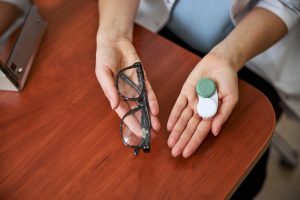

Which reading glasses are right for me? Doctor-medic Bányai offers tips.
If your eyesight leaves something to be desired, reading the daily newspaper becomes a strain and the letters in your favourite novel start to blur, then it’s time to take action.
For many people, the question arises: Which reading glasses are right for me? After all, there is a wide selection, and not every pair of glasses is suitable for every need. And what strength do I need?
In this article, you’ll learn about the available options and how to find the perfect visual aid for your individual needs. We’ll cover different types of glasses as well as alternatives to traditional glasses for presbyopia.
Selection of glasses in every prescription and style
The reading glasses market offers solutions for almost every need. From simple ready-made reading glasses and custom-fitted models to specialized lenses for different viewing distances – the options are numerous.
That makes it difficult to keep track: when choosing a vision aid, it’s not only a matter of personal taste but also of the effectiveness and comfort of the glasses.
So what types of glasses are available for age-related vision decline, and how do they differ?
Mono-, bi- and trifocal lenses – and how they differ from progressive lenses
Monofocal lenses are the most common type of reading glasses and correct near vision only. They are suitable for people who need assistance solely with reading or other close-up tasks.
Bifocal lenses, by contrast, combine two powers in a single lens: the upper portion for distance and the lower for near vision. The transition between the visual areas is marked by a visible line.
Trifocal lenses extend this concept by adding a third zone for intermediate vision, which is particularly helpful for tasks at arm’s length, such as computer work. However, a disadvantage of bi- and trifocal lenses is the abrupt transitions between focal zones, which can cause visual disturbances.
Progressive lenses offer a more modern alternative here. They provide seamless vision from near to far, without visible dividing lines on the lenses. The transition between viewing areas is smooth, resulting in a more natural visual experience.
However, progressive lenses require some time to get used to, as the brain needs to learn to use the different viewing zones correctly.
Common strength for reading glasses
Visual impairments vary from person to person and can change over time. This is particularly evident in presbyopia, where one can expect an increase of about +0.75 diopters every five years. This process usually begins around age 40 and is typically complete by about age 65.
People aged 45 and over often need glasses with +0.75 diopters, while those aged 60 and over often require +2.5 diopters or more.
It should also be noted that the visual acuity of the two eyes can differ. However, off-the-shelf reading glasses typically provide the same power for both eyes and do not take individual pupillary distance into account.
For optimal visual comfort, we therefore recommend glasses that have been individually fitted by an ophthalmologist or optician.
So what does all this mean for choosing your glasses?
5 questions to help you choose the right reading glasses
As explained in detail above, which reading glasses are right for you depends on several factors. To help you decide, ask yourself the following five questions—they can help you determine which glasses for presbyopia will suit you best.
Please note, however, that these considerations cannot replace individual consultation with an ophthalmologist or an optician. They can, however, give you an initial idea of which visual aid might be suitable.
1. How severe is your presbyopia?
The first step is to accurately determine the severity of your presbyopia. A professional eye examination is essential.
This is the only way to determine the exact diopter values for each eye and to identify any additional visual defects. Even small differences between the eyes can affect visual perception if they are not taken into account.
A properly fitted vision aid not only provides clear vision but, once you have adjusted to the glasses, does not cause headaches or early fatigue.
If you already wear glasses, you should have your vision checked regularly, as presbyopia can change over time. This ensures that your reading glasses always meet your current needs.
2. Do you have any other vision problems?
In addition to presbyopia, other refractive errors such as nearsightedness, farsightedness, or astigmatism may also be present. For example, if you experience blurred vision in the distance, you may need glasses that correct both near and distance vision. In such cases, varifocal or multifocal glasses are a sensible option.
It is different when other eye diseases occur in old age. The same applies to cataracts, which can lead to blindness if left untreated.
In such a case, refractive lens exchange may be an option, in which the cloudy lens is replaced with an artificial lens. At the same time, presbyopia can also be corrected.
3. What does your daily life look like?
Your lifestyle also plays an important role in choosing the right reading glasses. Do you spend a lot of time at your desk, or are you often on the go? What about sports? Do you enjoy reading books, or do you mainly work on the computer? For people who frequently need to switch between different viewing distances, progressive lenses are usually the most practical solution.
If, on the other hand, you only need glasses for specific activities, monofocal glasses may suffice. Athletes or active individuals could benefit from robust, lightweight materials, while those who are fashion-conscious may place particular value on design and aesthetics. Therefore, your daily habits should play a major role in the decision.
4. How much should reading glasses cost?
Budget is another important factor. Ready-made reading glasses are available at low cost, but they do not offer the individual visual comfort of custom-made glasses and should generally not be used as a long-term solution.
Individually tailored reading glasses are more expensive, but they offer significantly better visual quality and comfort.
Progressive lenses and other special spectacle lenses can increase costs further, but are worthwhile for their versatility and the added comfort.
Also consider the long-term costs: a high-quality pair of glasses can be more durable thanks to better materials and coatings, and thus pay off over time.
5. Are there any special requirements for glasses?
Specific requirements can influence your choice. Do you work in environments with high levels of dust, or do you need protection from blue light from screens? There are eyeglass lenses with special coatings that reduce reflections, are more scratch-resistant, or include a blue-light filter.
Allergic reactions to certain materials may also play a role. In such cases, hypoallergenic materials should be used.
If you need prescription sunglasses, there are also options that combine UV protection with corrective lenses. A detailed consultation will help ensure that all of these individual needs are taken into account.
Laser eye surgery as an alternative
Most of my patients used a vision aid before choosing laser eye surgery. At some point, however, they grew tired of wearing glasses and sought a more permanent solution.
Procedures such as laser eye surgery can improve vision in old age and let you live without visual aids.
In refractive lens exchange, for example, the eye’s natural lens is replaced by an artificial multifocal lens. This procedure can correct presbyopia as well as other refractive errors such as nearsightedness or farsightedness.
It is particularly suitable for people with advanced presbyopia.
The PRESBYOND® procedure combines the benefits of modern eye surgery with the brain’s processing power.
The cornea is shaped so that one eye is optimized for distance vision and the other for near vision. The brain can fuse these different visual inputs to produce a sharp image at various distances.
Our online laser eye suitability test gives an initial indication of whether laser eye surgery is an option for you.
Expert advice at our laser eye centers
If you’re considering laser eye treatment, a personalized, comprehensive consultation is essential. At our specialized laser eye centers in Karlsruhe and Stuttgart, our experienced ophthalmologists take the time to thoroughly assess your visual acuity, personal needs, and overall health.
At Bányai Neue Augen, we combine state-of-the-art technology with specialist expertise to determine the best possible treatment together with you—whether LASIK, PRESBYOND® or a refractive lens exchange. We answer all your questions about the procedure, its benefits and risks, and provide competent support on your path to better vision.
Our aim is to ensure that you feel well taken care of and can make your decision about laser eye surgery with confidence and peace of mind.