Contact lenses for presbyopia: What you need to know!

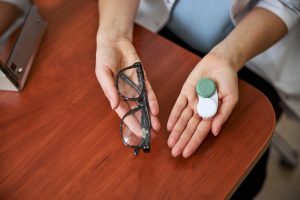
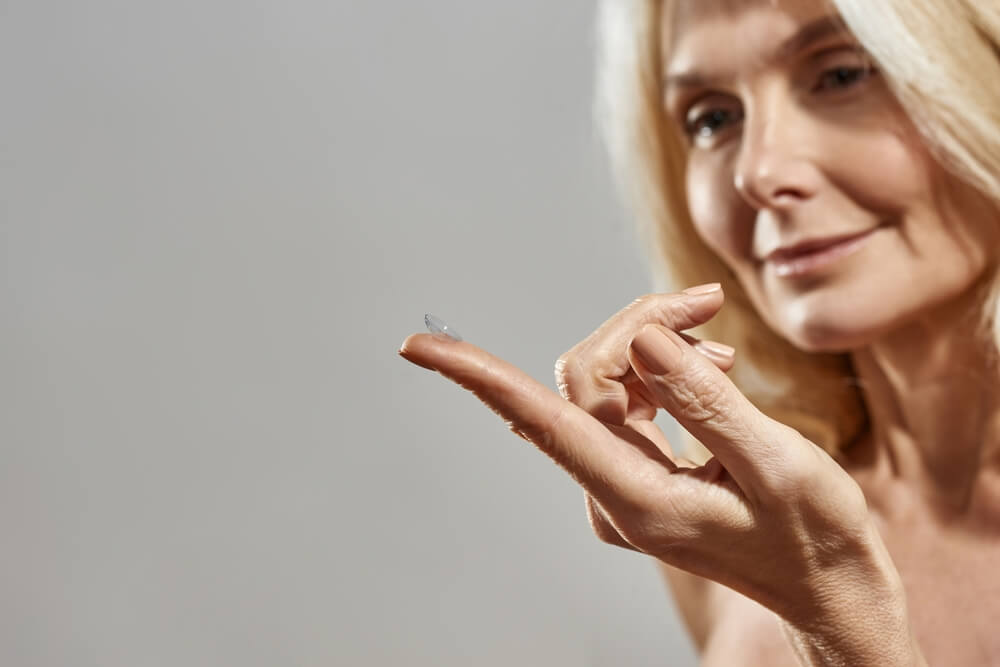
Contact lenses for presbyopia can effectively relieve its symptoms and help people manage everyday life without glasses. Many people are not aware of this option, and there are numerous uncertainties about presbyopia and contact lenses.
In this article, we provide an overview of what to consider if you want to compensate for your declining vision with contact lenses. We present the different types and also discuss other possible treatments for presbyopia.
First things first: Presbyopia can be corrected with contact lenses
Many people initially associate presbyopia with reading glasses or progressive lenses, but contact lenses can also effectively correct this refractive error. The age-related decline in vision is caused by the natural loss of elasticity of the eye’s lens, which becomes noticeable for most of us from around age 40. The eye’s ability to accommodate decreases, making clear near vision more difficult – the cause of presbyopia.
Modern multifocal contact lenses allow you to see clearly both at a distance and up close. They divide the lens into zones for different viewing distances, so the brain automatically selects the appropriate focus depending on where you look. For many contact lens wearers, this is a convenient solution to avoid relying on additional visual aids while enjoying a wide field of vision.
Types of contact lenses for presbyopia
There are several types of contact lenses designed specifically to correct presbyopia. Consider your personal preferences, the costs, and any existing visual impairments.
Single-vision lenses for reduced near vision?
Single-vision lenses correct vision at only one distance. For presbyopia, that would be near vision. However, this is often impractical in everyday life, because distance vision then becomes blurred, and constantly taking the lenses out is not as easy as simply taking off reading glasses.
Bifocal lenses and multifocal lenses
Bifocal contact lenses have two different prescriptions integrated into a single lens — one for near vision and one for distance vision. They work similarly to bifocal glasses, with the change between vision zones occurring when you look down or up.
Multifocal lenses, also known as multiple‑power lenses, take this a step further: they feature several viewing zones arranged concentrically. This lets you see clearly at different distances without having to change your gaze.
These multifocal contact lenses are available as soft lenses and as rigid (form-stable) variants. They offer excellent comfort and are particularly suitable for contact lens wearers who want a seamless transition between near, intermediate, and distance vision. Careful fitting is also important to achieve optimal results. Your optician can provide comprehensive advice on this.
With this method, one eye is corrected for distance and the other for near vision, allowing the brain to form a single clear image. This can be achieved not only with contact lenses!
”With the PRESYBOND® method, we also optimize for intermediate vision.”
– Bányai Neue Augen
Contact lenses and glasses can be used together
Sometimes combining contact lenses and glasses for presbyopia is a viable option for improving visual acuity. This can be useful, for example, if you have myopia in addition to presbyopia, since your distance vision is then impaired.
For example, nearsighted people can use reading glasses for near vision while wearing contact lenses for clear distance vision.
Consider any possible corneal astigmatism
Astigmatism affects the refraction of light in the eye and causes blurred vision at all distances. Toric contact lenses are specially designed to correct this refractive error.
For presbyopia, toric lenses can now be combined with multifocal properties to correct both corneal astigmatism and presbyopia. An experienced ophthalmologist will carefully examine your eyes and select the appropriate lenses. This ensures you have a clear image at all distances.
Not everyone tolerates contact lenses equally well
Although contact lenses offer many benefits, they are not suitable for everyone. Factors such as dry eyes, allergies, or sensitive eyelids can make them uncomfortable to wear. Soft contact lenses are often better tolerated than hard contact lenses because they conform better to the eye and cause less friction.
There are also differences in care: daily disposable lenses are intended for single use and do not require a cleaning solution, whereas monthly lenses must be cleaned regularly.
Another aspect is vision throughout the day. Some people notice that their visual quality when wearing contact lenses worsens as the day progresses. In such cases, combining them with glasses or switching to a different type of lens may be advisable. A personalized consultation can help determine the best solution for your needs.
This may be the aforementioned change in lens model, but also an alternative, permanent treatment for your visual impairment, such as laser eye surgery.

There are alternatives to the lens
If contact lenses are not an option for you or you are seeking a permanent solution, there are alternatives. Reading glasses or progressive lenses, for example, are traditional visual aids that do not require direct contact with the eye. They are individually fitted and generally provide high-quality vision. However, they only help while you’re wearing them.
On the other hand, there are now surgical options for the permanent correction of presbyopia. Many patients come to my practice who have never worn contact lenses and find it difficult to get used to the unfamiliar sensation in their eyes. Others do not want to rely on contact lenses for years only to switch to glasses later—if, for example, inserting the lenses becomes more difficult with age.
For people who want clear vision at every stage of life without glasses or contact lenses, we offer laser eye procedures such as PRESBYOND®. Here, one eye is optimized for distance and the other for near vision. The brain then combines the two visual inputs into a single sharp image.
Another option is refractive lens exchange (RLE), in which the natural, no longer flexible eye lenses are replaced with multifocal intraocular lenses. This method also prevents or treats cataracts. Cataracts are caused by clouding of the natural lens, which can no longer occur after RLE.
Glasses, contact lenses, or laser eye surgery: even this decision is often difficult. To make choosing between the different surgical procedures easier, we offer personal consultations. As part of check-ups, we assess your eye health; afterwards we discuss together which procedure is best suited to help you achieve clearer vision at any age.
Read more about presbyopia:
• Presbyopia (age-related long-sightedness) simply explained
• Declining vision in old age: When does vision begin to deteriorate?
• Do you become nearsighted or farsighted as you get older?
• What helps with age-related vision loss?
• Symptoms of presbyopia: How can I tell if I have presbyopia?
• What treatment options are available for presbyopia?
• How does presbyopia differ from other visual impairments?
• How does presbyopia affect my everyday life?
• What foods are good for eye health in old age?
• What factors affect presbyopia?
• Presbyopia vs. myopia: What are the differences?
• Presbyopia vs. Farsightedness: What’s the difference?
• Does smoking affect presbyopia?
• Myths about presbyopia: What’s the truth?
• Spread of presbyopia in Germany: Is everyone becoming presbyopic?
• Eye problems due to presbyopia – a concern as early as age 40
• What are the costs of treating presbyopia? A comparison of treatment options
• The 10 most common eye diseases in old age
• Exercises to help with presbyopia
• What to do about presbyopia and nearsightedness?
• Reading glasses – 10 things to keep in mind
• Reading glasses or progressive lenses: Which solution is best in the long term?
• Which reading glasses are right for me?
• Diopter table for presbyopia