
Laser up to how many dioptres of long-sightedness?

As a rule, farsightedness up to +5 diopters is lasered. However, the value depends very individually on the defective vision and on the person concerned. It may well be that a larger diopter number can be lasered. Therefore, a preliminary examination is necessary in order to be able to provide accurate information.
In most cases, we perform FEMTO-LASIK surgery to treat farsightedness. It is precisely the diopter number that allows first indications as to whether one is suitable for such an ophthalmic laser surgery with farsightedness.
Are you unsure whether lasers are possible at your diopter value? Take our free laser eye aptitude test!
Up to which diopter number is farsightedness lasered?
Eye lasers for farsightedness are usually possible up to a diopter number of +5 dpt. In individual cases, farsightedness can also be lasered at higher values. However, this strongly depends on the thickness of the cornea and will be decided in the course of preliminary discussions and check-ups.
In most patients, farsightedness is below +5 dpt anyway, so the diopter value is rarely an obstacle to laser eye treatment for hyperopia.
Laser treatment for long-sightedness at 6 dioptres
Laser vision at 6 diopters is a demanding challenge that needs to be weighed carefully. Modern laser treatments such as the LASIK or PRK method can in many cases enable effective correction. However, a thorough preliminary examination is important, in which the thickness and texture of the cornea as well as the general eye health are checked.
Patients with a farsightedness of 6 diopters may benefit from a significant improvement in their vision, but should have realistic expectations and be aware of the potential risks and complications. Individual consultation with an experienced ophthalmologist is essential to determine the suitability and chances of success of the treatment.
Laser treatment for long-sightedness at 5 dioptres
Farsightedness at 5 diopters can often be successfully corrected with laser treatments such as LASIK or PRK. These procedures aim to optimize the refractive power of the eye by reshaping the cornea in a way that correctly focuses the light onto the retina. A comprehensive ophthalmological examination will be performed prior to treatment to ensure that the cornea is sufficiently thick and healthy and that there are no other eye problems.
Patients with a farsightedness of 5 diopters may experience a significant improvement in their visual quality after laser treatment, although the exact success rate and the risk of possible side effects may vary individually. Careful planning and advice are crucial to achieve the best results.
The laser eye alternatives if the dioptric number is too high
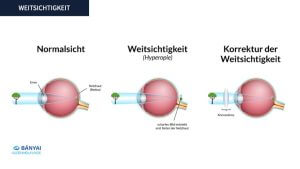
If the diopter number is too high to HAVE femtolASIK performed for farsightedness, there are still alternatives. We mainly rely on the ICL lens. This is an artificial lens that is used in addition to the body’s own lens behind the rainbow skin. With this, almost all refractive errors can be corrected.
At an advanced age, we do a clear lens exchange, also called a clear lens exchange, in which the patients’ natural eye lenses are replaced by implants. In this way, the path to improved vision can also be made possible without glasses and contact lenses.
How long must the diopter value remain stable?
In order to be able to treat farsightedness by means of laser eye surgery, the diopter value should remain stable over a longer period of time. Sometimes there can be fluctuations in the diopter number, especially up to the age of 18.
We therefore recommend that laser eye surgery be performed only after the age of 18. In addition, the degree of farsightedness (the diopter number) should not have changed within the past twelve months.
Further prerequisites for laser vision in farsightedness
In addition to the diopter value, further prerequisites for laser eye treatment in farsightedness are above all eye health, the thickness of the cornea, age and a constant degree of defective vision. Laser eye surgery is not recommended for farsightedness during pregnancy and breastfeeding.
Laser treatment for long-sightedness – with FEMTO-LASIK
For the treatment of farsightedness, we rely in most cases on the FEMTO-LASIK procedure at our laser eye centre in Stuttgart. This is a very safe method for laser eye surgery, in which a corneal cap is produced using state-of-the-art laser technology. The resulting flap is then folded over to treat the actual defective vision.
As a rule, we perform FEMTO-LASIK up to a farsightedness of about +5 dpt. If the diopter value is higher, however, alternatives for the treatment of farsightedness are available.

Conclusion: Up to what diopter number can you laser long-sightedness?
In principle, we recommend a correction of farsightedness by means OF femto-LASIK up to a diopter value of approx. +5 dpt. In individual cases, the method can also be used at a higher diopter value, which depends above all on the thickness of the cornea.
Alternatively, however, we can use methods such as the insertion of artificial lenses (ICL and Clear Lens Exchange), which can also be used to treat higher-grade farsightedness. We will be happy to advise you on the ideal ways to treat your refractive error!