Under-Eye Bags: Causes, Symptoms and Remedies

What to do about under-eye bags?
Everyone will at some point have to deal with eye bags and dark circles. While most people are only rarely affected, others face these swellings in the eye area every day.
People with dark circles or under-eye bags often wrongly give the impression that they are sleep deprived, not well, or even ill. Immediately, images of a sleepless night or a night of heavy drinking, of stress and alcohol, come to mind. These are not necessarily the causes of under-eye bags. And so under-eye bags or a sagging of the eye area are not something anyone wants. Rather, people want to remove this perceived sign of insufficient sleep immediately.
But what causes under-eye bags and dark circles? Do under-eye bags have anything to do with tears? And when should you seek advice about swelling around the eyes? This article explains the common causes, symptoms and treatment options for under-eye bags.
Under-eye bags, dark circles and tear troughs
Under-eye bags are usually linked to fluid retention, changes in skin elasticity or the natural ageing process. Dark circles mainly refer to darker colouring or shadowing beneath the eyes, while tear troughs are hollows below the lower eyelids. These conditions can occur together but have different causes.
Causes of under-eye bags and dark circles
The causes of lacrimal sacs – The term “lacrimal sacs” suggests that they are caused by tears. In fact, tears and lacrimal sacs have nothing to do with each other. Lacrimal sacs are located in a bony canal beside the nose and are always present.
In a healthy state, this swelling is not visible. If the lymph flow is disturbed, the fluid can no longer drain properly and collects in the tissue around the eye. This then causes the swelling commonly known as a “tear sac”.
However, fluid accumulation is only one cause of under-eye bags. In such cases, they can be temporary or permanent.
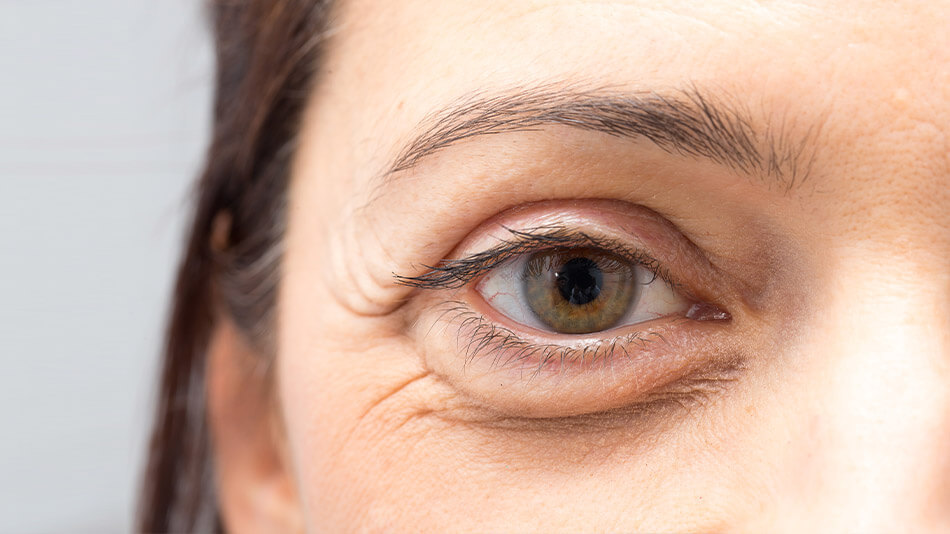
A second cause of under-eye bags is the permanent sagging of the skin, muscles, or fatty tissue beneath the eye. This second cause is either a personal predisposition or an age-related change in the skin.
Although the extent of swelling of eye bags and dark circles varies from person to person, under-eye swelling becomes more pronounced with age as the muscles, connective tissue, and skin lose elasticity.
A combination of both causes is also possible. Swollen eyes are, incidentally, especially noticeable in the morning when they occur temporarily.
Lacrimal sacs: Their causes at a glance
The following graphic illustrates the causes of under-eye bags. These range from stress and insufficient sleep to the natural aging process.

Do I need to see a doctor about under-eye bags?
The area around the eyes where under-eye bags form is one of the most sensitive. This is where the thin skin becomes apparent: it is many times thinner around the eyes than in other parts of the body (up to three times thinner than the rest of the facial skin and up to six times thinner than the skin on the rest of the body).
Since it also lacks subcutaneous tissue and firm connective tissue, it offers less firmness. This excess skin also makes it prone to fluid retention and swelling — and consequently to under-eye bags.
Stress or lack of sleep, in particular, can cause visible swelling around the lower eyelid. In these cases, the swelling is usually short-lived and harmless. This excess skin usually disappears once you get some rest and sleep.
If under-eye bags or dark circles persist and possibly even grow larger, seeing a doctor is advisable. The doctor can determine the causes of the under-eye bags and recommend eye care or further treatments.
Persistently swollen eyes can be signs of a disease – for example, liver or kidney disease, heart failure, or an allergy. Ultimately, however, only medical examinations can determine whether treatment of the lacrimal sacs is advisable, whether they are actually related to a disease, and how serious it is.
When should you see a doctor?
Consult an ophthalmologist if swelling develops suddenly, affects only one eye, causes pain or changes your vision. Medical advice is also recommended if the swelling persists, worsens or is accompanied by redness or other symptoms.
What can help with under-eye bags and dark circles?
Eye bags and dark circles are considered cosmetic blemishes by many people. People often try to conceal these blemishes with a so-called home remedy, for example by placing a tea bag—usually green or black tea—or cucumber slices over the eyes. Make-up, such as concealer, is also considered a home remedy in a figurative sense.
In addition, various manufacturers have for years been bringing eye-care products to market to combat skin aging and noticeable fat deposits, such as creams with or without collagen or hyaluronic acid. These are intended to contribute to the removal of under-eye bags and prevent or permanently address dark circles.
Often, these cosmetic remedies are very expensive and, like the regularly recommended connective-tissue massages for eyelid tightening (lower eyelid tightening, hooded eyelids), are not very effective. On the other hand, there is effective help for temporary visible swelling caused by lack of sleep. Whether the well-known quark or cucumber mask, cold teaspoons, or tea bags help, however, is questionable.
For temporary puffiness, some people use a cool compress or a suitable eye-care product. These measures may improve comfort or the appearance of swelling, but they cannot remove age-related or hereditary under-eye bags permanently.
However, none of these remedies is a solution for chronic eye bags and dark circles, whether they are due to the natural aging process, caused by stress, or hereditary. If you absolutely want to get rid of this type of lacrimal sac, your only option is an operation to remove the lacrimal sacs. As with any operation, a competent doctor who already has experience treating and removing lacrimal sacs is recommended.
What types of procedures are available to remove the lacrimal sacs?
If the tear troughs or dark circles are mild, a laser may be used. Alternatively, a surgical procedure for eyelid tightening is an option. In more severe cases, this procedure from plastic surgery is performed as follows:
The surgeon makes a small incision in the lower eyelid for the under-eye bags, removes fat and tightens the skin as well as the lax muscle tissue of the under-eye area. The resulting scar on the treated area is virtually invisible. However, you should definitely discuss with a doctor whether such a surgical procedure to treat under-eye bags makes sense or is necessary at all.
Consultation for the surgical removal of the lacrimal sacs
Can I remove eye bags and dark circles? Yes, there are different ways to remove eye bags or hooded eyelids. Persistent eye bags or dark circles can be treated with cosmetic eyelid surgery.
Please note that eyelid surgery is not performed at our clinics. Contact specialists in this field for more information.
Some of the treatments offered by Ms. Doctor-medic Bányai include therapy for cataracts and glaucoma, laser treatment for astigmatism, and laser eye treatments to correct short-sightedness and long-sightedness.
At the modern laser eye centres in Stuttgart and Karlsruhe, you benefit from many years of experience, personalised advice, and state-of-the-art technology. Feel free to learn more in a personal consultation or online about our full range of treatments.
What are some other common eye problems?
- Burning
- Adhesions
- Eye pain up to ocular migraine
- Weakening of the connective tissue (“under-eye bags”)
- Stye
- Inflammation of the eyelid margin
- Irritated, itchy eyes (herpes on the eye)
- Light sensitivity
- Watery eyes or increased tear production
- Blurred vision
- Eyelid redness (eye twitching)
- Dry eyes after surgery (Sicca syndrome)
- Persistent pressure in the eyes
- Red eyes and/or conjunctivitis
- Eye discharge
- Yellow eyes