
How long does laser eye treatment last in farsightedness? Doctor-medic Bányai informed
Laser vision in farsightedness is a popular method to get a permanent grip on refractive errors. But how permanent is the result really? How long eye lasers last in farsightedness cannot be said in general terms. However, the good news is that in many patients with farsightedness, the effect of laser eye surgery lasts almost a lifetime.
However, this is not always the case: some patients experience renewed refractive error after some time, which requires further correction – either through a new procedure or through the use of vision aids.
Laser treatment for long-sightedness – the methods at a glance
There is more than one method for laser treatment of long-sightedness. Femto-LASIK is one of the best known. The cornea is opened with a laser cut and folded to the side – creating the so-called corneal flap. Subsequently, another laser models the underlying structures so that the light is refracted correctly and the farsightedness is compensated for.
Especially in the case of presbyopia, methods such as the PRESBYOND ® procedure are used. Here, one eye is corrected for near vision, the other for distance vision, so that the brain can compose a sharp image from the two different visual impressions.
Another method of treating farsightedness is lens replacement: either with a scalpel or a laser, the cornea is opened to remove the underlying eye lens and replace it with artificial lenses. Although we are not talking about classic eye lasers here, this approach opens up an alternative for people who are not eligible for eye lasers to get rid of their farsightedness.
Farsightedness lasered: Why does it sometimes have to be corrected?
Why the lasered farsightedness sometimes needs to be corrected, even if the laser eye surgery was successful, can have different reasons. Two of the most important causes are, on the one hand, a change in vision after the procedure, on the other hand, an occurrence of presbyopia.
Degree of farsightedness has changed
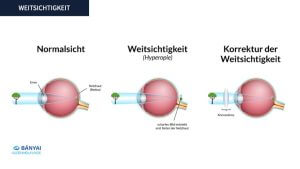
If the degree of farsightedness has changed (i.e. the diopter value), symptoms of visual impairment may recur after the procedure. This is related to the development of farsightedness: this does not always remain stable in the course of life, but can sometimes change. This is because farsightedness is caused by a shortened eyeball, so that the incident light does not produce a clear image exactly at the level of the retina. The result: blurred near vision.
Especially at a young age, the eye is still growing, which can also have an impact on its vision. This is also taken into account when deciding when you can have farsightedness lasers: Laser eye surgeries are only recommended from the age of 18 and with constant refractive error.
However, changes in vision can also occur in later years – usually to a lesser extent. However, if the change occurs after laser eye surgery, it can sometimes lead to renewed refractive error years after the procedure.
Farsighted again? Presbyopia as a possible cause
Old-age farsightedness can be another reason why farsightedness occurs again after laser eye surgery. According to one study, this ageing phenomenon affects about 80% of the population in Europe over the course of their lives.1 The first symptoms are usually noticed from the age of 40 – for example, that glasses are needed for reading.
The cause of presbyopia is a decreasing elasticity of the natural eye lens. In the further course, weakened ciliary muscles may also be added. This is the musculature that is jointly responsible for the bending of the eye lens and thus for the change between near and far vision. Affected people therefore sometimes need a visual aid in order to see clearly, especially in the vicinity.

Methods for correcting farsightedness
There are several methods to correct farsightedness. Probably the first measure can be to wear contact lenses or glasses again in certain situations. However, if the effect of the first surgery is no longer satisfactory, post-laser treatment may also be considered.
For example, if the first procedure WAS performed with femtolASIK, it can be repeated in many cases. This is also possible in those rare cases in which an over- or under-correction has occurred during the first intervention – this can also be treated in this way.
If the renewed farsightedness occurs as a symptom of presbyopia, there are other methods for correction. For example, we offer the PRESBYOND ©procedure to treat presbyopia. But a monovision, PRK or a refractive lens exchange can also help here.
Which method is most suitable varies from patient to patient and is determined within the framework of comprehensive control examinations.
If you are considering a correction, we are happy to support you with our many years of experience in the field of eye lasers in Karlsruhe and Stuttgart at Bányai Neue Augen. In our specialised centres, you will find state-of-the-art technology and individual support to find the right solution for you.
How often can farsightedness be re-lashed?
Post-lasering of farsightedness using FEMTOLASIK is possible as long as the condition of the affected eyes allows. Above all, it depends on the thickness of the cornea how often laser eye surgery can be repeated. However, with a normal corneal thickness, laser eye surgery can be performed several times.
If laser retouching is not an option, you can resort to other alternatives to correct farsightedness. These include, above all, lens operations – interventions in which artificial lenses are inserted into the eye to compensate for defective vision.
Conclusion – How long does laser vision last in farsightedness?
How long the eye laser lasts in farsightedness depends on many factors. In principle, however, it can be stated that for many patients, even years after the procedure, everyday life is possible without a visual aid.
Even if vision impairment occurs again after laser eye surgery with farsightedness, it can be treated again in many cases. If, for example, the degree of farsightedness subsequently changes, or if presbyopia occurs, further intervention may be considered to compensate for the refractive error again.
Read more about: What is farsightedness? | Symptoms of long-sightedness | Up to what number of dioptres can long-sightedness be lasered?
All the information you need about laser eye surgery – delivered directly to your email inbox!
Follow us