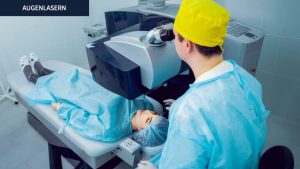

Eye lasers & dioptres: up to what value is it possible according to Dr. med. Bányai?

The treatment spectrum for eye lasers now ranges from -12 dpt to +6 dpt through the various methods. The exact diopter number that can be lasered varies from person to person. The type of refractive error and the individual state of health of the person or eye is decisive in determining how many dioptres can be lasered.
Those affected by (severe) refractive errors are increasingly concerned with having their eyes lasered. You often dream of a life without glasses and contact lenses and see your chance for clear vision in the surgical procedure. Absolutely right!
Although laser treatment is not an option for everyone, thanks to state-of-the-art technology and extensive eye laser experience, an enormous spectrum of refractive errors and dioptric values can now be treated.
In the following article, we will explain up to which values a treatment is possible and which methods are best suited for an optimal result.
What are diopters?
In ophthalmic optics, diopters are understood to be a unit of measurement (abbreviation DPT) of an optical system (such as spectacle lenses, contact lenses or even a magnifying glass, microscope). Diopters stand for refractive power, i.e. how strongly a spectacle lens or a lens must refract the light.
The natural adaptability of the lens (accommodation) normally ensures that we can see near and far sharply.
In the case of refraction, the visual performance (visual acuity) is determined by means of a measurement of the eye values and an eye test. This visual acuity is indicated by means of diopters and shows how much the refractive power of the eye differs from the norm. This shows how strong spectacle lenses or contact lenses should be in order to achieve the vision of a normal-sighted person.
In history, there have been “dioptres” since 1872. The French ophthalmologist Ferdinand Monoyer invented this measuring unit for the strength of a lens.
Diopter Values – Diopter Values (dpt)
On the one hand, a distinction is made between negative and positive diopter values:
- The minus values (negative diopter values) indicate myopia and a concave divergent lens is required for correction.
- The positive diopter values affect farsighted people. For the correction of farsightedness, converging lenses are curved outwards, i.e. convex.
How to convert diopters to calorific value
Diopter and focal length are terms from optical physics that are closely related to each other. The unit of dioptre (the refractive power of a lens) is defined by the reciprocal of the focal length.
The relationship of dioptre (D) and focal length (f) can therefore also be represented with a mathematical formula:
D = 1/f
How many diopters are many?
The following applies to both dioptres – the higher the value, the more strongly it must be corrected.
Mild refractive error is usually the case with about +/- 1.00 dioptres. A visual aid is not yet permanently necessary. In contrast, in the case of severe refractive error from approx. – 5.00 dioptres, a visual aid is unavoidable.
An annual check-up with the ophthalmologist to check vision and eye health is recommended.
If you do not know your diopter values – these are usually shown in your spectacle passport. Optician-adapted glasses (progressive vision glasses) are a simple means of sharp vision, but only a temporary solution.
Diopters in long-sightedness
About 35 percent of those under 60 suffer from hyperopia, better known as farsightedness.
Those affected by refractive error can see things better when they are far away. In the vicinity, e.g. at normal reading distance, on the other hand, they hardly recognize anything. The cause lies in an eyeball that is too short, which is responsible for the fact that the eye cannot focus the incoming light rays on the retina, but behind it.
Remember to have your farsightedness lasered if a correction of the defective vision should only be carried out up to a strength of approx. +5 diopters. In exceptional cases, it is possible to carry out a treatment at higher values, but at this point the thickness of the cornea should be taken into account.
In most patients, however, the refractive power of the eyes is below +4 to +5 dioptres anyway. Only very rarely do higher measured values occur in humans and thus an even greater farsightedness.
Typically, the femto-LASIK method is used for eye lasers for farsightedness.
Diopters in nearsightedness (myopia)
Short-sightedness is called myopia. As the name suggests, it is virtually the opposite of farsightedness (hyperopia).
In myopia, sufferers suffer from the effects of an eyeball that is too long in relation to the refractive power. As a result, the light can also not be focused on the retina, but already beforehand with this form of visual impairment. As a result, patients can see better in the vicinity than in the distance.
The professional societies for refractive surgery generally recommend that the dioptres should be a maximum of -10 when laser vision is nearsighted. For more details, see: Up to how many dioptres, laser short-sightedness!
As a treatment method, the ReLEx smile (NEW SMILE Pro) as well as LASIK and Femto-LASIK, which are also used for farsightedness, are particularly recommended. PRK/LASEK is also used for small corneal thickness or pre-treated eyes.
Diopters in presbyopia
With every person, the time has come: In order to be able to read without problems, reading must be kept increasingly farther away. At the latest when one arm length is no longer sufficient, there is no way around reading glasses.
From the age of 45, most people begin to have presbyopia. Over time, the lens becomes more rigid and its elasticity decreases. As a result, it can bulge worse and our human eye can no longer switch so well between near and far vision.
First and foremost, this restricts near vision. In the distance, on the other hand, everything can be recognized without problems.
Presbyopia is also a visual defect that can be treated with the laser.
For higher diopters or if corneal laser surgery is not possible, a replacement of the lens is considered. Nearly any degree of nearsightedness or farsightedness as well as presbyopia can be corrected.

Diopters in astigmatism (corneal curvature)
In astigmatism, a curvature of the cornea is responsible for the defective vision. So-called intentionality can occur either in connection with farsightedness and nearsightedness or on its own.
Such visual impairment can be corrected up to -5 dioptres by having your eyes lasered. As with myopia, ReLEx smile, Femto-LASIK and PRK/LASEK are suitable surgical methods for corneal curvature.
From how many dioptres can you have your eyes lasered?
Basically, the eyes can be treated with a suitable eye laser method from as little as -0.25 diopters for nearsightedness and from +0.25 diopters for farsightedness.
Furthermore, ReLEx smile, LASIK or PRK / LASEK treatment is usually possible if the patient is over 18 years old, the dioptres are stable, the cornea is thick enough and there are no other eye diseases such as cataracts.
Can my eyes be lasered?
Use the laser eye test to find out whether you are suitable for laser eye surgery in Karlsruhe or Stuttgart with Doctor-medic Liliana-Iulia Bànyai and Dr. med. Daniel Bányai.
From which diopter value does the eye laser no longer work?
Eye lasers no longer work above a certain diopter value. A personal examination by an ophthalmologist is recommended. As a rule, laser eye treatment no longer works with a farsightedness of +4 diopters, a nearsightedness of -10 diopters and a corneal curvature of 5 diopters.
Unfortunately, not all people who suffer from refractive errors are suitable for laser eye treatment. Particularly high dioptres or a very thin cornea can be to blame if surgery using ReLEx smile or LASIK is not possible and PRK/LASEK treatment is not an option. But book a free consultation in one of our ophthalmologist practices or in our ophthalmologist practice in Stuttgart Mitte.
The maximum values are specific to each visual impairment and depend on the individual parameters of the cornea. However, it can generally be said that extremely serious disorders, such as deviations from 12 dioptres, can no longer be corrected by eye lasers alone.
No more reading glasses and contact lenses
But what happens if these methods of ophthalmology are unsuitable, but they still desperately want a life without glasses or contact lenses?
What alternatives are there to laser eye surgery for high dioptres?
If eye lasers are not suitable as a treatment method due to a thin cornea or too high diopter values, there is the possibility of a lens replacement (lens implant) or an artificial lens used in addition to the body’s own lens (implantable contact lens).

During this operation, the eye lens is removed and replaced with an artificial lens. The following methods can be used for this:
- Monofocal lenses
- Multifocal lenses
Or an artificial lens is implanted in addition to your own lens:
- Phakic intraocular lenses
An experienced ophthalmologist will discuss which method is best for you in a detailed consultation.
Conclusion on eye lasers and dioptres
Until now, patients with a high diopter count have often only received a visual aid with the help of appropriate spectacle lenses. Thanks to state-of-the-art technology and innovative laser procedures, an effective treatment can now be carried out even at higher diopter values. The positive experiences of the past today result in a steadily growing range of possibilities.
Although laser therapy is not suitable for everyone, the range remains very large and the likelihood that your refractive error can also be treated by eye lasers is high.
So take the opportunity and come to the eye centre of ophthalmologist Liliana Bányai in Karlsruhe or Stuttgart. Let yourself be treated by specialists who have gained experience in the field of refractive surgery over a long period of time. Together, we will find the individually suitable method and help you to find new eyes.
FAQs
Up to how many dioptres is laser eye surgery possible?
The maximum diopter number up to which eye lasers are possible depends on the type of refractive error and the specific method. Short-sightedness (myopia) can usually be lasered to about -10 diopters, farsightedness (hyperopia) to about +5 diopters and corneal curvature (astigmatism) to about -5 diopters. Individual requirements such as the thickness and health of the cornea play a decisive role in this.
Is laser eye surgery possible at +6 dioptres?
Yes, laser vision at +6 diopters is possible in principle. Modern procedures such as LASIK or PRK can offer an effective correction in many cases, even if the limit up to +5 diopters is usually mentioned. However, a comprehensive examination by an ophthalmologist is necessary to ensure that the eyes are suitable for treatment.
Is laser eye surgery possible at +5 dioptres?
Yes, farsightedness at +5 diopters can often be successfully corrected with laser treatments such as LASIK or PRK. However, the suitability of the patient depends on individual factors such as the thickness and health of the cornea, which must be thoroughly examined before treatment.
Is laser eye surgery possible at -12 dioptres?
Laser myopia at -12 diopters is less common and more challenging. In such cases, alternative procedures such as Implantable Contact Lenses (ICL) or Refractive Lens Replacement (RLE) may be more appropriate. A detailed consultation and examination by a specialist are essential to determine the best method of treatment.
Read more about eye lasers:
- How much does laser eye surgery cost?
- When can I swim after laser eye surgery?
- Can I use my mobile phone after laser eye surgery?
- The cost of laser eye surgery in Stuttgart
- Does the health insurance cover laser eye surgery?
- Does laser eye surgery have disadvantages?
- From what age onwards?
- The latest eye laser methods at a glance