Laser eye surgery in Stuttgart and Karlsruhe
Always see clearly – without glasses or contact lenses.
Clear vision from as little as €990 per eye.
Why choose the Bányai Laser Eye Centre?
Highly trained ophthalmologists
Our medical team undergoes continuous training and can assist you in 16 languages.
Max. 2 hours
Surgeries take at most 2 hours and are performed on an outpatient basis.
Latest technologies
Our centres use first-class technologies, such as the Zeiss VisuMax 800.
from -10 dpt to +10 dpt
We offer tailored solutions for your visual impairment and can correct almost all refractive errors.
Centrally located in Stuttgart & Karlsruhe
The laser centre is located in central Stuttgart, just a few hundred metres from the main train station.
High customer satisfaction
Week after week, many people leave our laser centre satisfied and without glasses.
Laser eye aptitude test
Want to get rid of your glasses or contact lenses? Laser eye treatment can free you from your visual aids in the long term. However, not all refractive errors can be corrected with a laser. We will help you determine whether your refractive error can be treated with laser.
With the laser eye aptitude test you can find out within 2 minutes whether you are suitable for laser eye treatment.
Reviewed by Doctor-medic Liliana-Iulia Bányai
With over 50,000 successful surgical procedures, the experienced team at Bányai Neue Augen specializes in eye surgery. Thanks to ongoing professional development and training, you can be confident you are in exceptionally competent hands.

Doctor-medic Liliana-Iulia Bányai & Dr. med. Daniel Bányai

Eye laser procedure and experience report
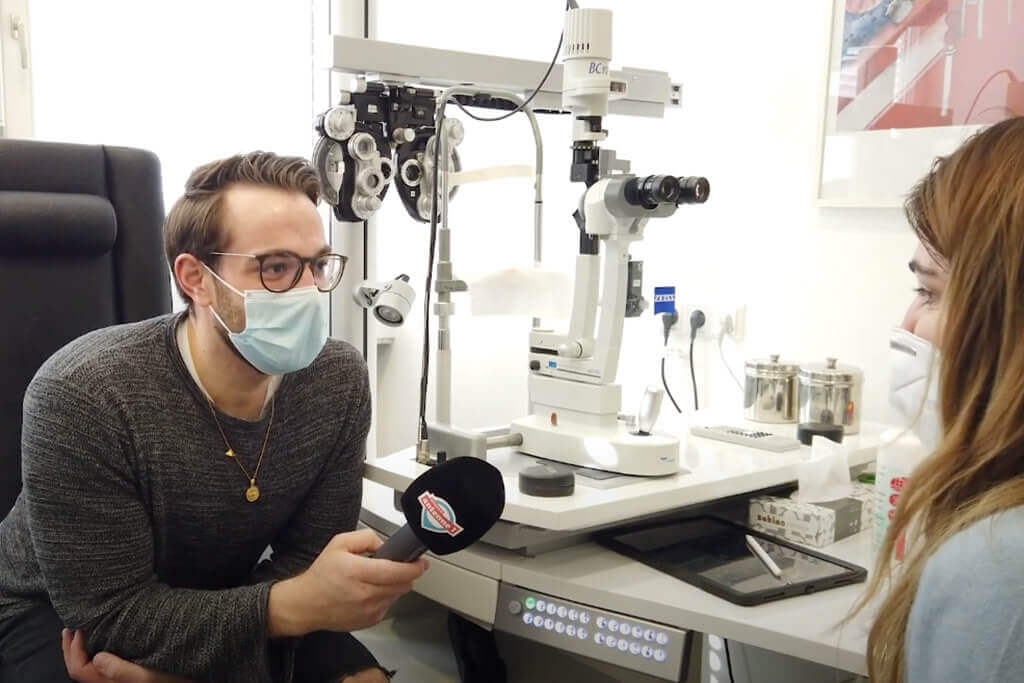
In the following video you can watch an experience report by Nico Auer of Hitradio Antenne 1. Nico suffers from nearsightedness. Accompany him on his path to a life without glasses.
Nico shares his personal experience with laser eye treatment. He shows the entire process from the initial consultation and pre-examination to the laser eye operation and follow-up checks.
Arrange a personal appointment at one of our locations. This is the first step toward a new life without glasses and contact lenses!
SMILE Pro®
from €2,900 from €121/ month*
SMILE® Pro’s advanced, minimally invasive technology delivers a life-changing result in under 10 seconds!
- Short-sightedness up to approx. -10 dpt
- Corneal curvature up to approx. 5 dpt
- minimal stress on the cornea
Femto LASIK
from €2,200 from €91/ month*
The Femto LASIK procedure uses modern laser technology to precisely shape your cornea and give you clear vision.
- Short-sightedness up to approx. -10 dpt
- Farsightedness up to approx. +5 dpt
- Corneal curvature up to approx. 5 dpt
PRK & LASEK
from €990 from €58/ month*
A-PRK (Advanced Photorefractive Keratectomy) and LASEK (Laser Epithelial Keratomileusis) are suitable alternatives for people with a thin cornea.
- Short-sightedness up to approx. -6 dpt
- Farsightedness up to approx. +2 dpt
- Corneal curvature up to +4 dpt
Presbyond®
from €3,150/from €131/ month*
Presbyond® corrects presbyopia by specifically adjusting the eyes for near and distance vision – sharp sight without intermediate zones.
- for presbyopia – suitable from 40 years
- only 15 min surgery duration per eye
- one of the gentlest treatment methods
* All prices include VAT and are per eye.
400+ reviews
from satisfied customers
All posts about laser eye surgery
FAQs – Laser eye surgery
Up to how many diopters can you have your eyes lasered?
Thanks to the modern laser eye techniques at Bányai Neue Augen, even high diopter values can be treated. With today’s technology, almost all refractive errors can be corrected by laser. Alternatively, a lens exchange can provide the desired solution. You are welcome to take our aptitude test, where you can enter your refractive error and diopter values. Read more: Up to how many diopters is laser eye surgery possible?
Is laser eye surgery possible despite corneal curvature?
Many people with corneal curvature or a very thin cornea ask whether eye lasering is even possible. If you have a very thin cornea, the PRK/LASEK method may offer a treatment option. The ophthalmologist’s examination will determine whether laser eye surgery is feasible. If the cornea is too thin, laser eye surgery cannot be performed. In such cases, surgical lens exchange is offered as an alternative. Read more: Laser eye surgery for thin corneas
Laser eye treatment steps
During laser eye surgery, the laser changes the eye’s refractive power so the retina can produce a sharp image again. After the operation, visual aids are usually no longer necessary. The procedure itself takes only a few minutes and is computer-controlled. Including preparation and post-operative checks, you should expect a total visit time of around two hours.
LASIK & Femto LASIK differences
- LASIK stands for laser in situ keratomileusis, often called flap surgery. In LASIK, a wafer-thin corneal flap is created with a microkeratome – a highly developed, computer-controlled microscalpel that prepares the flap and thus the top layer of the cornea.
- In Femto LASIK, the flap is created with a femtosecond laser.
- With both methods, the flap is lifted and the refractive correction is performed with an excimer laser. After the laser treatment, the flap is repositioned and the healing process begins. The flap grows back on its own and is not noticeable.
The laser treatment with the SMILE® Pro method
- Alongside Femto LASIK (femtosecond laser), SMILE® Pro is another effective and commonly used method that corrects vision without creating a corneal flap. The choice depends on the type and degree of refractive error. SMILE® Pro is often used for higher diopter numbers, particularly for nearsightedness.
- During SMILE® Pro, the laser creates a refractive lenticule and a small access incision of about 4 mm.
- The lenticule is removed through this small incision.
- Removing the lenticule produces a targeted change in the corneal tissue.
Advanced PRK & LASEK
- A-PRK (Advanced Photorefractive Keratectomy) and LASEK (Laser Epithelial Keratomileusis) are suitable for people with a thin cornea. Both techniques treat the corneal surface using an excimer laser to remove corneal layers.
What is the procedure before and on the day of the laser eye treatment?
Before undergoing laser eye treatment, the attending physician will perform a thorough pre-examination. You will be informed about the exact procedure and potential risks. This is followed by extensive measurements to diagnose your eyes and determine your visual impairment (measurements such as biometry, pupillometry, pachymetry, wavefront measurement, refraction determination, IOL Master). The ophthalmologist will recommend the best treatment path for you. Please note the following:
- Contact lenses: stop wearing soft contact lenses 2 weeks before the appointment (3–4 weeks for rigid lenses)
- The pre-examination for laser eye surgery takes about 2 hours.
- You must not drive yourself after the examination due to the eye drops used.
On the day of the laser operation: During laser eye surgery, the laser changes the eye’s refractive power so the retina can produce a sharp image again. The actual procedure takes only a few minutes and is computer-controlled. Including preparation and follow-up checks, expect around two hours. Be sure to plan a few hours of rest at home after your laser eye operation.
Read more:
How long before laser eye surgery should you stop wearing contact lenses?
What should be considered after laser eye treatment?
After the treatment, we will examine you again following a short rest. Even at this stage you should notice an improvement in your vision. Full visual acuity, however, is not immediate. Arrange for someone to accompany you home so you can relax and recover.
It is normal for the eyes to burn slightly, itch, or feel like there is a foreign body present. This should subside three to four hours after the operation. Your visual acuity will improve during this time. By the next day at the latest you should notice a clear difference. During the healing process, avoid activities such as reading or watching TV; let your eyes regenerate and rest.
The required rest time after laser eye surgery varies by person. In general, the initial recovery takes only a few hours, so be patient. Do not rub your eyes during this period.
Read more:
Can I drive after laser eye surgery?
Can I use my mobile phone after laser eye surgery?
How long should you wear sunglasses after surgery?
What not to do after laser eye surgery?
Follow-up for laser eye surgery in Stuttgart & Karlsruhe
What does the follow-up check look like?
- Whether or not you experience complaints after treatment, careful follow-up examinations are of utmost importance. We ask you to attend them. Only through these checks can we be certain that your eyes are healing perfectly.
- In general, follow-up examinations take place at these intervals:
- 1 day after treatment
- after 1 week
- after 3 months
Treatment results for laser eye surgery under 45
SMILE® Pro treatment results
With the SMILE® Pro method, results can be achieved quickly and gently. It can provide a lasting correction of visual impairments with relatively low risk. For example, flap displacement is not a concern because no flap is created. The minimally invasive procedure allows fast healing so patients can return to daily life without visual aids quickly. While achieving an exact 0 diopters cannot be guaranteed, SMILE® Pro achieves near perfection with an average residual of 0.07 diopters per eye. In most cases, contact lenses or glasses are no longer needed after SMILE® Pro.
Read more:
Experiences with laser eye surgery
Are there any negative experiences with laser eye surgery?
Alternatives to laser eye surgery under 45
As an alternative to laser eye surgery, ICL lens implants can be used. These are permanent contact lens implants placed in addition to your natural lens, positioned between the iris and the natural lens. The implant can correct visual defects permanently and can be removed if necessary. ICL stands for implantable Collamer lens and can be used for nearsightedness and farsightedness. The principle is similar to cataract surgery, where the cloudy natural lens is replaced by a new one.
How long do the results of laser eye surgery last?
Laser eye correction is generally long-lasting. However, in younger patients whose eyes are still growing, changes can occur over time. These are usually minor and can be corrected with a simple follow-up treatment. Read more: Long-term consequences after laser eye surgery
What side effects can occur with laser eye surgery?
Thanks to high technical standards, skilled specialists and strict hygiene measures, the risk of side effects is minimised. Side effects vary by method and type of refractive error. Each patient’s eyes are different, so no blanket statement can be made. For example, corneal surface condition and corneal thickness vary between individuals. It is likely that the eyes will sting mildly immediately after treatment. A foreign-body sensation in the first hours after surgery is normal. Eyes may be light-sensitive and produce more tears; this improves during the healing process, typically after about 2 weeks. It can take up to 3 weeks for the cornea to fully settle. Vision may fluctuate during this time. The tear film usually normalises within 3 months. Please attend all follow-up appointments, even if you have no complaints.
How often can you re-laser?
How often re-lasing is possible depends mainly on corneal thickness. Eyes with a normal, average corneal thickness can sometimes be re-treated more than once. In most cases, however, repeat laser treatment is not necessary.
What is the worst thing that can happen with laser eye surgery?
The worst possible complication is a very rare, nonspecific immunological reaction triggered by an infection from contaminated instruments, glove powder or lubricants. Such events are extremely rare.
How safe is laser eye surgery and from what age?
Laser eye surgery is a very safe procedure when performed by the right surgeon. This type of treatment has been performed and continuously improved for over 20 years, reflected in the high success rates of German laser eye centres (over 90%). The minimum age for laser eye surgery is 18 years. Read more: Is laser eye surgery safe? and From what age is laser eye surgery recommended?
Can you become blind from laser eye surgery?
No, you cannot become blind from laser eye surgery. That is a myth. The laser only acts on the front layers of the eye, so injury to the retina, optic nerve or lens is not possible.
Is laser treatment of the eye painful?
No, laser treatment of the eye is not painful. Before the procedure, the eye is numbed with anaesthetic eye drops. The effect takes a few seconds, and only then is the treatment started. More on this in the article: How painful is laser eye surgery?
How long does blurred vision last after laser surgery?
After laser surgery, blurred vision should last no longer than three weeks; otherwise a correction may be necessary. During several follow-up checks, your vision will be monitored over a period of weeks or months. Read more: Blurred vision after laser eye surgery
What are the advantages of laser eye surgery with Doctor-medic Liliana-Iulia Bányai?
Ophthalmologist Doctor-medic Liliana-Iulia Bányai and her experienced team perform over 3,000 eye operations per year. She is one of the top specialists in the field of laser eye treatment.
In addition, the technical equipment in our laser centres in Stuttgart and Karlsruhe is state of the art. We offer the world’s most modern and gentle laser eye methods and provide treatments for visual problems and dry eyes.
Laser eye surgery – What treatment methods are there?
There are several promising laser methods for eye correction, some of which are further developments of established procedures. In our centres we use, among others, the Zeiss VisuMax 800 femtosecond laser. We offer SMILE PRO (formerly ReLEx SMILE), Advanced LASEK & PRK, FEMTO LASIK, as well as Presbyond and SMILE Monovision for presbyopia.