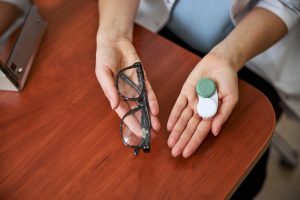

Declining vision in old age: When does eyesight begin to deteriorate?
After a certain age, many people notice a decline in their eyesight. Often, this gradual process begins around the age of 40 with presbyopia, which makes it difficult to see up close.
However, other age-related eye diseases, such as cataracts or age-related macular degeneration (AMD), can also significantly impair vision in old age. The risk for both of these conditions increases over the course of a lifetime.
In this article, we explore when vision begins to decline with age, which factors contribute to such changes, and what treatment options are available to help you maintain independence and self-determination as you age.

Which visual changes affect eyesight in old age
Not everyone experiences declining vision as they get older. Nevertheless, certain structures in the eye can change with age, which can lead to various changes in vision. Some of these are:
- Presbyopia : The lens of the eye loses elasticity, making it difficult to focus on nearby objects and impairing visual performance (initially, especially in low light conditions). The first signs of presbyopia usually appear from the age of 40.
- Cataract: The clouding of the lens causes blurred vision and sensitivity to light. This condition typically appears from around age 50 (the risk increases with age) and is treated by lens replacement.¹
- Age-related macular degeneration (AMD): This condition affects the retina and causes a gradual loss of central vision in those affected. It is the most common cause of vision loss in older people. Their risk also increases with age, so it’s advisable to have an eye examination with an ophthalmologist every six months from the age of 50.²
In addition to these visual disturbances, ophthalmology recognizes other eye diseases that can affect vision. Be it diabetic retinopathy, glaucoma (one of the main causes of blindness in Germany)³, or vitreous opacities: not every visual impairment is age-related. And yet, many people tend to experience a decline in visual acuity and overall vision as they age.
Special case of presbyopia – when and in whom it impairs vision
Presbyopia, also known as age-related farsightedness, affects almost everyone from the age of 40. Unlike nearsightedness or farsightedness, which result from refractive errors of the eye, presbyopia is caused by the natural aging of the eye’s lens. Over time, the lens loses its flexibility, making it harder to focus on nearby objects.
Reading small print, such as on price tags or smartphones, becomes difficult, and many reach for reading glasses for the first time. Since presbyopia affects almost everyone, it is one of the most common visual impairments in old age.
Presbyopia cannot be prevented. However, modern treatments such as laser procedures or lens replacement can significantly improve quality of life and reduce dependence on visual aids such as progressive lenses or contact lenses.
¹ Health information: Cataract. https://www.gesundheitsinformation.de/grauer-star-katarakt ²Charité:
What is age-related macular degeneration (AMD)? https://augenklinik.charite.de/leistungen
³ Dresden University Hospital: Glaucoma. https://www.uniklinikum-dresden.de
This often changes from the age of 40 onward, when the near point recedes so far that we, for example, have problems reading or doing computer work. In such cases, it’s worth considering possible treatments.
– Bányai Neue Augen
Better vision in old age = more independence
Reliable vision provides greater independence and a higher quality of life in old age. Whether driving, shopping, or in social situations – being able to see well enables independence. Untreated visual impairments can limit that independence and make daily life more difficult. Therefore, early diagnosis and appropriate treatment are essential.
Presbyopia in particular causes problems for many people from the age of 40. At Bányai Neue Augen in Karlsruhe and Stuttgart, we therefore offer various laser treatments for presbyopia.
Depending on your individual needs and the condition of your eyes, we will work with you to select the most suitable procedure for you – as part of comprehensive eye examinations and a personal consultation. In this way, we aim to help you achieve significantly better vision at every stage of life.