
Farsightedness (hyperopia) explained simply

Farsightedness, also known as hyperopia, is a widespread refractive error that affects many people. It is difficult to see near objects clearly, while distant objects are clearly perceived. This visual impairment can have a significant impact on daily life, from difficulty reading to problems with close-up work.
In this post, we explain what farsightedness is, what types exist, and what the causes and symptoms are. We also compare them with other refractive errors such as nearsightedness and corneal curvature, discuss the risks and limitations in everyday life and explain the various diagnostic and treatment options. Finally, we take a look at the modern laser eye treatments for farsightedness that are offered in Stuttgart and Karlsruhe.
What is farsightedness? A compact explanation
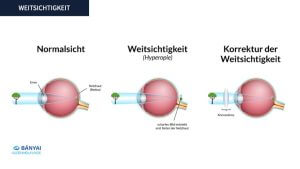
Farsightedness, also called hyperopia, hypermetropia, or clarity, is a refractive error in which nearby objects appear blurry while distant objects are clearly seen.
This visual impairment usually occurs when the eyeball is too short or the refractive power of the eye, especially the eye lens, is too weak. This causes the light to be focused behind the retina rather than directly onto it, creating a blurred image nearby. Normal-sighted people, on the other hand, have an eyeball that focuses the light exactly on the retina level.
Farsightedness can be both congenital and can occur during the course of life due to the loss of the elasticity of the lens. Young people can often compensate for farsightedness through the accommodation ability of their eyes, while in old age reading glasses are required to see a sharp image.
Types of long-sightedness
Farsightedness can be divided into different types, which differ in their causes and the affected structures in the eye. The two main types are refractive hyperopia and axial hyperopia.
Refractive hyperopia is caused by insufficient refractive power of the cornea or the lens of the eye. This causes the light behind the retina to become focused, resulting in blurred images in the vicinity. This type of farsightedness can be genetic or caused by changes in the course of life.
Axial hyperopia occurs when the eyeball is too short. Here, too, the light behind the retina is focused, which makes it difficult to see nearby objects. This form of farsightedness is often congenital and can manifest itself at a young age.
Special form of presbyopia
Presbyopia, also known as presbyopia, is a special form of farsightedness caused by the natural aging process of the lens of the eye. From about the age of 40, the elasticity of the lens begins to decrease, affecting the eye’s ability to focus on nearby objects. This causes sufferers to have difficulty seeing small fonts or nearby objects clearly.
The cause of presbyopia lies in the reduced accommodation capacity of the lens, which is controlled by the ciliary muscle. With age, the lens becomes less flexible and the ciliary muscle weakens, making it difficult to focus at close distances. Typical symptoms are blurred vision during close-up work, headaches and eye fatigue when reading.
Presbyopia is usually treated with reading glasses, progressive spectacles or contact lenses. There are also modern procedures such as multifocal intraocular lenses and laser treatments, such as the PRESBYOND ®procedure, which can improve vision. Presbyopia affects many people over the course of their lives and is a normal ageing phenomenon that can be easily corrected, so that sharp vision is also possible again in old age.
Causes of hyperopia
Farsightedness (hyperopia) can be caused by various anatomical and genetic factors. One of the most common causes is an eyeball that is too short, causing the light to be focused behind the retina rather than directly on it. This refractive error can be congenital or develop over the course of life. However, a refractive error of the lens (refractive hyperopia) or presbyopia can also be the background for blurred near vision, in which the incident light rays do not arrive correctly on the retina.
In some cases, genetic factors and family predispositions can contribute to the development of farsightedness. It is therefore important to have regular eye examinations, especially if there is a family history of refractive errors. An ophthalmologist can determine whether hyperopia is present through a refraction determination and other tests and recommend appropriate treatment options.
Interestingly, many children are temporarily farsighted at a young age. This is because their eyes are still growing and developing. Often, farsightedness corrects itself over the course of growth as eye length increases and refractive power adjusts.
Symptoms of long-sightedness
Farsightedness (hyperopia) can cause a variety of symptoms, which can vary depending on the severity of the refractive error. A primary sign is blurred vision, especially near objects. Affected people often have difficulty seeing near objects or small fonts sharply, while distant objects appear clear.
Other (secondary) symptoms are eye strain and headaches caused by the constant effort of the eye to produce a sharp image. This overexertion can also lead to burning eyes and general signs of fatigue, especially after prolonged close-up work such as reading or working on the computer.
Children and young people who are farsighted tend to squint or often narrow their eyes to see better due to constant accommodation. In severe cases, untreated farsightedness can lead to amblyopia (faint-sightedness), in which the vision of one eye is permanently impaired.
Another symptom may be the constant blinking or rubbing of the eyes to improve visual acuity. These symptoms are often indicative of refractive error and require examination by an ophthalmologist to determine accurate visual acuity and prescribe appropriate visual aids.
Comparing refractive errors: farsightedness, nearsightedness and corneal curvature
Farsightedness (hyperopia), nearsightedness (myopia) and corneal curvature (astigmatism) are the most common visual impairments. Here are the main differences and similarities of these vision defects:
| Defective vision | Causes | Symptoms |
|---|---|---|
| Long-sightedness (hyperopia) | too short eyeball, weak refractive power of the lens | blurred vision of nearby objects, headache, eye strain |
| Short-sightedness (myopia) | too long eyeball, strong refractive power of the lens | blurred distance vision, eye strain |
| Corneal curvature (astigmatism) | irregular curvature of the cornea or lens | distorted or blurred vision at all distances, headache |
Risks and limitations in everyday life
Farsightedness can lead to various risks and limitations in everyday life, especially with strong farsightedness. A common consequence of this visual impairment is difficult activities that require near vision, such as reading or working on the computer. This sustained exertion can lead to chronic eye strain and headaches and eye pain.
Amblyopia, also known as faint-heartedness, is a serious risk. It can occur if farsightedness remains untreated in childhood. In this case, the vision of an eye does not develop properly, which can lead to permanent vision problems.
Farsightedness can also increase the risk of more serious eye diseases such as cataracts: cataracts (glaucoma) is a condition caused by increased pressure in the eye that can damage the optic nerve, with the risk of vision loss. The reason may be, among other things, thickened ciliary muscles, which can be caused by constant accommodation.
In everyday life, people with severe farsightedness may have difficulty focusing on nearby objects, causing problems with everyday tasks. They often need visual aids such as glasses or contact lenses to improve their visual acuity. These visual aids are necessary to lead a normal life and easily cope with activities such as reading, writing and working.
Measurement and diagnosis – eye test for suspected hyperopia
Hyperopia can be diagnosed through a series of tests and examinations, which are sometimes also known from the optician. The process usually begins with an eye test that measures visual acuity at different distances. The patient is asked to read letters or symbols from different distances in order to assess the ability to see near and far.
Another important test is the refraction determination. In this test, a phoropter is used to hold lenses with different refractive power (indicated in diopters or dpt.) in front of the eye and to measure the reaction of the eye to the different lens powers. This helps to determine the exact visual acuity and the necessary visual aid.
A comprehensive eye exam at the ophthalmologist may also include pupil dilation. Eye drops are used to dilate the pupils, allowing the ophthalmologist to examine the retina and optic nerve more closely. This is important to rule out other possible causes of vision problems, such as retinal detachment or cataracts.
Another diagnostic procedure in ophthalmology is retinoscopy, which involves shining a light into the eye to observe how it is reflected by the retina. This provides information about the refractive error of the eye and helps in determining the appropriate corrective lens.
Regular eye exams are crucial, especially for symptoms such as blurred vision, eye strain, or headaches. Early diagnosis and treatment can significantly improve quality of life and reduce the risks of long-term vision damage.
Contact Lenses, Glasses & Co.: Treatment Options
Farsightedness can be treated in several ways to improve vision and relieve symptoms. The most common treatment methods are glasses and contact lenses, both of which correct the defective refractive power of the eye, allowing a sharp image on the retina.
Glasses for long-sightedness
Farsightedness lenses are convex shaped (plus lenses) to refract light correctly and focus on the retina. They are easy to handle and provide instant visual acuity improvement. Glasses also protect against dust and UV rays.
Contact lenses for hyperopia
Contact lenses work similarly to eyeglasses in that they refract light and focus on the retina. They sit directly on the cornea and offer a natural field of view without the limitations of a spectacle frame. Contact lenses are ideal for sports activities or for people who do not want to wear glasses. However, they require careful care to avoid infection and dryness.
Laser eye surgery for long-sightedness
Laser treatment may be considered for a more permanent solution. Procedures such as LASIK (laser in situ keratomileusis) and PRK (photorefractive keratectomy) change the shape of the cornea to correct refractive power. In some cases, a lens exchange operation (refractive lens exchange) can also be performed, in which the natural lens is replaced by an artificial lens. And good experiences have been made with the PRESBYOND ®procedure, for example, in the laser eye treatment of presbyopia.
Laser eye surgery for farsightedness – treatments in Stuttgart and Karlsruhe
Bányai Neue Augen offers various advanced laser and lens treatments to effectively correct farsightedness. Here are the main methods available in the centers in Stuttgart and Karlsruhe:
Femto LASIK
Femto LASIK (femtosecond laser-assisted in situ keratomileusis) is a proven method for correcting farsightedness. In this procedure, a thin flap is created in the cornea with a femtosecond laser, which is then folded over. An excimer laser then processes the underlying cornea to correct the refractive power.
ICL Lenses (Implantable Contact Lenses)
For patients who are not suitable candidates for LASIK, Bányai Neue Augen offers the option of implantable contact lenses (ICL). These lenses are inserted behind the iris and in front of the natural lens of the eye and correct the defective vision without changing the cornea. ICLs are an excellent solution for patients with high farsightedness or thin corneas who cannot undergo laser treatment.
PRESBYOND®
PRESBYOND® Laser Blended Vision is an innovative treatment designed specifically for patients with presbyopia. This method relies on correcting one eye for near vision and one for far vision, so that the brain generates a sharp image from these two visual impressions. This allows patients to see sharply both near and far, reducing the need for reading glasses. In addition, this method also corrects the mean distance, such as PC, dashboard, navigation system, etc., so that almost all distances are sharp without visual aids.
In order to find out before the visit to the ophthalmologist whether you are suitable for eye lasers in farsightedness, we offer an uncomplicated online eye laser aptitude test. Or you can make an appointment directly at one of our eye laser centers in Karlsruhe or Stuttgart, where we can work together on your options for sharp vision and find the best eye laser method for your needs.
Because Bányai Neue Augen offers state-of-the-art technologies and comprehensive care in the eye laser centres in Stuttgart and Karlsruhe. With over 27 years of experience and more than 51,000 successful laser procedures, patients can rest assured that they are in competent hands.
FAQs
How do you see with farsightedness?
People with farsightedness (hyperopia) have difficulty seeing near objects clearly, while distant objects remain sharp. This is because the light is focused behind the retina rather than directly onto it. Symptoms may include blurred vision during close-up work, eye strain, and headaches.
What can be done about farsightedness?
There are several ways to correct farsightedness. Glasses and contact lenses are the most common and provide an immediate improvement in visual acuity by adjusting the refractive power of the eye. For permanent solutions, refractive interventions such as femto-LASIK and PRK are suitable. Implantable contact lenses (ICL) and multifocal intraocular lenses are also effective options, especially for patients who are not candidates for laser treatments. An appointment with an ophthalmologist can quickly provide information about which treatment method is suitable for you.
What happens when you are farsighted?
Farsightedness occurs when the eye is unable to focus light rays correctly, causing nearby objects to appear blurry. This can lead to symptoms such as blurred vision, eye strain, headache and increased fatigue. Without correction, visual acuity may deteriorate in the long term. Especially in children, untreated farsightedness can lead to amblyopia (faint-sightedness), in which one eye permanently sees worse. Regular eye exams and appropriate visual aids can help prevent these problems and improve quality of life.