
Laser treatment for short-sightedness: health insurance does not cover the costs!

Laser eye surgery offers an effective way to permanently correct visual defects such as myopia and to do without glasses or contact lenses. Nevertheless, statutory health insurance companies do not cover the costs of this treatment in most cases.
This is because nearsightedness is usually classified as a non-serious medical impairment and can be adequately corrected by vision aids. In our blog, we explain the exact reasons for this decision and what alternatives there are.
In the following sections, we will give you a comprehensive overview of the various laser procedures available for the short-sighted and explain the role of individual diopter values as well as the health necessity in the assumption of costs by the health insurance companies.
Statutory and private health insurance in Germany
Differences between statutory and private health insurance
In Germany, insurance is compulsory for all citizens. Health insurance can be taken out either in the form of statutory health insurance (GKV) or private health insurance (PKV).
Statutory health insurance is compulsory for all employees whose regular annual gross income is below the annual salary limit. The benefits of the GKV are defined by law and include a wide range of medical treatments and medications.
Private health insurance, on the other hand, is primarily intended for the self-employed, freelancers and high-income workers. The benefits of the PKV can be agreed individually and are usually more extensive than those of the GKV.
Eye lasers in myopia and the assumption of costs by health insurance companies
In the area of laser eye treatments, there are often differences between PKV and GKV. Since this type of treatment is often classified as “not medically necessary” because alternative visual aids such as glasses or contact lenses are available, there is usually no reimbursement by the statutory health insurance companies.
On the other hand, it is often different with private health insurance. Depending on the respective tariff and the individual agreements in the insurance contract, the PKV may at least partially cover the costs of an eye laser treatment.
It is important to note that this is not a general rule and the specific assumption of costs should always be clarified with the respective health insurance company in individual cases. Regardless of whether you are insured by law or privately, it is always advisable to obtain a cost estimate before laser eye treatment and to discuss this with your health insurance company. This way you can ensure that you are informed in advance about possible costs and avoid unexpected surprises.
When is short-sightedness laser paid for by the cash register?
In addition to the general classification of medical necessity, other individual factors also play a role in the assumption of costs for laser eye treatments. The diopter values for myopia as well as special circumstances such as pressure points on the nose, dizziness or incompatibility of contact lenses are particularly important here.
Diopters in myopia and the assumption of costs
The diopter values are a measure of the severity of refractive error. The higher the diopter value, the greater the refractive error and the greater the need for correction. Some health insurance companies base their assessment of the assumption of costs on these values.
For example, a new cost assumption may only be considered if the refractive error exceeds a certain diopter value. As a rule, the more severe the refractive error, the sooner a medical need for laser eye treatment can be recognised.
What is short-sightedness?
Nearsightedness, also called myopia, is a common form of refractive error in which objects appear blurry in the distance while nearby objects can be seen clearly.
Short-sightedness occurs when the eye is too long in relation to refractive power. As a result, the light rays that enter the eye collide in front of the retina and not directly on it. The result is a blurry image. As a rule, this refractive error is corrected with visual aids such as glasses or contact lenses that have a negative diopter number.
How does laser eye treatment work for nearsightedness?
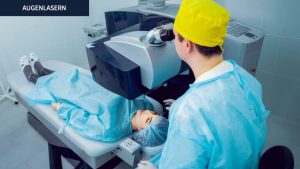
Laser eye treatment is a modern method of permanently correcting defective vision. In this treatment, the shape of the cornea of the eye is changed by laser to correctly focus the light on the retina. There are various procedures of laser eye treatment, including LASIK, Femto-LASIK, LASEK, PRK and ReLEx SMILE.
In the LASIK method, a thin corneal flap with a microkeratome or femtosecond laser is first created and folded to the side. Then the underlying cornea is removed with the excimer laser to change its shape. The flap is then folded back and serves as a natural dressing.
Femto-LASIK is a further development of LASIK in which both steps of the intervention with the laser are carried out. This procedure increases the precision and safety of the procedure.
In the LASEK and PRK procedures, the top layer of the cornea (epithelium) is removed or pushed aside before the underlying cornea is treated with the laser.
ReLEx SMILE is one of the newest methods of laser eye treatment. A small tissue disc is removed from the inner cornea and removed through a minimal incision. The procedure is particularly gentle and more stable corneal substance is retained.
All these procedures aim to change the shape of the cornea so that the light is correctly focused on the retina again, improving visual acuity. Which procedure is best for each patient depends on several factors, including the thickness of the cornea, the degree of refractive error, and the general health of the eye.
What to do next
Now that you have a comprehensive overview of the various aspects of laser eye treatment for myopia and the role of health insurance companies in covering costs, the question naturally arises: What happens next?
In any case, the first step should be a detailed consultation. Here, for example, an appointment with Doctor-medic Bányai is recommended, which can give you detailed information about the various treatment options and answer your questions about the procedure.
As part of this interview, a free preliminary examination is usually also carried out to check your individual state of health and your suitability for laser eye treatment. Various aspects are examined, such as the thickness of your cornea, your diopter values and any existing eye diseases. You are welcome to take our laser eye aptitude test online!
In addition, a cost estimate should also be obtained in this context. This gives you an overview of the expected costs of the procedure and allows you to discuss this information in advance with your health insurance company and to clarify possible questions about the assumption of costs. With ophthalmology Bányai, you can also benefit from an interest-free installment payment.
Finally, we would like to reassure you that despite the many information and considerations that laser eye treatment entails, the most important aspect should always be your health and well-being. Take the time you need, inform yourself in detail and make your decision only when you feel safe and well advised.
We wish you all the best on your way to a life without glasses or contact lenses!
FAQ’s – Laser treatment for short-sightedness – When does the health insurance company pay?
Is laser eye treatment for myopia covered by the statutory health insurance?
As a rule, laser eye treatment is not covered by the statutory health insurance companies, as it is often classified as not medically necessary. However, there are exceptions, for example in the case of incompatibility of contact lenses or very high refractive error. The exact assessment always depends on the individual case.
Does private health insurance cover the cost of laser eye treatment?
Whether and to what extent private health insurance covers the costs of laser eye treatment depends on the individual terms of the contract. As a rule, the benefits provided by private health insurers are more extensive, so that under certain conditions it may be possible to cover the costs.
What factors influence the assumption of costs by the health insurance company?
Various factors play a role in assessing the assumption of costs. These include, in particular, the medical necessity of the treatment, the degree of refractive error (measured in diopters), but also pressure points on the nose, dizziness or incompatibility of contact lenses are important.
What should I do if I am considering laser eye treatment?
The first step should always be a detailed consultation, for example with Doctor-medic Bányai. You can clarify all your questions about the procedure and have a free preliminary examination. In addition, you should obtain a cost estimate and discuss it in advance with your health insurance company.
How safe is laser eye treatment?
Laser eye treatments are usually very safe and most patients are very satisfied with the results. However, as with any surgical procedure, there are also risks that you should be informed about in a detailed consultation. Choosing an experienced doctor and a reputable center can help minimize the risks.