
Laser eye methods 2026: The latest procedures in laser eye surgery

Different methods of laser eye surgery are very popular. Do you also suffer from refractive errors and would like to do without glasses and contact lenses? Laser eye treatment can permanently improve defective vision such as farsightedness, nearsightedness and corneal curvature.
In our specialized laser eye centers in Stuttgart and Karlsruhe, we will advise you individually and find the right procedure together with you – for a life with more freedom of vision.
Evaluations show that around 90% of patients no longer need additional aids after the procedure. The risks of such an intervention are minimal. It is painless and has been tried and tested for years.
There are also various methods for laser eye surgery that can be used to achieve good results. Read here which laser eye methods are available from ophthalmologists in Germany and for whom they are suitable – including some of the latest laser eye procedures. In addition, we explain alternatives to laser surgery in the event of unsuitability.
What vision defects can be treated with an eye laser procedure?
Farsightedness (hyperopia), nearsightedness (myopia) and corneal curvature (astigmatism) can be lasered without problems with different laser eye procedures. By adjusting the refractive power of the eye, clear vision and unimagined visual acuity are possible.
For the treatment of visual defects and eye diseases (e.g. cataracts), different methods of eye laser or eye surgery are available. Which method is used depends on the severity of the visual defect and the conditions of the corneal tissue – in particular on the thickness of the cornea.
These eye laser methods are available
Depending on the patient, different methods of eye laser are available. Some of the most important laser eye techniques are:
SMILE® PRO
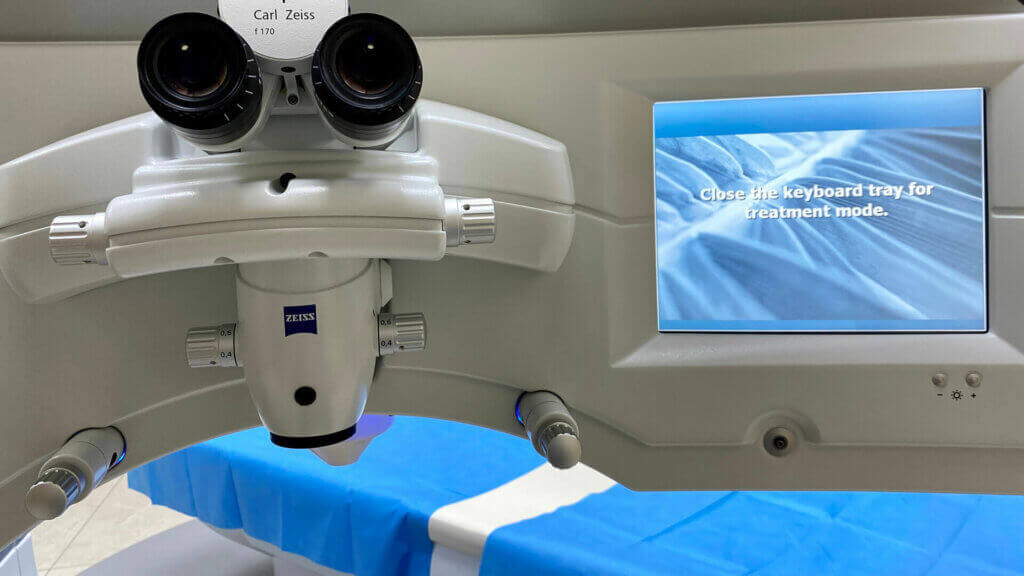
SMILE® PRO is the latest and most modern eye laser method and represents a gentler method of eye laser. SMILE® PRO is made up of Small Incision Lenticule Extraction; the state-of-the-art VisuMax ® 800 from the German company Zeiss is used for this laser procedure.
SMILE® PRO does not create and fold away a flap in the top layer of the cornea. There is only a minimally invasive incision at the edge of the cornea, which takes about 10 seconds.
Here, only the femtosecond laser is used and as little intervention as possible is made in the cornea. The surgeon removes a predetermined area in the underlying tissue (the lenticle) and removes it through the previously made incision. This also results in a rapid healing process after the procedure. The procedure is also suitable for patients with dry eyes, severe visual defects and thin corneas.
As with all other procedures, a detailed preliminary examination will determine whether this laser procedure is suitable for you in order to improve your vision.
SMILE® PER cost: 2900€ per eye.
Femto LASIK
The femto-LASIK method (LASIK: laser in situ keratomileusis) has been successfully used for years to correct defective vision. In this eye laser surgery, a femtosecond laser prepares the corneal cover, also called a flap, before the actual procedure takes place. An excimer laser is then used to correct the visual impairment. With Femto-LASIK, you can have your long-sightedness lasered.
Which is better: the LASIK or Femto-LASIK method?
The femto-LASIK method is a further development of the LASIK method. The difference between LASIK and Femto-LASIK is that in conventional LASIK, the corneal lid (flap) is created with an ultra-sharp computer-controlled precision blade instead of a 2nd laser.
In the Femto-LASIK method, a femtosecond laser is used to produce the flap. Thus, only a thin or the uppermost layer of the cornea is separated and the procedure is safer.
The cornea is not damaged. In addition, the procedure is painless and less traumatic for the tissue in the procedure. This method can be used for both nearsightedness and farsightedness as well as for corneal curvature. However, there are limit values for the diopters.
- Short-sightedness: Up to – 10 diopters
- Farsightedness: Up to + 4 diopters
- Corneal curvature: – 5 diopters
PRESBYOND®
The PRESBYOND®method is especially suitable for patients with presbyopia. It is a further development of monovision. The loss of elasticity of the natural eye lens is the reason for the development of presbyopia. This can be effectively treated with PRESBYOND ®.
In order for the eyes to work better together, the dominant eye is set to farsightedness and the other to near vision.
The brain then assembles the stimuli harmoniously into an image. The area where farsightedness and near vision converge is called the “blend zone”. Thus, it is also possible to see clearly in this area (intermediate area).
Topography-controlled LASIK
The topography-controlled LASIK method offers more possibilities for individualization. By means of topography, the surgeon receives data on the individual structure of the eye. This allows the surgeon to perform an individually adapted laser operation. The topography-controlled LASIK method is particularly suitable for people with corneal curvature.
The excimer laser changes the shape of the cornea and thus leads to an improvement in vision. 22,000 points on the cornea are measured and result in a detailed map of the cornea.
This reduces the risk of side effects of the procedure. As a rule, topography-controlled LASIK does not last longer than 15 minutes.
Advanced PRK & LASEK
Advanced PRK and LASEK is a further development of the PRK/LASEK method. In the course of photorefractive keratectomy (PRK for short), only a superficial ablation of the cornea takes place with the excimer laser. Compared to Femto-LASIK and SMILE® Pro, the regeneration time is longer.
After preparation, the excimer laser/LASEK laser removes the unevenness of the cornea. This can have a positive effect on their refractive power. The removed top layer grows back after 3 to 5 days.
After a week, symptoms such as foreign body sensation and watery eyes subside. Schedule at least one week of post-treatment leave. Noticeable improvements in vision appear after about three months. Then you can see just as well as after a SMILE® Pro or Femto-LASIK.
Can be used with:
- Short-sightedness: up to max. -8 diopters
- Farsightedness: up to max. 3 – 4 diopters
- Corneal curvature: 3 – 4 diopters
Monovision
Monovision using SMILE® Pro is another way to improve presbyopia. As a rule, the dominant eye is adjusted for distance vision and the non-dominant eye for near vision. The existing myopia of the non-dominant eye is only slightly improved, the dominant eye is adjusted to normal vision.
The eyes then provide the brain with two different images. It takes a while for the brain to put these together properly. After the treatment, however, glasses are usually no longer needed. Did you know? The poet Goethe was already born with this view, which is why it is also called Goethe’s view.
Lens implants as an eye laser alternative
A severe refractive error and thin cornea are reasons why in some cases no eye laser method can be used. Thanks to alternatives to eye lasers, however, this does not mean that only glasses or contact lenses are suitable for you.
Refractive surgery also offers the possibility of implanting lenses (ICL-OP). The intraocular lens is a good alternative to the eye laser: an artificial lens is used for this, which allows the patient to see normally again. Read more about eye.
FAQs
What is the best method for laser eye surgery?
The best method for laser eye surgery always depends on your personal requirements, such as your corneal thickness or the nature and severity of your refractive error or eye disease. In general, however, it can be said that – where applicable – the SMILE® pro method is one of the most modern eye laser procedures.
What is the PRK method?
PRK (Photorefractive Keratectomy) is an eye laser method for correcting refractive errors such as nearsightedness, farsightedness and astigmatism. This involves removing the top layer of the cornea and reshaping the underlying layer with an excimer laser to improve visual acuity. This method is particularly suitable for patients with thin corneas, as no corneal flap is created.
What types of laser eye surgery are there?
Current eye laser methods include, but are not limited to:
- Advanced PRK & LASEK
- SMILE® PRO
- PRESBYOND®
- Femto-LASIK
- Topography-controlled LASIK treatment
How should one behave after laser eye surgery?
Depending on the laser eye method, it is important to adhere to different behavioral recommendations after laser eye surgery. These will be discussed with your ophthalmologist and may include measures such as taking eye drops, wearing sunglasses or avoiding physical exertion. Such measures should help to promote an optimal healing process and prevent complications or the need for post-correction.