
Laser eye methods at a glance
SMILE® Pro, Femto-LASIK, PRK/LASEK, PRESBYOND® or ICL: which eye laser method fits depends on refractive error, cornea, age and your individual requirements. Bányai Neue Augen advises in Stuttgart and Karlsruhe after a thorough investigation.
State-of-the-art eye laser methods in comparison
Eye lasers correct nearsightedness, farsightedness, corneal curvature and presbyopia with modern procedures such as SMILE® Pro, Femto-LASIK, PRK & LASEK or PRESBYOND®. The cost of laser eye surgery varies between €990 and over €3,000 per eye, depending on the procedure. Bányai Neue Augen offers refractive surgery at the highest level in Stuttgart and Karlsruhe.
Smile PRO®
from €2,900 from €100/ month*
Smile Pro®‘s advanced, minimally invasive technology provides a life-changing solution in under 10 seconds! NEW: Smile PRO® Hyperop for farsightedness.
- Short-sightedness up to approx. -10 dpt
- Farsightedness up to approx. 6 dpt
- Corneal curvature up to approx. 5 dpt
- minimal impact on the cornea
Femto LASIK
from €2,200 from €71/ month*
The Femto LASIK procedure uses modern laser technology to precisely reshape your cornea and restore clear vision.
- Short-sightedness up to approx. -8 dpt
- Farsightedness up to approx. +4 dpt
- Corneal curvature up to approx. 5 dpt
PRK & LASEK
from €990 from €21/ month* (up to 1 dpt)
The A-PRK (Advanced Photorefractive Keratectomy) and LASEK (Laser Epithelial Keratomileusis) are suitable alternatives for people with a thin cornea. Costs from 1 dpt: from €1,400 per eye.
- Short-sightedness up to approx. -6 dpt
- Farsightedness up to approx. +2 dpt
- Corneal curvature up to +4 dpt
Presbyond®
from €3,150 from €111/ month*
Presbyond® corrects presbyopia by specifically adjusting the eyes for near and distance vision – clear vision without intermediate zones.
- for presbyopia – suitable from age 40
- only a 15-minute procedure per eye
- one of the gentlest treatment methods
* All prices include VAT and are per eye.

SMILE® Pro
The advanced, non-invasive technology of SMILE® pro (Small Incision Lenticule Extraction) is the further development of ReLEx SMILE and is considered one of the gentlest interventions in refractive surgery and offers a solution that makes everyday life easier in less than 10 seconds of laser time per eye. The state-of-the-art VisuMax ® 800 from the German company Zeiss is used for this laser procedure. Over a tiny incision of only 2 to 3 millimeters, a thin corneal lens disc – the so-called lenticle – is removed to change the refractive power of the eye.
Now new: SMILE® Pro Hyperop also for farsightedness.
- Short-sightedness up to approx. -10 dpt
- Farsightedness up to approx. 6 dpt (hyperopia)
- Corneal curvature up to approx. 5 dpt
- minimal stress on the cornea
Femto-LASIK
Femto-LASIK, short for laser in situ keratomileusis, has been considered the gold standard of refractive surgery for many years and is the most frequently performed eye laser procedure worldwide.
In the past, a mechanical microkeratome was often used to generate the corneal flap – also called the corneal lamella. Modern centres like ours at Bányai Neue Augen now rely exclusively on the precise femtosecond laser. An excimer laser then models the underlying corneal tissue according to the individual’s visual acuity and defective vision before the flap is folded back and adheres on its own.
- Short-sightedness up to approx. -8 dpt
- Farsightedness up to approx. +4 dpt
- Corneal curvature up to approx. 5 dpt
Topography-controlled LASIK
In topography-controlled LASIK, the individual shape of the cornea is measured in particular detail. Based on this data, the laser treatment can be adapted to the personal cornea. The method can be tested in particular for irregular corneal shapes or a corneal curvature. Whether this method is suitable will be determined during the preliminary examination.


PRK & LASEK
PRK (photorefractive keratectomy) and LASEK (laser epithelial keratomileusis) are among the surface procedures that work without a flap. The epithelium is first removed or pushed aside manually before the laser correction takes place.
Since there is no flap, these procedures are considered particularly stable in the long term – for example, for people with an increased risk of injury to the eyes, for example in contact sports. The disadvantage: the regeneration of the epithelium takes more time. In this phase, you will receive individually tailored eye drops; a temporary foreign body sensation is normal in the first few days.
- Short-sightedness up to approx. -6 dpt
- Farsightedness up to approx. +2 dpt
- Corneal curvature up to approx. +4 dpt
PRESBYOND®
From about the age of 45, most people notice presbyopia, also known as presbyopia. There are also specialised laser procedures for this.
PRESBYOND® blended vision combines the proven Femto-LASIK technology with a special adjustment of the refractive power: one eye is primarily corrected for distance, the other primarily for proximity, while both eyes are additionally tuned to the intermediate distances. In the following weeks, the brain learns to generate a composite, sharp overall picture from both visual impressions.
- for presbyopia – suitable from 40 years
- only 15 minutes of surgery per eye
- one of the gentlest treatment methods


ICL Lens Implants
ICL stands for “Implantable Collamer Lens”. In this procedure, an individually calculated lens is inserted into the eye in addition to the natural eye lens. The cornea is not removed. ICL can be considered in particular for higher refractive errors or if laser treatment is not suitable due to the cornea or other prerequisites.
In the case of eye diseases such as cataracts (cataracts) or glaucoma (cataracts), a lens procedure is often in the foreground instead of laser correction; in some cases, multifocal lenses are also used, with which reading glasses can also be dispensed with in most cases.
- can also be tested as an alternative for higher refractive errors
- no removal of corneal tissue and no flap
- individually calculated lens that can be removed in principle
Laser eye methods and procedures in direct comparison
| Method | Suitability | Healing | Procedure | Risks |
|---|---|---|---|---|
| SMILE® Pro | Especially myopia and astigmatism; suitability depends on the examination | Everyday life often after a few days; individually different | Small cut, no flap | Dry eyes, glare, residual correction possible |
| Femto-LASIK | Nearsightedness, farsightedness and astigmatism in the area examined | Often rapid visual improvement; individually different | Established procedure, rapid rehabilitation | Flap-related risks, dry eyes, glare |
| PRK | Selected refractive errors, even if a flap does not make sense | Epithelial healing over several days; visual acuity stabilizes later | No flap, suitable for certain corneal profiles | Stronger symptoms in the early phase, slower rehabilitation |
| LASEK | Selected refractive errors and individual corneal profiles | Several days to weeks; individually different | No flap | Pain, delayed healing, glare sensitivity possible |
| PRESBYOND® | Presbyopia in suitable patients | Adjustment of the brain possible over several weeks | Can combine near and far vision | Not suitable for everyone; contrast, glare and visual quality must be weighed |
| ICL | Higher refractive errors or if laser treatment is not suitable | Depends on course and aftercare | Cornea is not removed; lens can be removed in principle | Intraocular surgery with own risks; thorough examination required |
The table serves as a first orientation. Dioptric limits, suitability and healing process are not a blanket commitment. The final method is only determined after examination of the cornea (including corneal thickness), tear film, eye surface and retina.
“There is no one ‘best’ method – there is the best method for your eyes. That is precisely why we start every treatment with a thorough preliminary examination, in which we take into account corneal thickness, diopter values and your individual circumstances.”
– Doctor-medic Liliana Bányai

Costs and financing for laser eye surgery
The cost of laser eye surgery depends on the chosen procedure and the individual requirements. At Bányai Neue Augen, prices currently start at €990 per eye for PRK & LASEK, €2,200 per eye for femto-LASIK, €2,900 per eye for SMILE® Pro and €3,150 per eye for PRESBYOND®. The specific costs are determined after the preliminary examination and individual consultation.
Funding in monthly installments is possible. The amount of the installment depends on the chosen procedure, the total amount and the agreed term. You can find out about the current financing conditions in a personal consultation.
Does the health insurance cover the costs?
The cost of laser eye treatment is usually not covered by the statutory health insurance companies, as it is usually an individual health service. In the case of private health insurance or supplementary insurance, a partial assumption of costs may be possible depending on the contract. Please clarify the reimbursement directly with your insurance company before the treatment.
Which method fits which refractive error?
In addition to the method itself, the specific initial situation is decisive for many patients. Here is an overview of which procedures are typically considered in the case of which refractive error:
Short-sightedness (myopia)
The most common initial situation for laser eye treatment. Depending on the diopter value and corneal condition, several procedures are possible:
- SMILE® pro: minimally invasive, usually very fast recovery
- Femto-LASIK: also very fast vision improvement, larger diopter range
- PRK & LASEK: Alternative for thinner corneas or contact sports
Long-sightedness (hyperopia)
Even with farsightedness, different procedures are possible depending on the diopter value and corneal condition:
- Femto-LASIK: established procedure for the correction of farsightedness
- PRK & LASEK: Alternative for certain corneal profiles
- SMILE® Pro: possible under suitable conditions even with farsightedness
Corneal curvature (astigmatism)
Today, a corneal curvature can also be easily corrected with modern procedures, often in combination with existing nearsightedness or farsightedness:
- Femto-LASIK: versatile, covers a wide range
- SMILE® Pro: suitable for certain conditions
- PRK & LASEK: Alternative for special corneal findings
Presbyopia
From about the age of 45, the focus is usually no longer on classic laser correction, but on a specialised procedure:
- PRESBYOND®: Combines near and remote correction with extended depth of field
- Refractive lens replacement: especially useful with additional lens opacity
Which procedure is actually best suited for you can only be reliably assessed after a thorough preliminary examination (the so-called “initial check”).
Determination of the appropriate method
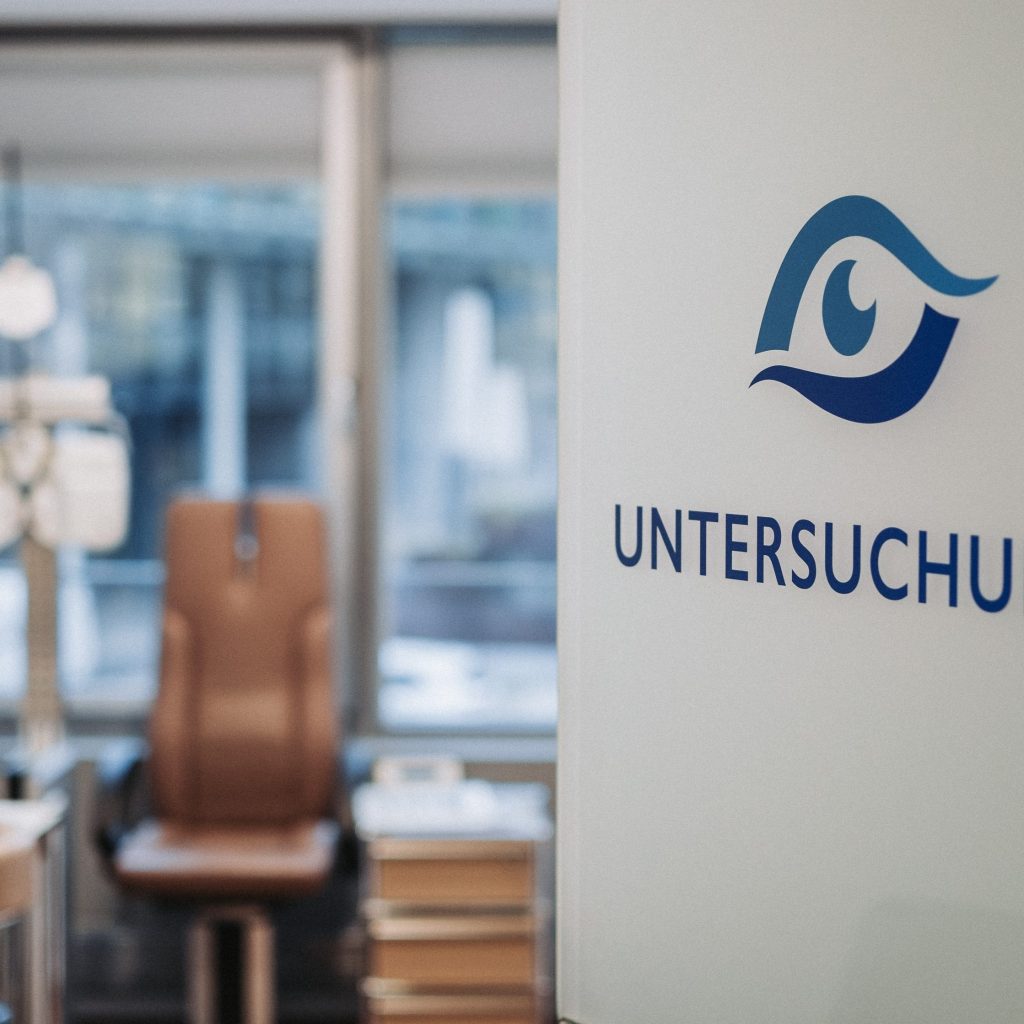
Choosing the right procedure is not a free decision based solely on personal preference, but the result of a comprehensive preliminary examination. The following factors, among others, are included in the recommendation:
- Corneal thickness (measured by pachymetry)
- Corneal topography (to detect irregularities)
- Diopter values and type of refractive error
- Tear film quality and dry eye tendency
- Lifestyle and professional requirements (e.g. contact sports, screen work)
“Some patients are basically suitable for several procedures and can then make co-decisions taking into account their lifestyle. Others are only suitable for a certain method from the outset due to their individual corneal anatomy, “explains Doctor-medic Liliana-Iulia Bányai.
Laser eye aptitude test
Want to get rid of your glasses or contact lenses? Laser eye treatment frees you from your vision aids in the long term. However, not all refractive errors can also be lasered. We will help you find out whether your refractive error can be corrected with a laser.
With the help of the laser eye aptitude test, you can find out within 2 minutes whether you are suitable for laser eye treatment.
Start the online test now!
Request a no-obligation consultation now.
The idea of eye surgery can be intimidating. We do everything we can to make you feel well cared for.
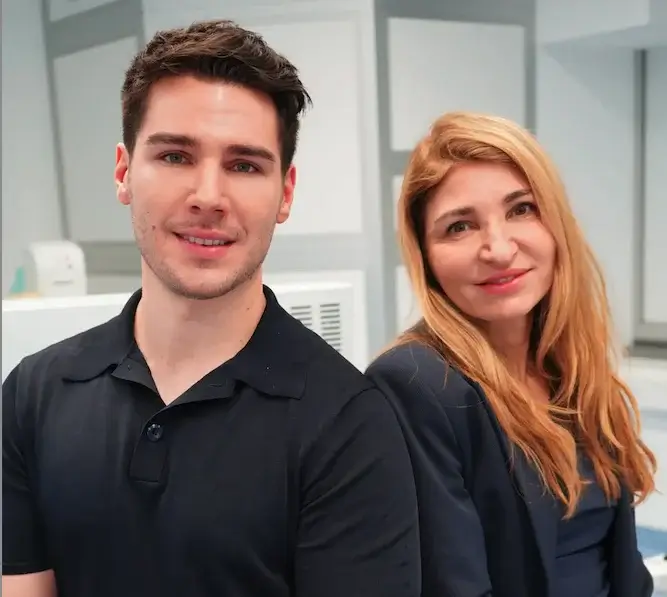
Reviewed by Doctor-medic Liliana-Iulia Bányai
With over 50,000 successful surgical procedures, the experienced team at Bányai Neue Augen specializes in eye surgery. Thanks to ongoing professional development and training, you can be confident you are in exceptionally competent hands.
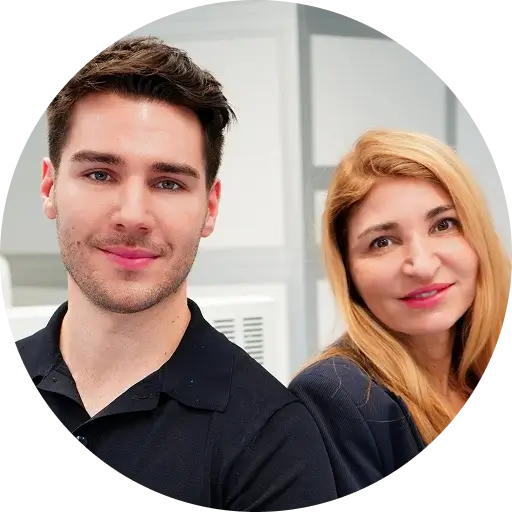
Doctor-medic Liliana-Iulia Bányai & Dr. med. Daniel Bányai

More about laser eye surgery
-

Stye Home Remedies: 10 Natural Tips for Relief – Bányai Augenheilkunde
Everyone knows it, everyone hates it: the stye. Those small, stubborn, painful bumps on the eyelid. Styes can often be treated effectively with simple home remedies. In this article, I’ll introduce 10 natural home remedies and tips to help with styes.
-

Stye (Hordeolum), what now?
A stye (hordeolum) is an unpleasant inflammation on the eyelid. Learn all about the causes, symptoms, treatment and why you should never express a grain of stye!
-
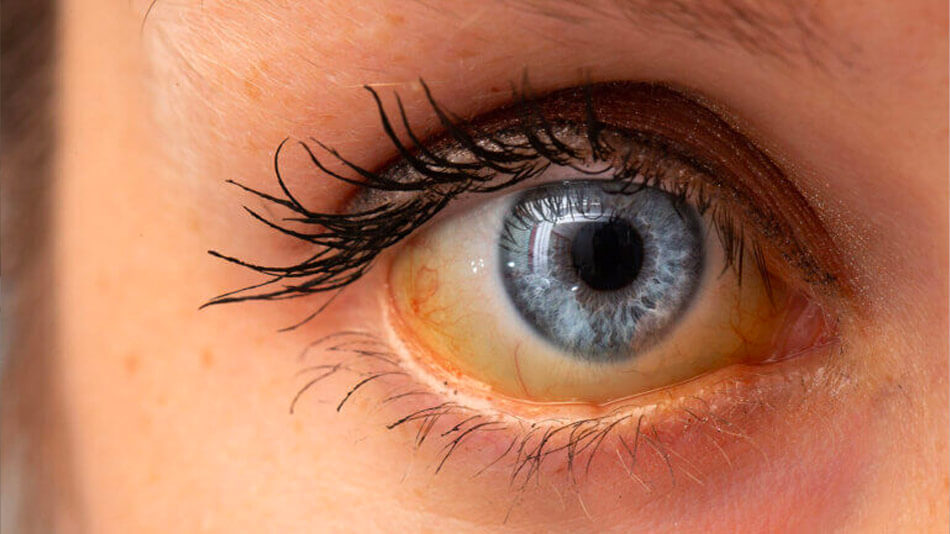
Yellow Eyes: Causes and What They Reveal About Your Health
Yellowing of the eyes can have different causes. Certain medications, a number of medical conditions, and in most cases yellow eyes are due to jaundice. Learn more about this in the following post!
Frequently asked questions (FAQs) about laser eye methods
There is no generally “best” method in ophthalmology – each method has specific strengths. SMILE® Pro is one of the latest eye laser techniques and convinces with a small cut without a large flap. Femto-LASIK offers quick rehabilitation, while PRK & LASEK can offer benefits for thinner corneas. The individually appropriate method will be determined as part of the preliminary examination.
You are not allowed to drive yourself immediately after the treatment. Only when the necessary visual acuity has been achieved and the attending ophthalmologist has confirmed the fitness to drive is driving allowed again. Decisive is the individual follow-up, not a flat-rate period.
With SMILE® Pro, a corneal lens disc is removed through a very small incision without creating a larger flap. In Femto-LASIK, on the other hand, a corneal flap is generated, raised and folded back after the laser treatment.
In classic LASIK, the corneal flap is created with a mechanical microkeratome. In Femto-LASIK, a femtosecond laser takes over this step. An excimer laser then forms the underlying corneal tissue. Which variant is suitable depends on the individual cornea and the preliminary examination.
Regardless of the chosen procedure, eye laser surgery is one of the best studied procedures in refractive surgery today. Studies put the rate of severe complications at less than 0.3 percent across all modern methods, while over 99.5 percent of patients achieve visual acuity of 0.8 or better.
An important quality feature in the choice of your treatment centre is the certification by the Commission for Refractive Surgery (KRC) – the joint specialist commission of the German Ophthalmological Society (dog) and the Professional Association of Ophthalmologists in Germany (BVA), which defines nationwide quality standards for all refractive procedures.
To the question “Does eye lasers hurt?” there is a clear answer: No. As a rule, laser eye surgery is painless. You will be given special eye drops before the operation. The operation itself often takes only a few minutes, depending on the treatment, and proceeds without pain.
Even if it is repeatedly promised that laser eye treatment will help to achieve lifelong clear vision, this does not have to be true in every case. Although it is rather the exception that repeated refractive error occurs, and in most cases, laser eye corrections also last a lifetime. Nevertheless, despite the treatment, it is not excluded that you will later develop presbyopia and need reading glasses or a cataract will impair your vision.
There are also a few disadvantages with laser eye surgery: there are certain risks, as is common with any surgery; after treatment, side effects such as eye itching may occur temporarily (you will be advised in detail for follow-up care); and health insurance or insurance may not cover the costs.
In the case of thin or irregular corneas, a surface procedure such as PRK, LASEK or Trans-PRK can be tested as part of refractive surgery. In addition to the thickness of the cornea, the shape of the cornea and the height of the dioptres are also decisive. In some cases, an ICL may be an alternative to laser eye treatment. The decision is made after the preliminary examination and the applicable recommendations of the KRC.
All three procedures are forms of refractive eye surgery and work without a corneal flap. In PRK, the epithelium is removed and the cornea corrected with the excimer laser. In LASEK, the epithelium is pushed to the side. In the case of Trans-PRK, processing is carried out without contact with the laser. A temporary foreign body sensation and a longer healing time are possible with surface procedures. Bányai Neue Augen offers PRK & LASEK, Trans-PRK is not carried out.
There is no generally best eye laser method. Which treatment is suitable depends, among other things, on the defective vision, the diopter values, the thickness and shape of the cornea, the tear film, the age and the individual requirements. SMILE® Pro can be considered for suitable nearsightedness or corneal curvature, Femto-LASIK offers a wide range of applications and rapid rehabilitation. PRK & LASEK may be an alternative for certain corneal profiles, while PRESBYOND ® is aimed at correcting presbyopia. For higher refractive errors or if laser treatment is not suitable, a lens procedure such as ICL can also be tested. Which method is actually suitable for you can only be assessed after a thorough preliminary examination.
You are not allowed to drive yourself immediately after the treatment. Only when the necessary visual acuity has been achieved and the attending ophthalmologist has confirmed the fitness to drive is driving allowed again. Decisive is the individual follow-up, not a flat-rate period.
The costs depend on the procedure and the individual findings. At Bányai Neue Augen, they currently start at €990 per eye for PRK & LASEK and range up to €3,150 per eye for PRESBYOND ®, depending on the method. Funding in monthly installments is possible. You can find out the current conditions in the consultation.
As a rule, the costs of laser eye treatment are not covered by the statutory health insurance companies. Partial reimbursement of costs may be possible with private health insurance or supplementary insurance. Please clarify the reimbursement directly with your insurance company before the treatment.