Yellow Eyes: Causes and What They Reveal About Your Health

Your eye whites suddenly appear yellow? As an ophthalmologist, I, Dr. med. Daniel Bányai, possible causes and the necessary examinations. Seek urgent medical attention for new yellow eyes or yellow skin as recommended by the NHS 1.
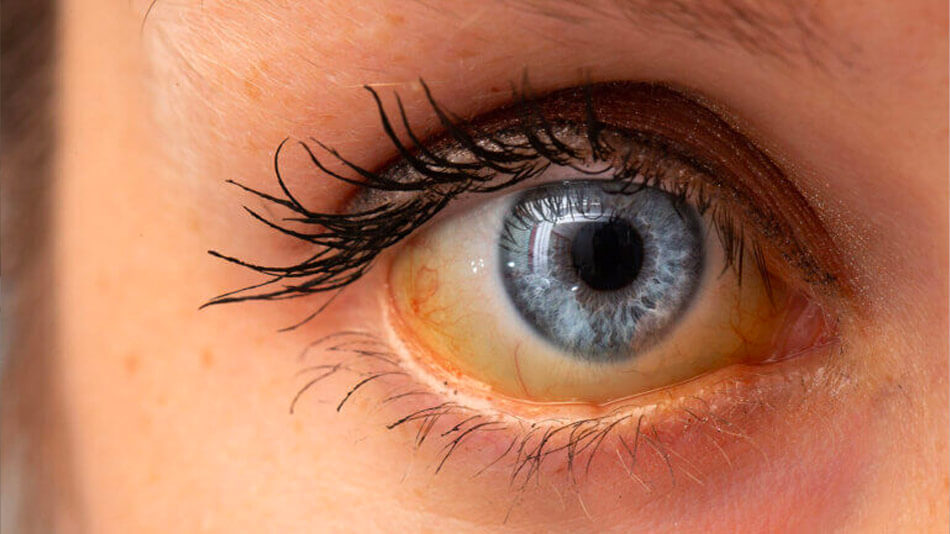
Yellow eyes (sclerenicterus2) are caused by an increased level of bilirubin in the blood. The yellowing of the whites of the eyes is a sign of jaundice (jaundice). Possible causes lie in the liver, the bile ducts or in the blood. Gilbert’s syndrome3, called Meulengracht disease, can also be behind this.
In jaundice, the blood concentration of the pigment bilirubin is increased. This is a yellowish-brown bile dye that is produced during the breakdown of red blood cells.
If the body does not excrete it sufficiently, it deposits in the tissue. As a result, the skin, mucous membrane and especially the whites of the eye can turn yellowish. Yellowing of the skin, light stools and dark-coloured urine may be added.
Jaundice is common in newborns. Have a yellow coloration assessed by a doctor, especially in the first 24 hours of life.
Causes of yellow eyes
The dermis of the eye (sclera) usually appears white. A new or increasing eye discoloration should be clarified by a doctor.
Yellowing of the whites of the eyes is referred to in medicine as scleral jaundice.
Jaundice itself is not a disease, but a symptom. It can indicate malfunctions of the liver, liver diseases or disorders of the gallbladder and bile ducts. That’s why you shouldn’t ignore them.
Yellow eyes can occur at any stage of life. The causes and frequencies differ in the individual age groups.
Possible causes of jaundice in older children or adults include:
- Inflammation of the liver: Hepatitis, also called liver inflammation, can be caused by an infection.
- Autoimmune diseases: In autoimmune hepatitis4, the immune system attacks the liver and causes inflammation.
- Bile: Gallstones can block the bile ducts and interfere with drainage. This is called obstructive jaundice.
- Liver cirrhosis: The tissue of the liver changes and restricts organ function. Excessive alcohol consumption can cause liver damage. A fatty liver5 often remains without discomfort and does not automatically explain yellow whites of the eyes.
- Other causes include inflammation of the pancreas or certain blood diseases. Malaria, certain cancers or rare genetic defects are also possible. Blood disorders include hemolytic anemia6. Red blood cells break down prematurely, which can produce more bilirubin. A tumour can obstruct the outflow of bile. Liver cancer7 is also a possible cause.
The diseases mentioned are not recognizable on the basis of yellow eyes alone.
How liver and bile process bilirubin
The liver processes bilirubin so that the body can excrete it. This is a degradation product of the red blood pigment hemoglobin. Liver cells process it and deliver it to the bile.
The pigment is removed via the bile. The gallbladder stores some of it; eventually, the fluid enters the intestine. This is how bilirubin leaves the body.
If the liver is not working properly or if the outflow is disturbed, the bilirubin concentration in the blood may increase. This can lead to discoloured skin and yellow eyes. Impaired liver function is only one possible explanation.
Looking at the eye shows the discoloration, but not its trigger. Only the medical examination and blood values2 help to distinguish the possible causes.
Yellow eyes in newborns: When medical attention is needed
Jaundice is common in newborns. After birth, babies’ bodies break down red blood cells, producing bilirubin.
Babies’ livers often do not fully process the pigment at first. The concentration increases and the excess bilirubin is deposited in the tissue.
Jaundice in newborns is often temporary. Nevertheless, have a yellowing of the eyes and skin assessed by a doctor. If it occurs in the first 24 hours of life, you need urgent medical help with your baby. Nice guideline8 requires that the bilirubin level be measured quickly and that your baby be examined by a doctor. Even after the first day of life, a quick measurement is necessary. The color alone does not show you how high the value is.
Yellow eyes: examinations and treatment
The treatment of yellow eyes depends on the underlying condition. The discoloration itself is an indication of a deeper cause.
Your doctor’s office will ask about your medical history (anamnesis) and perform a physical examination. With blood tests, she measures the bilirubin values and checks further liver values. Depending on the findings, an ultrasound examination may follow to examine the liver, gallbladder and bile ducts.
Other side effects such as light stools and dark urine, fatigue, fever or sudden weight loss help clarify the situation. Depending on the cause, abdominal pain, nausea or itching may also occur. The findings help your doctor to determine the appropriate therapy.
Also name any medications you are taking. Paracetamol can damage the liver if overdosed. Certain antibiotics are also possible triggers.9 Do not change your medication on your own. Discuss the intake with your doctor’s office.
Corresponding options are:
- According to CDC10, there is no targeted treatment for hepatitis A against the virus. Treatment relieves discomfort.
- In the case of hepatitis C, drugs are used that act directly against the virus 11. The selection is based on your findings.
- Abstain from alcohol if it is the cause of the liver damage. If a medication damages your liver, your doctor’s office will decide on a change in treatment.
- For confirmed biliary tract problems, an ERCP12 can help, for example, to remove a stone. The examination combines a reflection with X-ray images. It has more risks than ultrasound and is not a routine test.
Whether the discoloration decreases and liver function improves depends on the cause and treatment.
Depending on the disease, surgery may also be necessary, for example to open a blocked bile drain.
Yellow eyes – do I need to see an ophthalmologist?
Not exclusively. An ophthalmological examination alone is not sufficient for new yellow whites of the eyes. If the dermis in the eye turns yellow, this may indicate a disease of the liver or bile ducts.
Have a new change in eye colour clarified urgently by a doctor, for example in a family doctor’s or internal medicine practice. An ophthalmological examination can supplement, but does not replace the general clarification of possible causes.
In this way, your doctor’s office can initiate appropriate therapy at an early stage and treat the underlying disease. In case of severe abdominal pain, confusion or signs of gastrointestinal bleeding, you should seek medical help immediately. The MSD Manual2 calls these accompanying signs particularly worrying.
For the doctor’s consultation: four details that you can have ready. They are based on the anamnesis in MSD Manual2.
- Beginning and course: Since when do you notice the discoloration? Has it increased?
- Eyes, skin, excreta: Is your skin also yellowish? Has urine or stool changed?
- Other complaints: Name abdominal pain, fever or itching. In case of pain, also describe the location, strength and duration.
- Medication: Have names, dosages and start of use of your medication ready. Also mention over-the-counter and herbal preparations.
This information does not replace an investigation. In case of warning signs, do not wait until your notes are complete.
I work as an ophthalmologist at Bányai Neue Augen. My further education led me to the Eye Clinic of the University of Ulm (2021–2022). Subsequently, I was in further training at the Charité Berlin (2022–2023).
For general eye problems, the Bányai ophthalmology team looks after you at six practice locations. These include Ditzingen, Weil der Stadt, Böblingen, Leonberg, Stuttgart-Feuerbach and Stuttgart-Mitte. Eye care does not replace the clarification of jaundice in your general practitioner or internal medicine practice. Do not wait for a practice appointment in case of warning signs.
Frequently Asked Questions about Yellow Eyes
Yellowish discoloration can have different causes. Often there is inflammation of the liver or a disturbance of the bile outflow behind it. Damage from alcohol can also cause yellow eyes. A too rapid breakdown of red blood cells is also possible. A safe classification is only possible through a medical examination.
A localized yellowish spot may have causes other than a general yellowing of the whites of the eyes. In the event of a new or increasing change, you should have it assessed by a doctor.
No, a yellowish change is not automatically an indication of a specific disease. The extent, course and possible accompanying symptoms are decisive. In Meulengracht’s disease, the liver breaks down bilirubin more slowly. Yellowish eyes can occur without further discomfort. In the case of new discoloration, you should not assume this syndrome as the cause yourself.
Have new or increasing yellow eyes examined by a doctor as a matter of urgency, even without further discomfort. Also mention pain, visual disturbances or yellowish skin at the same time. In newborns, such discoloration is particularly urgent in the first 24 hours of life. Severe abdominal pain, confusion or signs of gastrointestinal bleeding require immediate medical attention.
References
1 NHS. Jaundice [Jaundice] [Internet]. NHS; 2018 Jan 30 [updated 2024 Jan 22; cited 2026 Oct 6]. Available at: https://www.nhs.uk/conditions/jaundice/. Language: English
2 Jaundice [jaundice] [Internet]. MSD Manual Professional Edition; [updated 2025 Aug; cited 2026 Oct 6]. Available at: https://www.msdmanuals.com/professional/hepatic-and-biliary-disorders/approach-to-the-patient-with-liver-disease/jaundice. Language: English
3 ICD code E80.4: Gilbert-Meulengracht syndrome [Internet]. gesund.bund.de; [cited 2026 Oct 6]. Available at: https://gesund.bund.de/icd-code-suche/e80-4
4 National Institute of Diabetes and Digestive and Kidney Diseases. Autoimmune hepatitis [Autoimmune hepatitis] [Internet]. NIDDK; [updated 2023 Mar; cited 2026 Oct 6]. Available at: https://www.niddk.nih.gov/health-information/liver-disease/autoimmune-hepatitis. Language: English
5 National Institute of Diabetes and Digestive and Kidney Diseases. Symptoms & causes of NAFLD & NASH [Symptoms and causes of NAFLD and NASH] [Internet]. NIDDK; [updated 2021 Apr; cited 2026 Oct 6]. Available at: https://www.niddk.nih.gov/health-information/liver-disease/nafld-nash/symptoms-causes. Language: English
6 Overview of hemolytic anemia [Internet]. MSD Manual Professional Edition; [updated 2026 Apr; cited 2026 Oct 6]. Available at: https://www.msdmanuals.com/professional/hematology/anemias-caused-by-hemolysis/overview-of-hemolytic-anemia. Language: English
7 National Cancer Institute. What is liver cancer? [What is liver cancer?] [Internet]. NCI; [cited 2026 Oct 6]. Available at: https://www.cancer.gov/types/liver/what-is-liver-cancer. Language: English
8 NICE. Jaundice in newborn babies under 28 days: recommendations (Clinical guideline CG98) [Internet]. NICE; 2010 May 19 [updated 2023 Oct 31; cited 2026 Oct 6]. Available at: https://www.nice.org.uk/guidance/CG98/chapter/Recommendations. Language: English
9 Fontana RJ, Liou I, Reuben A, Suzuki A, Fiel MI, Lee W, et al. AASLD practice guidance on drug, herbal, and dietary supplement-induced liver injury. Hepatology. 2023 Mar;77:1036. doi:10.1002/hep.32689. PMID: 35899384. Available at: https://pmc.ncbi.nlm.nih.gov/articles/PMC9936988/. Language: English
10 CDC. Clinical care of hepatitis A [Internet]. CDC; 2024 May 15 [updated 2025 Jan 31; cited 2026 Oct 6]. Available at: https://www.cdc.gov/hepatitis-a/hcp/clinical-care/index.html. Language: English
11 CDC. Clinical care of hepatitis C [Internet]. CDC; 2024 May 15 [updated 2025 Jan 31; cited 2026 Oct 6]. Available at: https://www.cdc.gov/hepatitis-c/hcp/clinical-care/index.html. Language: English
12 National Institute of Diabetes and Digestive and Kidney Diseases. Endoscopic retrograde cholangiopancreatography (ERCP) [Internet]. NIDDK; [updated 2024 Jan; cited 2026 Oct 6]. Available at: https://www.niddk.nih.gov/health-information/diagnostic-tests/endoscopic-retrograde-cholangiopancreatography. Language: English