
Reading glasses – 10 things to keep in mind

Before deciding to buy reading glasses, many people first try to leave an incipientpresbyopia untreated.
Over time, however, this becomes increasingly difficult: the newspaper or the book must be kept further and further away from the eye. Reading normal font sizes no longer wants to succeed. Relatives or friends are already asking if it would be time forreading glasses.
These signs almost certainly indicate presbyopia – a perfectly normal process with age. And yet, you should see your ophthalmologist as soon as you notice a change in yourvision.
Thus, on the one hand, serious eye diseases can be ruled out and, on the other hand, treatment options for presbyopia can be considered.
One of them is the reading glasses, which is why this post is about them. From the different types and benefits to the requirements for optical sunglasses to possible alternatives – here are 10 things you should know about reading glasses!
1. Reading glasses ≠ reading aid
Reading glasses or reading aid – is there a difference? The answer is yes! Both are visual aids that support you in yourpresbyopia. However, they differ significantly in their quality and the duration for which they are designed.
There are the following differences between reading glasses and reading aids:
Reading glasses:
- Your individual reading glasses will be made by the optician or ophthalmologist on the basis of an eye test.
- Not available in the drugstore.
Reading aid (ready-to-read glasses):
- A reading aid is an off-the-shelf product.
- Available in drugstore or online store
- No individual adjustment to your visual impairment and diopter value.
The right reading glasses for you should therefore meet certain quality standards and absolutely meet your individual needs if you want to wear them for longer. Reading aids, on the other hand, should only be used to bridge the gap. You will find out why in the next chapter.
2. The catch with cheap reading glasses?
Over time, the reading glasses should also match your own style – so it’s no wonder that many people choose a new model more often than necessary. In order to save money, the choice often falls on cheap ready-to-read glasses off the shelf. But the question arises: is such a visual aid really the best solution in the long term?
In general, you should only use such a reading aid as a second or third pair of glasses. Over-the-counter reading aids are usually single-vision lenses. If there is more than half a diopter (DPT) difference between the two eyes, they can cause a headache when reading. In addition, such a visual aid is not adapted to your individual face shape.
Even if the wearing comfort may be convincing at first, ready-to-wear glasses often lack the necessary fine-tuning by the optician. This not only ensures the right visual acuity, but also pays attention to important details such as the exact centering of the lenses.
The individual eye distance plays a decisive role in this – if this is not taken into account correctly, dizziness, nausea or general malaise can be the result.
Can I get rid of my reading glasses by laser eye surgery?
Use the laser eye aptitude test to find out whether you are suitable for laser eye treatment.
3. There are clear signs that you needreading glasses
The deterioration of vision in old age is, as already mentioned, completely normal. At the beginning, those affected notice that they see less well at close range than usual. This manifests itself, for example, when reading the newspaper or looking at your smartphone.
Especially when the symptoms are still not very pronounced, they can still be compensated for relatively well by, for example, holding the text further away from the eyes. At some point, however, the stretching of the arms is no longer sufficient to be able to see clearly.
If these signs apply to you, then you may have presbyopia and need reading glasses:
- Seeing at close range becomes much more difficult
- Fast switching between near and far vision is no longer easy
- Letters blur
- Tired eyes and headaches while reading
Do not ignore these signs and make an appointment with the ophthalmologist. From my experience as an ophthalmologist, I know that many limitations in quality of life can be prevented by early diagnosis.
4. Reading glasses from 40 are not uncommon
Presbyopia begins in most people around the age of 40. Even before that, from the age of 35, vision changes. A perfectly normal sign of aging and nothing to worry about.
We all age throughout our lives. Our eye lens is no exception to this, and so the near point (the closest possible point at which sharp vision is possible) becomes increasingly distant from adolescence. For a long time, we notice little or nothing of this.
This changes from about 40 years: From here on, the near point is often so far away that the change in everyday activities – such as reading – becomes increasingly clear. Accordingly, it is not uncommon to reach for reading glasses from about this age.
By the way – a widespread myth about presbyopia is that women are affected by it earlier and more often. This is a misconception: in fact, however, it is the case that women tend to do something about the decreasing visual impairment earlier and then often wear reading glasses.
5. Presbyopia cannot be directly prevented
Presbyopia can affect anyone. Lens hardening is a completely normal process that occurs with age, and ciliary muscles also weaken with age. Unfortunately, this process cannot be stopped or reversed.
However, what you can do is:
- Pay attention to your overall eye health: While there is little you can do about the aging process in the eye, you can help reduce the severity of symptoms. To do this, you should pay attention to your overall eye health and have other eye complaints treated to allow for better vision overall. Dry eyes, AMD or cataracts can also be prevented to a certain extent.
- Let the symptoms of presbyopia be clarified and treated: Something can be done about the symptoms of presbyopia. Have your eyes checked by the ophthalmologist to rule out serious eye diseases and to discuss the options for treating presbyopia.
6. In addition to reading glasses, there are other glasses for presbyopia
The right reading glasses differ not only in the shape of the glasses and the frame. In particular, the types of spectacle lenses can be different. For example, if you suffer from more than one visual impairment at the same time, we recommend reading glasses that compensate for these visual impairments together.
It is best to clarify which reading glasses are right for you with your ophthalmologist. As an overview, you will find below a list of possible glasses against age-related visual impairment. And by the way – it is also possible to wear contact lenses if you have presbyopia.
High-quality reading glasses from the optician vs. cheap ready-to-use reading glasses
Classic reading glasses, which are only designed for activities such as reading, are one of the so-called single vision glasses. It compensates for a single diopter range (e.g. +1.25 dpt), but is removed when viewing at a distance.
With classic glasses, high-quality reading glasses from the optician can be distinguished from those that are available at petrol stations or in drugstores, for example. These reading aids are not necessarily inferior to the reading glasses from the optician in terms of design and processing, but often in terms of accuracy of fit. Because the optician adjusts the fit and visual acuity exactly to your face and eyes to improve comfort.
Bifocal glasses & trifocal glasses with multiple prescriptions
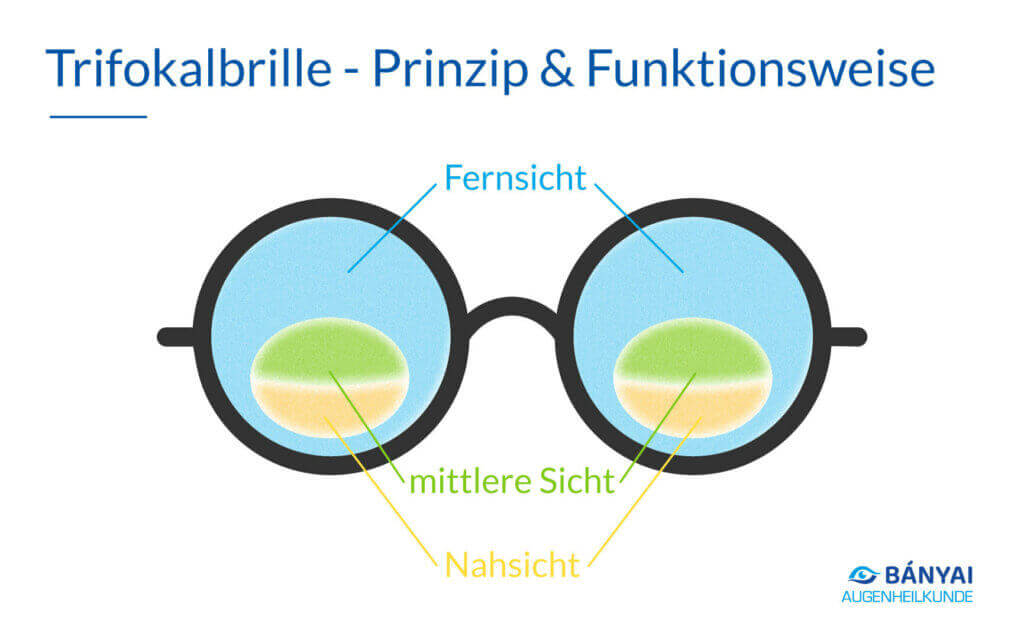
The bifocal glasses are a special shape of glasses that combine two different lens thicknesses. In the upper part of the spectacle frame is the spectacle lens, which corrects short-sightedness or farsightedness. The lower lens compensates for presbyopia. The lower part can thus also be seen as integrated reading glasses.
There are also trifocal glasses. These reading glasses also come with a third section of glass, which allows you to see clearly at medium distances. These glasses allow you to perceive all areas of vision.
As you can see from the figure, the different glass sections are clearly separated from each other.
Progressive glasses instead of classic reading glasses?
If you already suffer from several refractive errors, such as nearsightedness and presbyopia, then progressive vision glasses are a possible option for you instead of classic reading glasses.
The varifocal glasses are very similar to trifocal glasses and are also part of the multifocal glasses. It compensates for nearsightedness or farsightedness as well as presbyopia. However, the difference lies in the lens. The three areas that compensate for the refractive errors merge smoothly into each other. In other words, they provide a “sliding” view. Hence the name progressive spectacles.
Such glasses have some advantages over single vision glasses. These are:
- No annoying removing and putting on the different single vision glasses
- No “bouncing” of the images thanks to the sliding view
- The optics: the different lenses have no visible dividing line, so progressive lenses look much more discreet
However, there are also disadvantages of progressive spectacles, such as:
- If you start wearing late, you will usually only get used to the field of vision of the progressive spectacles slowly.
- Despite the large selection, the prices of progressive spectacles can be comparatively high.
- Sharp vision is less possible at the edges of the lenses (head must be moved more accordingly).
Computer glasses or screen glasses
If you spend most of your work in front of a computer, it is recommended that you think about screen glasses or computer glasses.
It has the same functions as progressive spectacles. The upper zone allows you to see clearly (two to three metres). The lower part of the lens improves your view of the keyboard and notes you have in front of you at close range.
An additional point is that the computer glasses have a large range of vision for the short and medium distances. This is the middle part of the lens and gives you a good and clear view directly on the monitor.
Tip: Progressive glasses, contact lenses or “normal” glasses can often hardly meet the requirements for long working hours in front of the computer. That is why the cost of computer glasses is very often even borne by the employer.
Sunglasses with prescription incl. UV protection
Sunglasses to enjoy life outside, for example lying in the sun with your favourite reading in your hand: for this to be possible, your prescription sunglasses should not only be tinted. It should also ensure safe UV protection.
You should pay particular attention to this when buying optical sunglasses:
- Optimal adjustment of your diopter value – best with an optician or ophthalmologist
- Protection against harmful UV-A and UV-B radiation only with guaranteed UV protection (pay attention to the CE mark)
- Let your optician advise you on the correct filter thickness and coating of thelenses!
Reading glasses with blue light filter
Blue light can be very distressing to your eye in the long run. You are especially in front of a computer or various monitors when using your smartphone or exposed to car headlights. Many modern lamps are also equipped with LEDs, which contain a very high proportion of blue in white light.
Blue light filterglasses protect you from these harmful blue components in the light. Features of blue light filter glasses are:
- slight yellowish tint (5 to 7%), which is not noticeable in everyday life
- 100% suitable for everyday use
7. The reading glasses can also be stylish
Many people see reading glasses as a visible indication of their own aging and feel uncomfortable with them. On the one hand, this does not have to be because aging – including that of the eyes – is a part of life that affects us all. And on the other hand, there have long been fashionable reading glasses that even underline your personal look.
Because the shape and colour of reading glasses are diverse. Whether Havana pattern, striking brown, noble blue or elegant black: with stylish reading glasses, hardship can be made a virtue.
8. Reading glasses should be adjusted regularly
Once presbyopia has started (usually around the age of 40), the process progresses until around the age of 65. During this time, it can be assumed that the presbyopia will continue to worsen.
Accordingly, it is necessary to adjust the reading glasses again and again in order to compensate for the increasing visual impairment in the best possible way.
9. Often it is not only presbyopia that needs to be compensated for
Presbyopia can also occur in combination with nearsightedness (myopia) and farsightedness (hyperopia). You can find out how these relationships are to be evaluated in the following lines.
Presbyopia and short-sightedness
Short-sighted people do not see clearly in the distance. This happens when there is a disproportion between the refractive power of the eye and the length of the eyeball.
With nearsightedness combined with presbyopia, many nearsighted people tend to leave out the distance glasses for reading. Sharp vision, both near and far, is no longer possible with the same pair of glasses.
Presbyopia and long-sightedness
With farsightedness, you can see distant objects clearly. Difficulties occur in the vicinity, such as reading a magazine or looking at it from the mobile phone display. The reason for this is that the eyeball is too short.
Likewise, an altered refraction of the cornea or lens can also lead to farsightedness. The refraction of light in the eye is therefore no longer sufficient to see nearby objects clearly.
If presbyopia is added to farsightedness with increasing age, one often also speaks of “presbyopia”. At the latest with this combination, you will no longer be able to cope well without reading glasses.
10. There are alternatives to reading glasses
Presbyopia can be compensated for by glasses, contact lenses or a surgical procedure.
If you opt for glasses, then reading glasses or progressive glasses are suitable for you.
In order to compensate for your presbyopia by means of an operative procedure, the use of a multifocal lens is a very safe and promising method. But methods such as PRESBYOND® can also provide lasting relief.
Treatment by refractive lens exchange
In refractive lens exchange, also known as RLE (refractive lens exchange), the body’s own eye lenses are removed because they can no longer adequately adapt to near vision.
Instead, multifocal artificial lenses are usually used, with which you can see clearly at different distances.
Laser eye treatment
Another alternative to reading glasses is laser eye surgery. In my practice, people are often surprised when I tell them about these possibilities, because they are still comparatively new and therefore not yet known to many patients.
In our specialised laser eye centres in Stuttgart and Karlsruhe, we offer you precisely such innovative procedures. Please make an appointment for a personal consultation and find out whether you too are eligible for laser eye treatment.
However, at Bányai Neue Augen we have both the know-how and the equipment to successfully use innovative processes such as PRESBYOND ®.
This procedure is extremely gentle and is based on the following principle: one eye is lasered to see at a distance, the other for close range. The brain can then generate a sharp image for different distances from these two sensory impressions.
Would you like to know whether laser eye treatment would be suitable for you?

Conclusion: Reading glasses or alternatives?
There is no question that reading glasses have advantages. In the meantime, it has also become a fashionable accessory, as you can choose between semi-rim, full-rim or rimless frames and thus underline your individual type.
There is a wide range of different glasses shapes, from round to square to “cat-eye”glasses – in the end, however, the glasses only help as long as you wear them.
Fortunately, there are alternatives so that patients can decide for themselves whether to wear glasses or to undergo permanent laser treatment. We would be happy to discuss with you whether such a laser treatment is suitable for you in the context of preliminary examinations and a personal consultation. This gives you maximum transparency to make an informed decision according to your needs.
FAQs
What is the difference between normal glasses and reading glasses?
The difference between normal glasses and reading glasses lies in the use: Reading glasses are mainly used for reading and seeing at close range. Classic eyeglasses, on the other hand, can also be worn permanently in different life situations.
What strength do I need with reading glasses
The range between which the range of most reading glasses move is between +1 and +2 or +2.5 diopters. This range is relatively large, so it is recommended to go to the ophthalmologist, who can determine the visual impairment more precisely.
Can I see far when I drive with reading glasses?
Reading glasses do not support you if you want to see into the distance while driving. Here you need a visual aid that is suitable for distance vision. These two functions can be combined with progressive spectacles.