

Differences between presbyopia and farsightedness

Visual disturbances such as presbyopia and hyperopia often lead to uncertainty, as they show similar symptoms but have different causes.
Both impair near vision, but for different reasons. While presbyopia is a natural consequence of the aging process, farsightedness occurs regardless of age and has structural causes in mind.
In this post, we explain the main differences between these two vision defects and how they can be treated.
The differences between presbyopia and farsightedness
Even if they are partly similar, there are clear differences that can be used to distinguish presbyopia and farsightedness. We explain what these are and how they come about in the following sections.
Differences in origination
The two visual impairments can already be distinguished in their causes. Presbyopia is caused by the natural aging process of the lens of the eye. With age, the lens loses its elasticity, which is necessary for focusing on nearby objects.
The ciliary muscle responsible for deforming the lens may also weaken over time, resulting in the lens no longer being able to flex its curvature. This makes it difficult to quickly switch from near to far vision.
With farsightedness, on the other hand, in contrast to presbyopia, the eyeball is often too short or the refractive power of the cornea too weak. This causes the light that strikes the eye to be focused behind the retina rather than directly onto it. As a result, nearby objects appear blurry, while more distant objects are often better recognized.
This type of refractive error often occurs at a young age, sometimes together with astigmatism. In such cases, it is also easier to exclude presbyopia as an alternative explanation of the symptoms – because presbyopia usually only occurs from the age of 40.
Typical Symptoms – Differences and Similarities
The symptoms of presbyopia and hyperopia are typically manifested by difficulty seeing near objects in sharp focus. People with presbyopia often notice that they have to keep texts or objects such as books or smartphones further away from their eyes in order to see them clearly. This is especially pronounced in poor lighting or after prolonged periods of close vision, such as when reading or working on the computer.

In contrast, these complaints are usually present at a young age in farsighted people. And the consequences of the two visual impairments are also similar: in addition, both often have headaches and eye fatigue caused by constant exertion. In some cases, increased sensitivity to light is also reported, especially at dusk or artificial light.
Diagnosis by an ophthalmologist – this is where the differences become clear
In order to be able to clearly distinguish whether you are dealing with presbyopia or farsightedness, you need to be diagnosed by an ophthalmologist. A central test is the refraction measurement, in which the refractive power of the eye and the point at which the eye can no longer see nearby objects clearly are checked.
The ophthalmologist can determine whether it is presbyopia or farsightedness through specific measurements and the comparison of distance and near vision. This distinction is decisive for the further course of treatment.
How we can distinguish farsightedness from presbyopia
The age of the patient gives us a first clue: if the patient’s symptoms do not appear until after the age of 40, there is a clear tendency to presbyopia in the diagnosis. But the differences are also measurable.
First, we check visual acuity near and far to determine which distances are affected. Then we test the eye’s ability to accommodate itself, i.e. how well it can adjust to different distances. With the help of refraction measurements and special test lenses, we determine the exact refractive error.
Presbyopia typically shows reduced near-focusing due to the declining elasticity of the lens. Farsightedness can affect both near and far vision, often caused by an eyeball that is too short.
– Bányai Neue Augen
Differences in treatment
Finally, the differences between presbyopia and farsightedness are most evident in the treatment.
On the one hand, both visual impairments can be compensated for by visual aids, whereby varifocal spectacles are often used for the treatment of presbyopia. But contact lenses are also a possible approach.
For a permanent solution, on the other hand, there are a variety of modern methods for laser and treatment of both presbyopia and farsightedness.
In our practice, we mainly use femtolASIK, refractive lens replacement and the A-PRK procedure for farsightedness. In terms of presbyopia, on the other hand, we have had convincing experiences with PRESBYOND ® and – again – lens replacement.
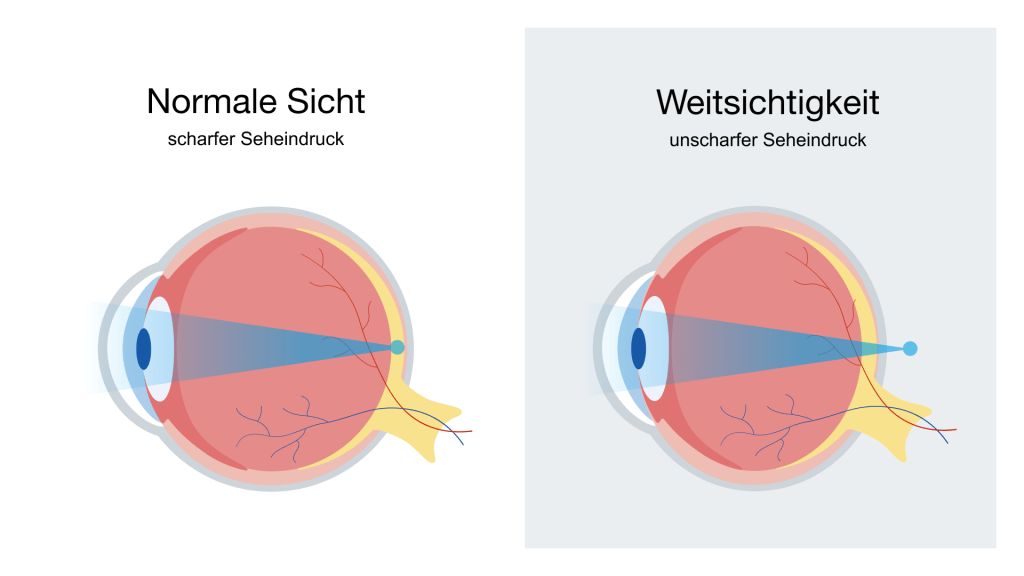
Presbyopia vs. Farsightedness: The Differences at a Glance
Distinguishing between presbyopia and hyperopia can often be difficult based on symptoms, as both vision defects impair near vision. In both cases, patients often report blurred vision when reading or working on the computer. However, since different causes are underlying, an exact diagnosis is important to choose the appropriate treatment.
With presbyopia, the eye lens loses its elasticity over the course of life, making it difficult to focus on nearby objects. Farsightedness, on the other hand, is a congenital defective vision in which the eyeball is too short or the cornea has too little refractive power, which focuses the light behind the retina. Both visual impairments affect near vision, but their development and treatment are fundamentally different.
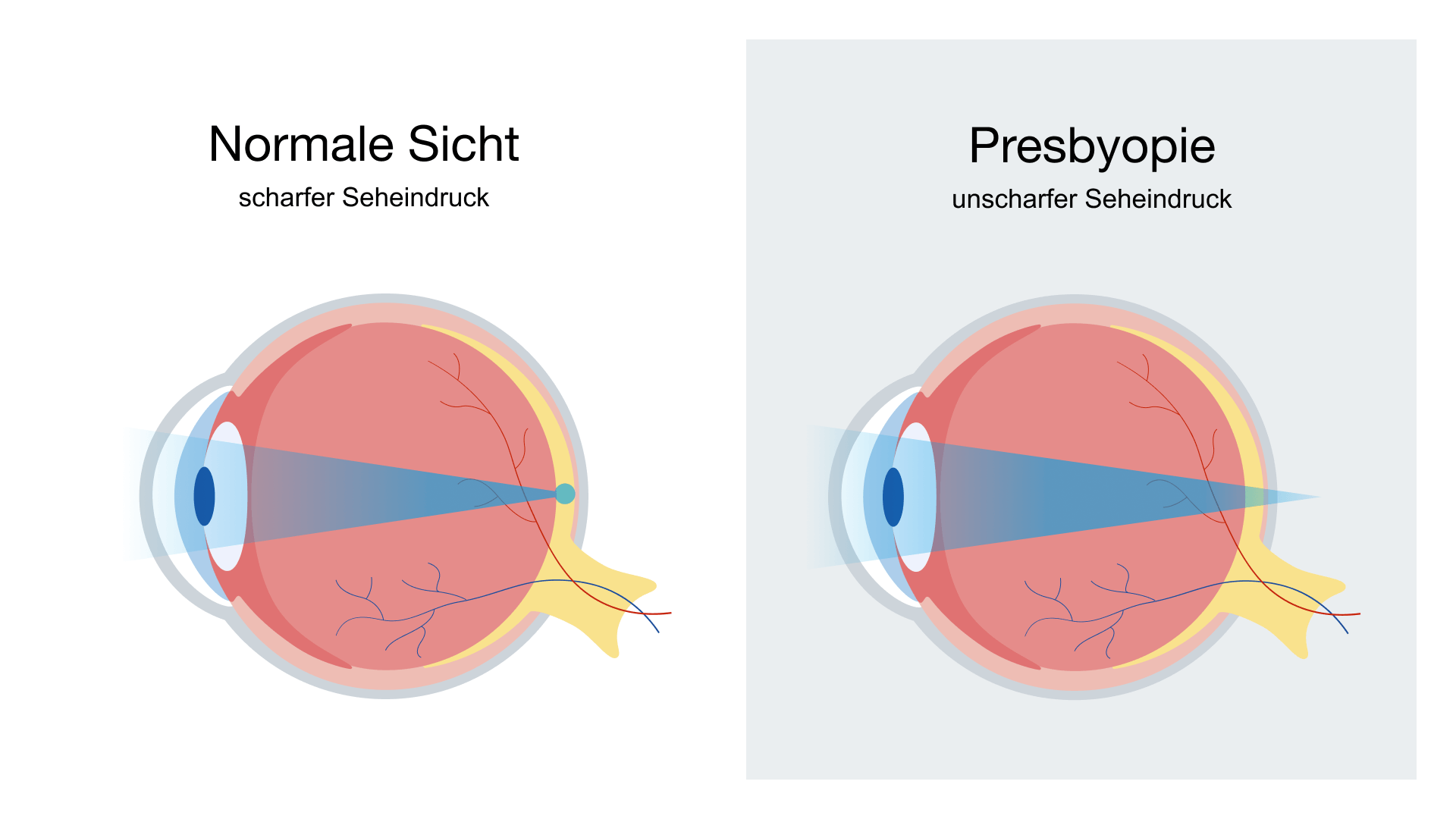
Since the symptoms are often very similar, it is difficult to distinguish them accurately without a thorough examination. However, a competent ophthalmologist has the know-how and the necessary diagnostic equipment and performs various eye tests to determine whether there is presbyopia or farsightedness.
The refractive power of the eye is measured and the ability of the eye to switch between near and far vision is tested.
In a detailed consultation, the doctor discusses suitable treatment options with the patient, ranging from glasses or contact lenses to modern laser treatments and eye surgeries such as PRESBYOND ® or refractive lens replacement.
Thanks to these technologies, vision can be permanently improved in both old age and farsightedness.