Treatment for presbyopia – what are the options? Dr. med. Bányai explains

Fortunately, treatment for presbyopia today is extremely varied – from traditional visual aids to surgical procedures and modern laser treatments. From around the age of 40, many people notice the aging of the eye’s lens, which increasingly reduces its ability to focus on nearby objects.
When reading, working on a PC, or using a smartphone becomes a strain on the eyes, people naturally ask about treatment options for presbyopia — and this article will address that question.
Treatment of Presbyopia with traditional visual aids
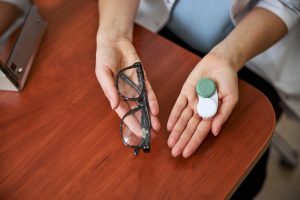
The standard treatment for age-related farsightedness, or presbyopia, often begins with visual aids such as reading glasses or progressive lenses, which compensate for the lens’s decreased ability to accommodate.
For many people, visual aids are a practical, straightforward solution that makes everyday life easier. They provide an immediate correction for refractive errors and help you see clearly and sharply at close range while you wear them.
Reading glasses to correct presbyopia
Reading glasses are a widely used solution for correcting presbyopia. Over the years, the eye’s lens loses elasticity, making it difficult to focus on nearby objects.
Reading glasses restore near vision without affecting distance vision. They are especially useful for people who otherwise have no vision problems but have difficulty reading or using smartphones.
Reading glasses are an inexpensive and straightforward way to manage presbyopia. Compared with progressive lenses, which correct both near and distance vision, reading glasses are intended only for near tasks and must be put on and taken off as needed. However, they provide an immediate and effective correction of the near-vision impairment caused by presbyopia.
Contact lenses for presbyopia?
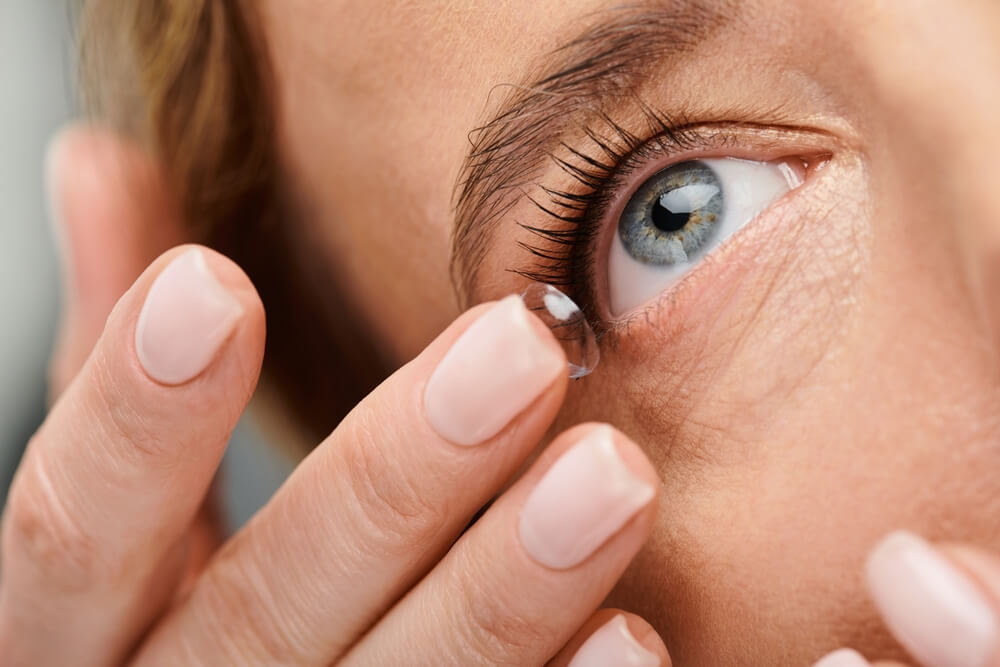
Contact lenses provide a flexible alternative to reading glasses for presbyopia. Multifocal lenses, in particular, are designed to correct both near and distance vision.
These special lenses enable the eye to adjust to different distances, which conventional contact lenses cannot do.
The advantage of multifocal lenses is that they compensate for the eye’s natural loss of accommodation by providing multiple prescriptions simultaneously.
Intraocular lenses are also an option for patients who do not want to wear glasses. These implantable contact lenses can be placed during a surgical procedure to permanently correct refractive errors.
These methods provide a long-term solution for people with presbyopia who wish to manage everyday life without visual aids and to improve their vision at all distances.
How progressive spectacles work
Progressive glasses are a proven way to correct presbyopia. They are also suitable for people with presbyopia who have an additional refractive error, such as nearsightedness or farsightedness.
A progressive lens corrects multiple areas of vision within a single lens: the upper part is optimized for distance vision, the lower part for near vision. Between them is a smooth transition zone that allows a gradual, seamless adjustment of focus.
This combination ensures that vision is corrected at all distances without having to switch between different pairs of glasses. It is particularly important that progressive lenses are precisely fitted by an optician so the transition between near and distance vision is optimally matched to each individual’s visual needs.
The glasses then allow you to switch comfortably between different distances in everyday life, whether when reading or driving.
Laser eye treatments for presbyopia
Laser eye surgery offers a permanent option for treating presbyopia. Unlike visual aids such as reading glasses or progressive lenses, these laser procedures aim to directly improve the eye’s refractive power.
Our state-of-the-art laser eye centers for laser eye surgery in Karlsruhe and Stuttgart use precise methods such as PRESBYOND®. This procedure specifically alters the shape of the cornea to compensate for age-related visual impairment. Alternatively, a refractive lens exchange can be performed, in which an artificial lens replaces the natural lens – a proven option, especially in cases of severe presbyopia.
Given the many laser treatment options for presbyopia available in ophthalmology, it’s worth taking a closer look at the individual procedures.
PRESYBOND® Blended Vision
PRESBYOND® Blended Vision is an advanced laser treatment specifically designed to correct presbyopia. It adjusts the dominant eye for distance vision and the non-dominant eye for near vision. Both eyes are corrected for intermediate vision.
This allows the brain to fuse the two images into a single sharp visual impression. Vision is thus optimised at all distances without the need for glasses.
In this method, the surgeon uses the femtosecond laser, which operates with precision and minimal invasiveness to correct the eye’s refractive power. Unlike conventional procedures, PRESBYOND® ensures a harmonious depth of field, resulting in significantly improved near vision and excellent visual performance at intermediate distances.
Refractive Lens Replacement
Refractive lens replacement is another popular method for the permanent treatment of presbyopia, especially in advanced cases or in early-stage cataract. In this procedure, the eye’s natural lens is replaced by an artificial lens.
The multifocal intraocular lenses, in particular, can correct both near and distance vision and improve the eye’s refractive power.
As part of lens replacement, the eye’s natural lens is removed and a multifocal or other specialized artificial lens is implanted.
This is an effective treatment for patients who suffer from presbyopia and cataracts, since lens replacement can address both conditions. The results provide clear vision at various distances, eliminating the need for visual aids such as glasses.