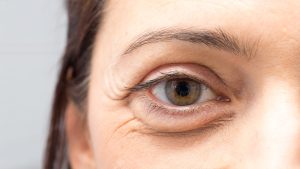

Eye twitching: causes, warning signs and what you can do

Eye twitching (fasciculation) is harmless in most cases and is triggered by stress, lack of sleep, caffeine or magnesium deficiency 1. Twitching usually affects only one eye and disappears on its own within days. You should only see an ophthalmologist if you have persistent twitching for several weeks.
The eyelid is one of the most sensitive muscles in the body. It can therefore quickly cramp and lead to an unpleasant twitching. The causes of a nervous eye and cramping can be multifaceted. In order to counteract a frequently occurring eye twitch, the cause must be clarified and appropriate measures taken.
What causes eyelid twitching?
We have summarized the most common triggers that can cause the involuntary muscle twitches on the eyelid at a glance:
- Stress
- Insufficient sleep and fatigue – tired eyes (dark circles)
- Vitamin deficiency and magnesium deficiency
- Pregnancy
- Caffeine, alcohol and nicotine
- Dry Eyes (Sicca Syndrome)
- Allergy
- Long screen time
- Nutritional problems
- After eye surgery or correction of refractive error
- Eye infections, such as conjunctivitis
- High blood pressure
Your eye twitches more often? Is your eye twitch always on the left? The right eye never twitches? Then look at this list and consider whether any of these triggers may be the reason your eyelid is twitching. Often, with conscious awareness, you can change the trigger yourself by making a change in your diet or lifestyle.
According to reports, muscle relaxation can be achieved, for example, through autogenic training. This way, the twitching of your eyelid can disappear again. In rare cases, the eyelid twitch is chronic or there is a neurological disease behind it. In case of suspicion, an ophthalmologist should always be consulted.
How is eye twitching triggered?
The eye twitch, called fasciculation in technical jargon, is triggered by muscle cramps. The eye muscle is involuntarily contracted for various reasons.
As a rule, the twitching is very easy, which is why it is difficult for the other person to notice. Nevertheless, the person concerned feels the eye twitch very clearly and usually finds it extremely disturbing.
Twitching eye left or right
Is your eye twitching left or right? The eye twitch usually only occurs in one eye. So it may be that only your right eye twitches.
However, the eye twitch can also only occur on the left. In addition, either the upper eyelid (upper eyelid) or the lower eyelid (lower eyelid) is affected.
Stress as a cause of a twitching eyelid
A common cause of twitching eyelids is stress12. The eye is very sensitive and prone to psychological distress. A high level of stress can strain the eye muscles and lead to unwanted twitching.
Stress hormones can also lead to tension such as jaw or neck tension. These in turn affect the eye muscles.
To counteract this scenario, relaxation is the solvent. Whether small yoga sessions or being pampered by the masseur, it is up to you. Even small relaxation exercises during office work in between can be helpful.
The main thing is to give the eye a break. Regular sports sessions or meditations can be extremely beneficial in reducing stress sustainably and counteracting a twitching eye. Laser eye surgery for athletes has many positive advantages.
If the body does not get enough sleep, the stress resistance may suffer and the eyelid may start to twitch as a result. If a twitching eyelid muscle has this cause, the problem can be remedied with sufficient sleep.

Vitamin deficiency & magnesium deficiency as a cause of eyelid twitching
A vitamin deficiency or magnesium deficiency can be the cause of an annoying eye twitch. In addition, it is important to also consume sufficient minerals. Thus, magnesium has a significant influence on nerves and muscles. A deficiency can therefore be the cause of eye twitching.
Twitching of the eyelids due to vitamin deficiency
A vitamin B12 deficiency often favours a nervous and twitching eyelid. In order for the body to absorb enough vitamin B12, meat and dairy products should be consumed regularly.
Vegans in particular are at risk of a vitamin B12 deficiency and so it can happen that an eyelid twitches. Vitamin B12 is almost exclusively contained in animal products. Vegans are therefore recommended to take vitamin B12 supplements.
In addition, a lack of minerals could cause a twitching eyelid. As a result, sufficient mineral water should be consumed daily. The guideline value is at least 1.5 litres.
Magnesium deficiency can mainly affect the nerves supplying the eyelid 6. As with other muscle spasms, magnesium can counteract muscle twitching in the eye area. Think about whether this may be the reason your eyelid is twitching.
Pregnancy eye twitching
Eye twitching in pregnancy can be common. Pregnant women have an increased need for magnesium. If this is not breastfed, it can lead to increased twitching of the eyes.
A balanced diet rich in magnesium should therefore be ensured, especially during pregnancy. Magnesium is mainly found in the following foods:
- Nuts
- Potato
- Vegetables
- Legumes
- Fruits
- Wholemeal bread
More reasons why your eyelid twitches
The reasons why your eyelid twitches are often versatile. Some of these causes are listed below:
1. Coffee, alcohol or nicotine consumption as a cause of twitching eyes
An annoying eye twitch can be caused by excessive coffee, alcohol and nicotine consumption. Excessive consumption has a negative effect on the eye muscles. Nicotine inhibits blood circulation and, like alcohol, is a nerve agent.
Alcohol consumption can dry out the eye fluid, the tear film of the eye is disturbed and so a twitching eye can quickly develop.
Caffeine has a stimulating property that affects heart rate and muscles, among other things. The eye muscles can be quickly affected if caffeine consumption is too high and a twitching eyelid can be the result.
2. Lack of sleep promotes eyelid twitching
You had a long night, couldn’t sleep and the left eyelid twitches in the morning? As all of us know, too little sleep harms the body and nervous system if this happens regularly.
Our eyes also need appropriate rest. If this is not the case, the ring muscle around the eyes spasms and twitches occur. The left or right eyelid then twitches within short intervals. Usually only the left eyelid or the right eyelid twitches, rarely both.
3. Allergies and diseases as a cause of twitching eyes
Allergies can lead to a twitching eye, itching or swelling in the eye area. If you suffer from eye twitches caused by an allergy, antihistamine eye drops may be the solution.
Very unlikely and rarely occurring is a tumor as a cause of eye twitching. Multiple sclerosis (MS) can also be noticeable in the eye area. As a rule, however, not in the form of eyelid twitches.
4. Dry eyes as a cause of eyelid twitching
Blinking is generally used to moisturize dry eyes4. Therefore, it is obvious that the eye automatically blinks more often if there is a lack of tear fluid, so that the lack of moisture can be compensated again.
This frequent blinking can quickly lead to uncontrolled twitching. The cause of dry eyes can in turn be too long a time in front of the PC or TV. This was also observable, for example, when during the coronavirus era many people increasingly worked from home at non-ideal workplaces at home (as far as lighting and screens were concerned).
Home remedies such as chamomile tea can sometimes do more harm than good for twitching eyes, as the already stressed eyes sometimes become even drier.
5. Correction of defective vision as the cause
Nowadays, visual impairment is often corrected surgically. However, as with any surgical procedure, care should be taken to ensure that the procedure is carried out professionally.
An improper correction of defective vision could also be a trigger for a twitching eye. After eye surgery, swollen eyes are a “normal” reaction and twitching can also occur.
On the other hand, a twitching eye can occur due to poor vision or be an indication of an unsuitable diopter power of the spectacle lenses. Therefore, a visit to the optician or ophthalmologist should always take place with twitching eyes.
What can be done to prevent twitching of the eyelid?
Below we have summarized 9 tips on what you can do against eye twitches. Depending on the cause, a different approach helps:

Can a twitching eye be interpreted as a warning signal from the body?
If the eyelid twitches, it does not mean a serious illness for most people. However, it is of course extremely annoying if the left eye or the right eye constantly twitches.
Nevertheless, you can see the eye twitch causes listed above as small warning signs from your body that something is not right. Consciously perceive your lifestyle and listen to your body.
Eyelid twitching – when should I see an ophthalmologist?
An ophthalmologist does not have to be consulted immediately in the event of a sporadic eye twitch. The twitching eye usually disappears quickly on its own and there is no serious illness behind it.
Often, the cause of the eye twitch is obvious. This can counteract eye twitching even without medical supervision.
Blepharospasm is when the eyelids close spasmodically. This is usually caused by irritation in the eye, including injuries, inflammation or due to a foreign body.
This type of twitching often begins with a strong urge to blink. An ophthalmologist should definitely be consulted here.
If eye twitching is very common or unusual inflammation develops around the eye area, an ophthalmologist should be consulted for safety. Sometimes the twitching of the eyelid is also due to a disease requiring treatment, such as high blood pressure or hyperthyroidism. In the case of further examinations, it is sometimes advisable to consult a neurologist.
In very rare cases, persistent eye twitching is treated with minimal Botox injections to stop the spasmodic, involuntary – often very stressful – muscle contractions.
Attention: If there are eye twitches in connection with visual disturbances, speech disturbances or signs of paralysis, it is essential to contact an emergency doctor, as these may be signs and symptoms of a heart attack or stroke.
If you have persistent complaints, you are welcome to get individual advice and examination in our laser eye centre in Karlsruhe and laser eye centre in Stuttgart.
Frequently asked questions about eye twitching
A suddenly twitching eye is usually a so-called eyelid twitch (fasciculation) and in most cases harmless1. The most common triggers are stress, lack of sleep, increased caffeine consumption or dry eyes. Twitching usually only affects one eye and stops on its own within minutes to days.
Occasional eye twitching is not a cause for concern. However, if the twitching persists for several weeks, affects both eyes or is accompanied by visual disturbances, facial cramps or paralysis, you should consult an ophthalmologist promptly. In rare cases, there may be a so-called blepharospasm, which should be treated by a doctor 23.
It often helps to consciously reduce stress, get enough sleep and reduce caffeine consumption 1. In dry eyes, moisturizing eye drops can have a soothing effect4. Even a conscious screen break (20-20-20 rule: look into the distance every 20 minutes for 20 seconds) can reduce twitching.
Yes, magnesium plays an important role in the transmission of stimuli between nerves and muscles. Deficiency can lead to involuntary muscle twitching, including on the eyelid6. Magnesium-rich foods (nuts, legumes, whole grains) or a medically coordinated supplementation can counteract this.
If the eye twitching lasts longer than two to three weeks, you should see an eye doctor. This is especially true if the twitch becomes stronger, spreads to other facial muscles or accompanying symptoms such as redness, swelling or changes in vision occur. The physician may rule out blepharospasm or other causes 23.
References
1 Jafer Chardoub AA, Patel BC (2023): Eyelid Myokymia. StatPearls, Treasure Island (FL): StatPearls Publishing.
2 Peckham EL, Lopez G, Shamim EA et al. (2011): Clinical features of patients with blepharospasm: a report of 240 patients. European Journal of Neurology, 18(3):382-386.
3 Hall TA, McGwin G Jr, Searcey K et al. (2005): Benign essential blepharospasm: risk factors with reference to hemifacial spasm. Journal of Neuro-Ophthalmology, 25(4):280-285.
4 Martino D, Defazio G, Alessio G et al. (2005): Relationship between eye symptoms and blepharospasm: a multicenter case-control study. Movement Disorders, 20(12):1564-1570.
5 Zhao G, Wang J, Ma Q et al. (2024): Comparison of upper eyelid pressure and ocular surface parameters in dry eye disease and benign essential blepharospasm. Contact Lens and Anterior Eye, 47(6):102298.
6 Kothari M, Wanjari A, Shaikh SM et al. (2024): A Comprehensive Review on Understanding Magnesium Disorders. Cureus, 16(9):e68385.