
How does presbyopia differ from other vision problems? Dr. med. Bányai explains.

If reading small text suddenly becomes difficult or the restaurant menu only looks clear from a distance, presbyopia may be to blame. This natural change in the eye becomes noticeable at a certain age and affects almost everyone.
But how exactly does presbyopia differ from other visual impairments such as cataracts, glaucoma, nearsightedness, or farsightedness? This question is especially important when determining treatment options, and it is what this article will address.
Presbyopia – an overview
Presbyopia is not a disease but a normal part of aging that typically begins around age 40. Unlike other refractive errors such as nearsightedness or farsightedness, it results from the natural aging of the eye’s lens.
With age, the lens loses elasticity and with it the ability to quickly focus on nearby objects. In addition, the ciliary muscles, which are responsible for changing the curvature of the eye’s lens, may also weaken. This loss of accommodation makes near vision increasingly difficult.
Typical symptoms include blurred near vision, difficulty reading small print, or the sensation that one’s arms are not long enough to hold objects at a comfortable distance. Diagnosis is made by an ophthalmologist, who can determine the eye’s refractive power and the degree of presbyopia using vision tests and specialized equipment.
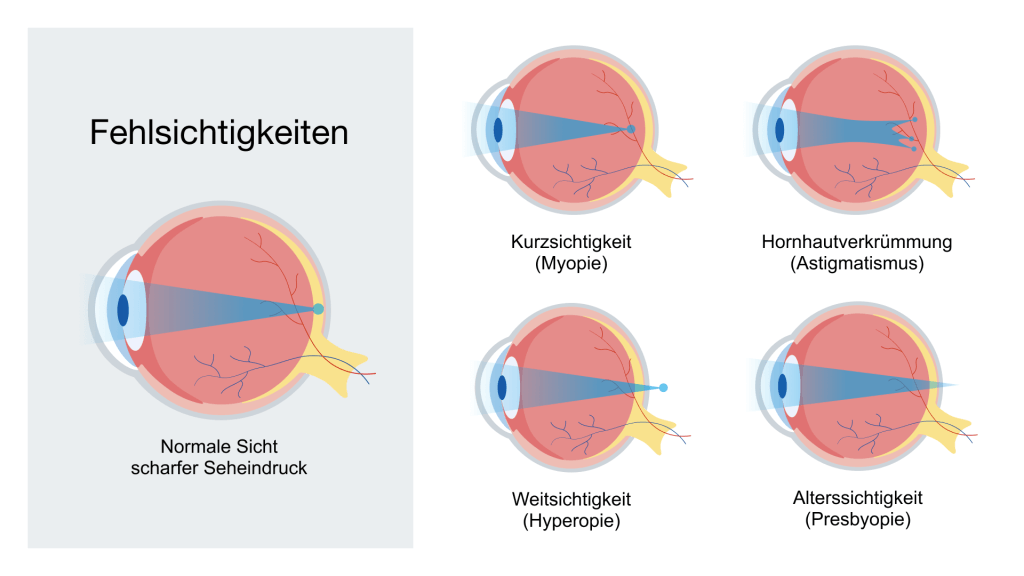
Comparison with other vision problems: How presbyopia differs from …
Although presbyopia is specifically caused by the aging process, it shares similarities and differences with other vision problems that often occur simultaneously.
Below, we explain the key differences and similarities between presbyopia and cataract, glaucoma, myopia, and hyperopia.
However, it should be emphasized that here we can only outline the most basic characteristics and differences. In particular, when distinguishing presbyopia from farsightedness, a visit to an experienced ophthalmologist is essential for a reliable diagnosis.
Cataract
Cataract and presbyopia often occur at around the same age, but have different causes. While presbyopia results from a loss of elasticity in the lens of the eye, cataract is a clouding of the lens that affects overall vision.
Cataracts cause an overall deterioration of vision, often accompanied by sensitivity to light and hazy vision that is not limited to near vision.
Presbyopia is often treated with visual aids or laser procedures, whereas cataracts are usually treated only with surgery, in which the cloudy lens is replaced by an artificial lens.
In cataract surgery, the patient’s cloudy natural lenses are removed and replaced with artificial lenses. This lens exchange also treats presbyopia.
– Bányai Neue Augen
Glaucoma
Glaucoma is a serious eye disease that damages the optic nerve and can lead to blindness if left untreated. In contrast to presbyopia, which affects near vision, glaucoma often causes a gradual loss of the visual field.
Many patients do not notice a loss of visual acuity at first, because central vision remains intact for a long time while peripheral vision gradually becomes restricted.
An important difference is that presbyopia is an age-related change in the eye’s lens, while glaucoma is primarily caused by increased intraocular pressure.
This pressure damages the optic nerve and typically requires lifelong treatment to prevent disease progression. Treatments such as eye drops, laser therapy, or surgery can help reduce the pressure.
Presbyopia vs. short-sightedness
Short-sightedness (myopia) and presbyopia both affect vision but in different ways. People with myopia can see nearby objects clearly, while their distance vision is blurred.
In contrast, presbyopia affects near vision, while distance vision is often unaffected. Additionally, myopia usually appears in childhood or adolescence and can worsen over the years, whereas presbyopia typically begins in middle age.
For presbyopia and short-sightedness, glasses or contact lenses can be used to correct vision, but modern laser procedures offer a more permanent solution – such as Femto-LASIK or SMILE® pro for short-sightedness.
Presbyopia, on the other hand, can be corrected with procedures such as PRESBYOND® or lens replacement.

Age-related long-sightedness vs. long-sightedness
Presbyopia and hyperopia can feel similar, since both impair near vision. The difference lies in their causes: presbyopia results from the natural loss of elasticity of the lens, while hyperopia is often genetic and typically presents in childhood.
With farsightedness, the eyeball is too short, which causes light to be focused behind the retina.
Distinguishing between the two refractive errors is often difficult based on symptoms alone, since near vision is blurred in both cases. An accurate diagnosis by an ophthalmologist is therefore required to determine whether it is presbyopia or farsightedness.
Although both conditions can be corrected with glasses, contact lenses, or modern laser treatments, the specific treatment options can depend on the type of vision problem.
For clarity, we have summarized the differences between the vision problems discussed below:
| Visual impairment | Possible causes | Key Symptoms | Treatment | Features |
| Presbyopia | Age-related loss of elasticity in the eye lens | Blurred near vision, difficulty reading | Glasses, progressive glasses, Laser eye surgery,lens replacement | Typically begins around age 40; distance vision is preserved. |
| Cataract | Age-related clouding of the eye lens | Blurred or cloudy vision, glare | Artificial lens (surgical procedure) | Affects near and distance vision, gradual course |
| Glaucoma (green star) | Increased intraocular pressure, optic nerve damage | Visual field loss, impaired vision | Eye drops, laser therapy, surgery | You may become blind and require lifelong treatment. |
| Short-sightedness (myopia) | An excessively long eyeball or severe corneal curvature | Blurred vision at a distance | Glasses, contact lenses, Laser eye surgery | Occurs frequently in youth; near vision remains sharp |
| Long-sightedness (hyperopia) | Abnormally short eyeball, genetic predisposition | Blurred near vision, headaches | Glasses, contact lenses, laser eye surgery | Occurs frequently in youth; affects near vision |
Shared characteristic with other visual impairments: they are usually treatable
Whether it’s presbyopia, nearsightedness, farsightedness, or other vision problems, the good news is that these conditions are usually easily treatable. Glasses and contact lenses provide quick relief for many of them.
An exception is glaucoma — this serious eye disease requires a nuanced and prompt response. Cataract, on the other hand, can be treated effectively even in advanced stages, but it cannot be corrected with glasses or contact lenses and requires eye surgery.
For the other eye conditions discussed, eye surgeries and laser-eye procedures are also good options for permanently reducing symptoms.
If you are interested in laser eye surgery in Karlsruhe or laser eye surgery in Stuttgart, you will find modern procedures, personalised care and the highest medical expertise at Bányai Neue Augen – tailored to your needs.
In the case of presbyopia, these include:
- PRESBYOND®
- Refractive lens replacement
We will determine together which treatment method is best for you during a thorough pre-examination and consultation, where all your questions, concerns, and wishes will be fully addressed. This ensures we treat your presbyopia as effectively as possible so you can enjoy everyday life again with clear, unobstructed vision.