
Presbyopia vs. Myopia: What Are the Differences?

Visual disturbances such as presbyopia and myopia are common causes of poor vision, but they have different causes and symptoms. While myopia typically appears early in life, presbyopia affects almost everyone once they reach a certain age. Both conditions lead to impaired vision at particular distances, but their underlying causes and their impact on everyday life differ significantly.
This article outlines the main differences between presbyopia and nearsightedness, explains their causes and symptoms, and describes how they are diagnosed and treated. It provides an overview of the typical characteristics of both conditions and the options available to improve your vision.
Difference in how it develops
These two vision problems can often be distinguished by when the first symptoms appear. Presbyopia is a consequence of the natural aging process of the eye. As we age, the lens of the eye loses elasticity, so it can no longer change shape quickly enough to focus on nearby objects.
This loss of accommodation usually begins around the age of 40 and worsens over time, primarily affecting near vision. In addition, the ciliary muscles may weaken — they are also crucial for accommodation, i.e., adjusting between near and distant vision.
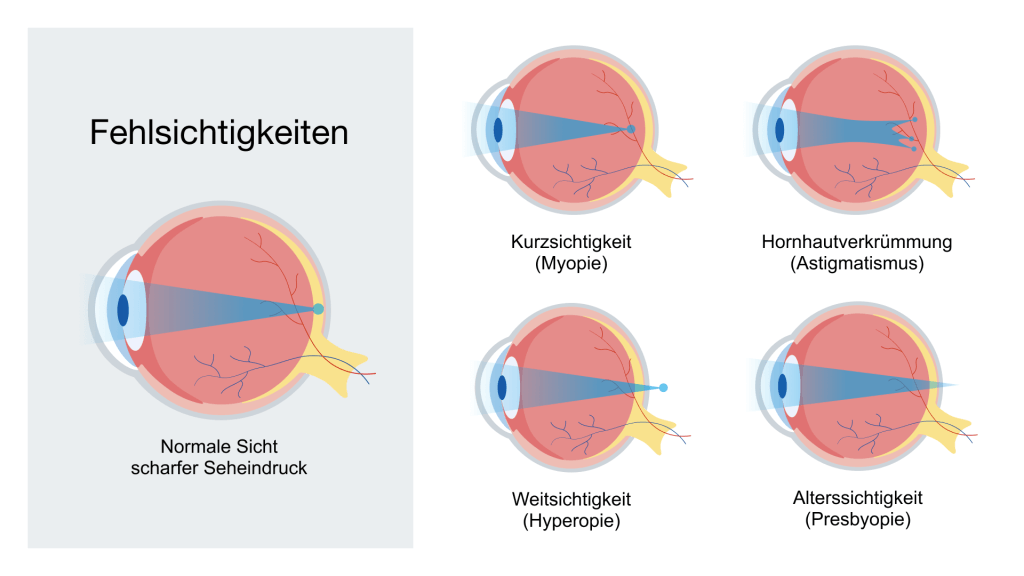
Short-sightedness (myopia), on the other hand, is a congenital or acquired refractive error in which the eyeball is either too long or the cornea is too curved. The light is not focused correctly but instead converges in front of the lens, so nearby objects can no longer be seen sharply. Short-sightedness often develops in childhood or adolescence and can worsen over time.
In my practice, I often see myopia and presbyopia occurring together. However, when a nearsighted patient also develops presbyopia, the two conditions only marginally compensate for each other. We must then select a combined treatment to address both conditions.
Differences in the symptoms
The differences in the symptoms of these two vision problems are particularly clear. With presbyopia, it is difficult to see nearby objects, such as smartphone screens, clearly. Those affected often need to hold objects farther away to see them better. Presbyopia is especially noticeable in low light and is often accompanied by headaches and eye strain.
Short-sightedness is characterised by blurred vision in the distance. People with short-sightedness have difficulty clearly recognising road signs, distant objects or faces. They often blink or squint. However, short-sighted people can usually see well up close, which distinguishes it from presbyopia.
Here is an overview of the different symptoms of presbyopia and short-sightedness:
| Presbyopia | Short-sightedness (myopia) | |
| Visibility? | Blurred vision up close | Blurred vision at a distance |
| Problem areas? | Difficulty reading, working on a computer, or using a smartphone | Difficulty seeing distant objects |
| Common behaviors? | Hold objects farther away to see them clearly. | Hold objects farther away to see them clearly. |
| Light sensitivity? | Problems in low light, often accompanied by headaches and fatigue. | No particular sensitivity to light |
| Age at onset | Usually beginning at age 40 | Usually occurs in childhood or adolescence |
Diagnosis: Short-sightedness or presbyopia?
The diagnosis of presbyopia and nearsightedness is made by an ophthalmologist. A comprehensive examination is performed to determine the eye’s exact refractive power. Through vision tests and diopter measurements, it can be determined whether a person is nearsighted or presbyopic.
For the diagnosis of short-sightedness, the doctor measures how well the eye can focus on distant objects. In presbyopia, by contrast, the near point is assessed – the distance at which the eye can still see nearby objects clearly. The autorefractometer plays an important role in accurately determining the eye’s refractive power. The doctor then determines which visual aids or treatment options are most suitable.
Overview of treatment options
| Methods for treating presbyopia | Methods for treating nearsightedness (myopia) |
| PRESBYOND® – Expansion of depth of focus and correction of near and distance vision using Laser Blended Vision | SMILE® Pro – Minimally invasive laser treatment to correct short-sightedness |
| Refractive lens exchange (RLE) – replacing the natural lens with a multifocal intraocular lens for sharp vision at all distances | Femto-LASIK – Effective laser treatment for the permanent correction of short-sightedness |
| Contact lenses/glasses – Traditional correction with visual aids, especially with progressive spectacles | A-PRK – an alternative for thin corneas or when LASIK is not an option |
| Contact lenses and glasses – traditional correction using visual aids to improve distance vision |
Whether—and which—method of laser eye surgery is most suitable for you can be determined during a thorough preliminary examination. For example, the exact type and extent of your visual impairment, as well as your overall eye health, will be assessed. With this information, you and your ophthalmologist can make the best decision to permanently say goodbye to your visual impairment – whether it’s presbyopia or nearsightedness, or even farsightedness, astigmatism, or cataracts.
Read more about presbyopia:
• Declining vision in old age: When does vision begin to decline?
• Do you become nearsighted or farsighted as you get older?
• What helps with age-related vision loss?
• Symptoms of presbyopia: How can I recognize it?
• What treatment options are available for presbyopia?
• How does presbyopia differ from other visual impairments?
• How does presbyopia affect my daily life?
• What foods are good for eye health as you age?
• Which factors influence presbyopia?
• Presbyopia vs. Farsightedness: What’s the Difference?
• Does smoking affect presbyopia?
•Differences between presbyopia and long-sightedness
• Myths about presbyopia: What’s really true?
• Spread of presbyopia in Germany: Is everyone becoming presbyopic?
• Eye problems due to presbyopia – a concern starting at age 40
• What are the costs of presbyopia? A comparison of treatment options