
Spread of presbyopia in Germany: Does it affect us all?
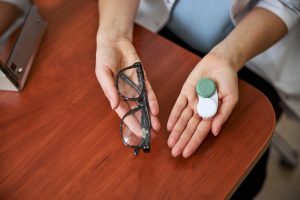
In the course of life, almost all Germans are affected by presbyopia. There are differences in the severity of this completely normal, age-related visual impairment. For example, some people get by without vision aids, while a majority of Germans need glasses at some point in their lives.
You can find out why this happens, how presbyopia is spread worldwide and what can be done about it in this article.
Why we see worse in old age
With age, the lens of the eye loses elasticity. This accommodation ability, i.e. the ability of the lens to adjust to near and far vision, decreases continuously.
This makes it increasingly difficult to see nearby objects such as books or smartphone displays clearly. The so-called near point, i.e. the point at which a nearby object can still be seen sharply, shifts further and further away from the eye. Another problem is the ciliary muscle, which is involved in lens curvature and also loses flexibility.
This age-related change affects almost all people from the age of 40 to 50 years and leads to presbyopia, which can make everyday life significantly more difficult without appropriate visual aid or treatment.
Many patients do not come directly to my practice, but try to come to terms with the declining vision. But that does not have to be the case, and I am happy to clarify that there are many treatment routes to lead a carefree life.
Presbyopia in Germany and worldwide
In Germany, presbyopia affects the vast majority of people. This is also shown by a recent survey: about half of Germans between the ages of 18 and 24 say they wear glasses at least once in a while. Among the over-55s, this proportion is 92%, and this increase can sometimes be attributed to presbyopia.¹
This means that millions of people need reading glasses or some other form of vision aid to cope with their everyday lives. Worldwide, the prevalence is similarly high: it is estimated that about one billion people are affected by presbyopia.²
This number continues to increase, because increasing life expectancy and access to better medical care fortunately mean that more and more people are enjoying a longer life – but also in the area where presbyopia is becoming an issue. The treatment options vary depending on the region.
¹Statista: Glasses use increases significantly from middle age. https://de.statista.com/infografik/28301/anteil-der-befragten-die-mindestens-hin-und-wieder-brille-trag
²Health information: presbyopia. https://www.gesundheitsinformation.de/alterssichtigkeit-presbyopie.html.
Laser eye surgery for clear vision at any age
Laser eye surgery has become one of the most effective methods for correcting presbyopia in the long term and enabling clear vision without glasses.
Modern methods include the PRESBYOND® Blended Vision procedure. With this very innovative method, the refractive power of the eyes is adjusted to create a flowing transition zone. This allows clear vision for both near and distant objects.
Refractive lens replacement is a good option for patients for whom eye lasers are out of the question. Here, the natural lens is replaced by an artificial lens to improve vision at different distances. A positive side effect of the RLE: Any cataracts will be corrected at the same time.
It turns out that presbyopia eventually affects most of us, but nowadays there are a number of treatment options. This sometimes results in the difficulty for patients to decide which option to choose.
We at Bányai Neue Augen will therefore sit down with you for a personal consultation after the comprehensive preliminary examinations. All your questions have room here, and together we will find the ideal path to more self-determination for you.
Read more about presbyopia:
• Declining vision in old age: from when does vision decrease?
• Do you become nearsighted or farsighted in old age?
• What helps against age-related visual impairment?
• Symptoms of presbyopia: How do I recognize presbyopia?
• What treatment options are available for presbyopia?
• How is presbyopia different from other visual impairments?
• How does presbyopia affect my everyday life?
• What foods are good for the eyes in old age?
• What factors influence presbyopia?
• Presbyopia vs. myopia: what are the differences?
• Presbyopia vs. Farsightedness: What’s the Difference?
• Does smoking affect presbyopia?
• Myths about presbyopia: What’s really true?
• Eye problems due to presbyopia – an issue from the age of 40
• What is the cost of presbyopia? A comparison of treatment options
• The 10 most common eye diseases in old age
• Exercises to improve presbyopia
• What to do in case of presbyopia and nearsightedness?
• Reading glasses – 10 things to keep in mind
• Reading glasses or progressive lenses: Which solution makes sense in the long term?
• Which reading glasses are right for me?
• Contact lenses for presbyopia: what you need to keep in mind!
• Diopter table for presbyopia