
Eye problems due to presbyopia – an issue from the age of 40
Vision problems usually increase with age. The first issues affecting vision often appear around age 40. Presbyopia, in particular, becomes an issue when it gets harder to see nearby objects such as books or screens clearly.
While some of these age-related changes are perfectly natural and not cause for concern, the risk of serious eye diseases increases with age. Regular check-ups with an ophthalmologist are therefore important to detect changes early and identify appropriate treatment options.
In this article, we explain which vision problems most commonly occur after age 40 and how to recognize them.
Eye problems due to presbyopia – already a concern from age 40
At the beginning of this list, we will address a phenomenon that is not actually an eye disease but nevertheless causes increasing visual impairment with age: presbyopia. Also known as age-related long-sightedness, it often begins as early as age 40 and mainly affects near vision in almost everyone.
This natural process occurs because the eye’s lens loses elasticity with age, making it harder to focus on nearby objects — similar to long-sightedness. This age-related change is therefore not a disease, but a normal part of the aging process.
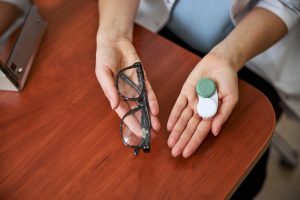
To compensate for the symptoms of presbyopia — namely reduced near visual acuity — many people turn to reading glasses, progressive glasses, or contact lenses. These aids correct the refractive error and restore sharp near vision. Laser eye surgery for presbyopia is also frequently used so people can continue, as much as possible, without visual aids.
Eye diseases in later life
As people age, not only do vision problems such as presbyopia become more common, but so do many serious eye diseases that can affect otherwise healthy eyes. These diseases often involve the eye itself or the structures necessary for clear, sharp vision.
Some of these conditions develop gradually and may go unnoticed for a long time, which is why regular visits to an ophthalmologist are crucial to detect and treat them early.
Below, we present some of the most common eye diseases in old age that can severely impair vision. From retinal detachment to glaucoma, these conditions often require specialized, prompt treatment to preserve vision.
Cloudy vision due to cataracts
In this condition, the eye’s lens becomes cloudy, causing gradual vision loss, and affected individuals notice a progressive deterioration of their eyesight. Typical symptoms of cataract include blurred vision, faded colors, and increased sensitivity to glare in bright light. People over the age of 74 are particularly affected; more than half of them suffer from cataracts.
If left untreated, cataracts can cause severe vision loss that significantly impairs daily life. Fortunately, cataract surgery, in which the cloudy natural lens is replaced with an artificial intraocular lens, can largely restore vision. This procedure is very common and has a very high success rate.
Diabetic retinopathy
Diabetic retinopathy is a serious eye disease that primarily affects people with diabetes and can, over time, lead to vision loss or even blindness.
In Germany, about 1.53% of the population are affected. The condition is particularly common among people with diabetes: around 21.7% of individuals with diabetes develop diabetic retinopathy. It is caused by damage to the retinal blood vessels resulting from high blood sugar levels. This damage leads to visual disturbances, such as blurred vision, distorted images, and reduced perception in low-light conditions.
Regular eye examinations by an ophthalmologist are particularly important to ensure early diagnosis and treatment. People with diabetes should have their eyes checked regularly to prevent permanent damage. With early detection, it is possible to slow the progression of the disease and minimize vision loss before irreversible damage occurs.

Age-related macular degeneration
When considering the causes of severe visual impairment in older adults, age-related macular degeneration (AMD) is the most common cause in developed countries. This condition affects the macula, the central area of the retina responsible for sharp vision.
With advanced macular degeneration, visual acuity is severely impaired, making details, faces, and texts difficult to discern. Older adults are particularly affected: about 1 in 100 people aged 65 to 75 have AMD, while 10 to 20 out of 100 people over the age of 85 are already affected.
Age-related macular degeneration does not lead to complete blindness, but it significantly impairs central vision, which can severely limit quality of life. It is important to detect the disease early during routine check-ups and to take measures to slow its progression and minimize vision loss.
Glaucoma – rare but serious
Also known as glaucoma, this condition affects about 1–2% of the population and is a serious eye disease that can lead to blindness if left untreated. Glaucoma is often caused by increased intraocular pressure, which damages the optic nerve and gradually impairs vision. The risk of this disease increases with age: in people over 65 it occurs in 2–4%.
The disease progresses slowly and often causes symptoms only in its late stages, which is why regular check-ups with an ophthalmologist are particularly important for early detection.
The most common symptoms include visual field defects, blurred vision, and occasionally severe headaches or eye pain.
Since glaucoma usually occurs without early warning signs, it is considered the “silent thief of sight.” If the condition is detected early, it can be treated with medications, laser therapy, or surgery to lower intraocular pressure and prevent further damage.
³ University Hospital Zurich, article about the green star https://www.gesundheitsinformation.de/altersabhaengige-makuladegeneration-amd.html#:~:text=Die%20Makuladegeneration%20ist%20in%20den,100%20Personen%20%C3%BCber%2085%20Jahre.
⁴ Gesundheitsinformation.de – Age-related macular degeneration https://www.gesundheitsinformation.de/altersabhaengige-makuladegeneration-amd.html#:~:text=Die%20Makuladegeneration%20ist%20in%20den,100%20Personen%20%C3%BCber%2085%20Jahre.
⁵ University Hospital Zurich, article about glaucomahttps://www.usz.ch/krankheit/glaukom/#:~:text=Etwa%20ein%20bis%20zwei%20Prozent,Kaukasiern%20insbesondere%20ab%20dem%2050.
Retinal detachment
Retinal detachment is a medical emergency that affects about 1 in 10,000 people each year. It occurs when the retina separates from the layer beneath it, causing sudden visual disturbances. The risk increases with age: 3% of people experience retinal detachment by age 85.⁶ ⁷
A common warning sign is the appearance of flashes of light, dark shadows in the visual field, or blurred vision. The vitreous, which stabilizes the retina, also plays a role in this condition – it can change with age and pull on the retina, which can promote retinal detachment.
If left untreated, retinal detachment can lead to permanent vision loss or even blindness. It is important to see an ophthalmologist immediately at the first signs so that treatment can begin quickly – every hour counts. Surgery is often necessary to reattach the retina and stabilize vision.
Vision problems and their effects in old age
Many people’s vision declines with age, which can lead to various vision problems. These include not only reduced visual acuity but also dry eyes, altered colour perception, and increased sensitivity to light in low-light conditions.
On the one hand, visual impairments have a noticeable impact on everyday activities – whether driving, reading, or working on a PC. On the other hand, these impairments also have broader health consequences, as a study by Hans-Helmut König et al. shows.
This is because increasing vision problems cause people to restrict their leisure activities and make them less likely to ride a bicycle, do gardening, or even perform mental tasks.
All of these are important activities to maintain physical and mental well-being, so early treatment of visual impairments is important for overall health.
Many patients also report feeling unsafe in everyday life, either avoiding certain activities altogether or having suffered injuries—for example, from falls in poorly lit conditions.
Often, however, these limitations and risks need not occur. Once diagnosed and appropriately treated, many effects of age-related vision loss can be largely compensated for.⁸
Check-ups: Essential in old age
Regular check-ups with the ophthalmologist are always, and especially in older age, the basis for detecting age-related vision problems such as presbyopia at an early stage and for pursuing appropriate treatment options.
Especially in older age, conditions such as cataract, glaucoma, or age-related macular degeneration become more common. They often progress gradually and can lead to a significant loss of vision. Early diagnosis makes it possible to take appropriate measures to preserve vision. But even normal age-related changes can be corrected with modern ophthalmology.
Consider, for example, presbyopia, which will affect most of us sooner or later.
For the correction of presbyopia, alongside traditional visual aids such as glasses, modern procedures like laser eye surgery are available. Methods such as PRESYBOND®, Monovision or lens replacement offer long-term solutions to restore clear vision.
But regardless of which treatment you choose, what is crucial for eye health in old age — and should be emphasised here again — is that regular check-ups with an ophthalmologist take place. Many patients, especially those with age-related vision problems, feel ashamed.
But they don’t have to be, because aging affects all of us and is part of life. With good health, you can also enjoy the positive aspects of getting older.
⁷ https://www.gesundheitsinformation.de/netzhautabloesung.html
Learn more about presbyopia:
• Declining vision in old age: When does vision begin to deteriorate?
• Do you become nearsighted or farsighted as you age?
• What helps with age-related vision loss?
• Symptoms of presbyopia: How can I recognize it?
• What treatment options are available for presbyopia?
• How does presbyopia differ from other vision problems?
• How does presbyopia affect my daily life?
• What foods are good for eye health in old age?
• Which factors affect presbyopia?
• Presbyopia vs. myopia: What are the differences?
• Presbyopia vs. Farsightedness: What’s the difference?
• Does smoking affect presbyopia?
• Myths about presbyopia: What’s the truth?
• Prevalence of presbyopia in Germany: Does everyone become presbyopic?
• What are the costs of treating presbyopia? A comparison of treatment options
• The 10 most common eye diseases in old age
• Exercises to help with presbyopia
• What to do about presbyopia and nearsightedness?
• Reading glasses – 10 things you need to know
• Reading glasses or progressive lenses: Which solution is the better long-term option?
• Which reading glasses are right for me?
• Contact lenses for presbyopia: What you need to know
• Diopter chart for presbyopia
All the information you need about laser eye surgery – delivered directly to your email inbox!
Follow us