
Reading glasses or progressive lenses: Which is the better long-term solution?

Reading glasses or progressive lenses: Many of us eventually face this question. With the onset of presbyopia, which will affect almost all of us at some point, we look for ways to compensate.
Reading glasses are often the first solution when presbyopia sets in – which is the case for many of us from around age 40. They correct near vision, while distance vision usually remains unaffected. People who don’t have other vision problems, such as nearsightedness or farsightedness, often choose reading glasses because they are an inexpensive and simple solution.
On the other hand, progressive glasses are needed when distance vision is impaired in addition to near vision. They combine multiple corrections into a single lens and are particularly convenient for people who want to see clearly both up close and at a distance without constantly switching glasses.
With both visual aids, the question arises of which option makes the most sense in the long term. Costs, everyday suitability, and effectiveness factor into this decision and are therefore discussed in this article, where we clarify the differences between reading glasses and progressive lenses.
An overview of the differences between visual aids
The fundamental difference between reading glasses and progressive glasses lies in their function. Reading glasses are intended exclusively for near vision, while progressive glasses provide several vision zones. These differences stem from the construction of each type of glasses, which we will discuss, along with the costs associated with reading glasses and progressive glasses.
Structural differences
Reading glasses have a simple design and a single lens power focused for near vision — similar to a classic spectacle lens used to correct farsightedness.
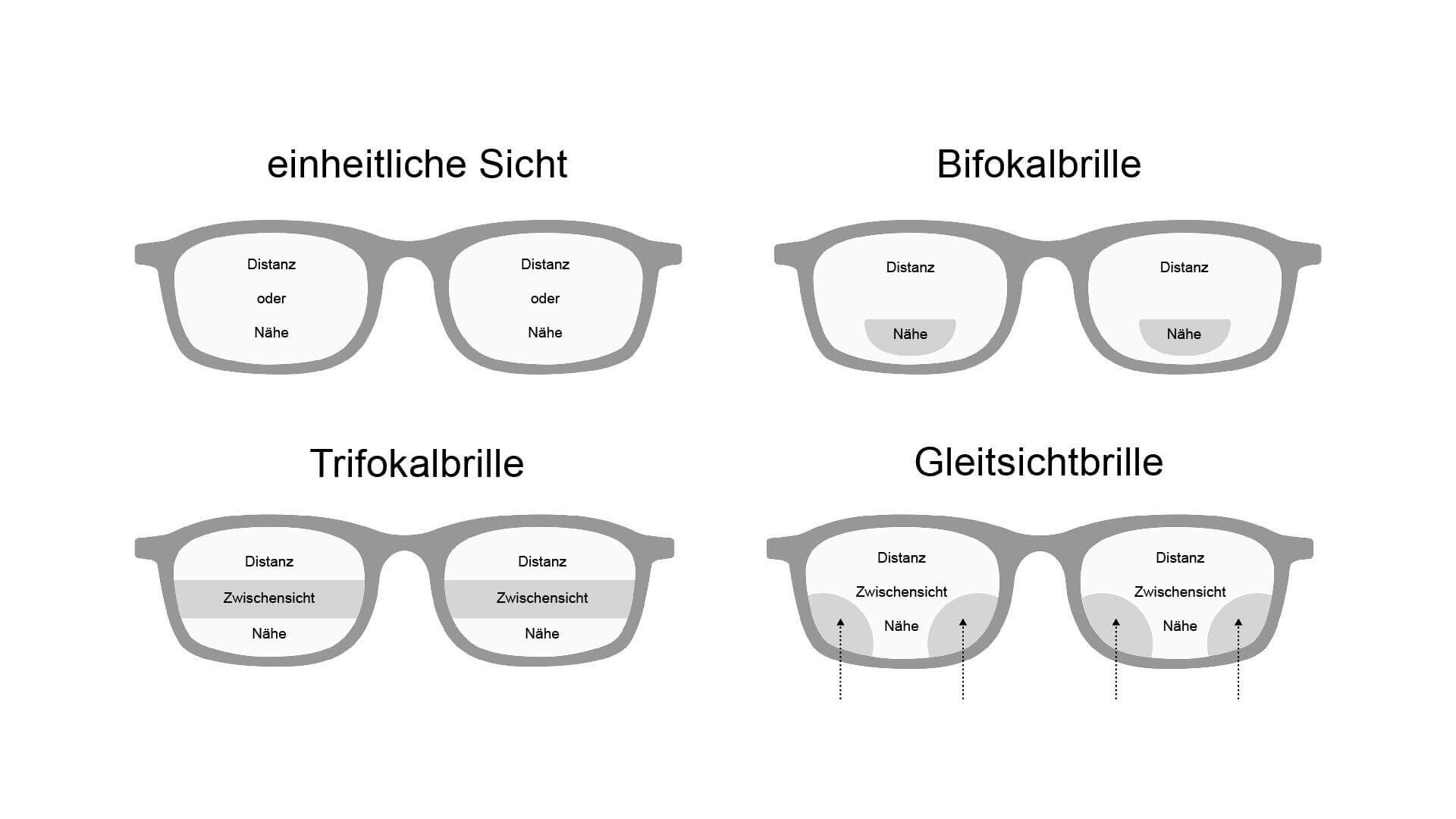
Progressive glasses, on the other hand, have several viewing zones that transition smoothly across the lens. The upper part is for distance vision, while the lower part is for near vision. The middle section provides clear vision at intermediate distances, for example when working on a computer.
For the different zones to function properly, progressive glasses must be precisely fitted to the wearer by the optician. Reading glasses should also be adjusted individually, since parameters such as pupillary distance vary from person to person.
In this respect, reading glasses also differ from reading aids, such as the inexpensive ones available in drugstores, which are often not intended as permanent visual aids.
When are reading glasses and progressive lenses suitable, and when are they not?
Reading glasses usually have single-vision lenses. This means that they are designed to correct a single diopter value (e.g., +1.25 dpt). However, because presbyopia primarily affects near vision while distance vision often remains relatively good, reading glasses interfere with distance viewing and must be removed.
It becomes difficult with activities like driving, where you need to keep an eye on the speedometer, the radio and the road at the same time. If twilight or glare add to the challenge of focusing on different distances, driving can become a real ordeal. One solution can be bifocal glasses, which make reading easier in the lower part of the lens but provide no correction in the upper part.
Especially if you have other vision problems in addition to presbyopia – such as nearsightedness or farsightedness – progressive lenses can be worthwhile. Unlike conventional bifocal or trifocal glasses, the transitions between the different viewing zones are seamless, allowing you to see clearly at varying distances.
However, a major drawback of progressive lenses is that the different zones can make it difficult to judge lines and curves. Architects, graphic designers, and engineers can therefore sometimes struggle with them.
Are reading glasses the same as computer glasses?
In short: reading glasses and computer (or workplace) glasses are not the same. They do have similarities, however, since both types of eyewear are intended for relatively short distances. Computer glasses are specifically optimized to bring the area between the keyboard and the computer screen into sharp focus.
Another (possible) difference: computer glasses are usually equipped with a blue-light filter. This reduces eye strain during extended periods in front of the screen, which typically emits light with a relatively high blue component.
Although reading glasses and computer glasses are not the same, not everyone necessarily needs both. Above all, it depends on how much time you regularly spend at the computer.
Progressive or reading glasses: A matter of price?
As a rule, reading glasses are the cheaper option. Although ready-made reading glasses from the supermarket are not necessarily suitable for long-term use, reading glasses from an optician are still less expensive than progressive glasses.
An individually fitted pair of reading glasses from the optician costs between 50 and 500 euros, depending on the lenses and frame. Progressive glasses are more expensive due to their complex design and specialized lenses. Depending on the manufacturer, lens quality, and frame, they can cost several hundred to over 1,000 euros.
However, progressive spectacles also offer the advantage of covering many areas of vision, thereby replacing several pairs of glasses. This is particularly beneficial for people who can use them instead of their glasses for short-sightedness.
Advantages and disadvantages compared: What makes sense in the long term?
Reading glasses are simple and inexpensive. However, they only correct near vision, which means they must be put on and taken off constantly. For people who do not have any other vision problems, they are a good and cost-effective solution.
Progressive glasses, on the other hand, allow correction of multiple vision zones, which makes everyday life much easier. One drawback, however, is the adjustment period: some people need time to get used to the smooth transitions between the different areas of vision.
In addition, they are considerably more expensive than simple reading glasses, which matters especially if presbyopia is still progressing. This is usually the case between the ages of 40 and 65, so your vision aid – whether progressive glasses or reading glasses – must be adjusted every few years.
| Reading glasses | Progressive glasses |
|---|---|
| + Affordable solution | + Corrects near, intermediate, and distance vision |
| + Easy setup and quick adjustment | + Practical everyday glasses that replace several pairs |
| + Easily available, including as ready-made glasses for short-term use | + No need to switch glasses |
| + More modern technology, better suited for people with multiple refractive errors | |
| – Only suitable for close-range use | – More expensive than reading glasses |
| – Frequent putting on and taking off required | – A period of adjustment is necessary because of the different visual zones |
| – No support for distance or intermediate vision | – Initially, distortions may occur, especially during rapid head movements |
| – Not ideal for people with multiple refractive errors (e.g., nearsightedness and presbyopia) | – For specific close-up tasks (e.g., prolonged reading), it may not be as comfortable as wearing reading glasses |
Progressive glasses or reading glasses: In the long run, it depends on what your priorities are and whether you already have other vision problems. Reading glasses are less expensive and a good solution if you don’t mind taking them off repeatedly, for example when looking up from your reading into the distance.
Progressive lenses, on the other hand, provide clear vision at multiple distances, can correct several vision problems, but are also more expensive.
If you’d prefer neither visual aid and don’t want to wear contact lenses, here’s some good news: there are alternatives. Thanks to modern laser eye procedures, presbyopia can be corrected without glasses.
Alternatives to glasses for presbyopia
My patients are often surprised when I suggest laser eye surgery as a treatment for their declining vision. This is understandable, since this option is relatively new. Yet there have been significant advances in the field, so today we can offer a range of procedures to help people enjoy a more carefree everyday life.
The PRESBYOND® method offers a long-term solution for correcting presbyopia. Using a femtosecond laser, the eye’s refractive power is altered to improve vision with age. The eyes are optimized for different distances, and the brain can then combine the two different visual inputs to produce a sharp image at each distance.
Lens replacement (RLE) is another option in which the natural lens is replaced by an artificial one. This method provides a permanent correction and prevents a cataract from developing.
During a check-up and a personal consultation, we can determine whether and which method of laser eye surgery is suitable for you. We also welcome your concerns and preferences so you can enjoy long-term improved vision with confidence.
Read more about presbyopia:
• Declining vision in old age: when does it start?
• Do you become short-sighted or long-sighted with age?
• What helps with age-related vision problems?
• Symptoms of presbyopia: How can I recognize it?
• What treatment options are available for presbyopia?
• How does presbyopia differ from other vision problems?
• How does presbyopia affect my everyday life?
• What foods are good for eye health in old age?
• What factors influence presbyopia?
• Presbyopia vs. myopia: What are the differences?
• Presbyopia vs. Farsightedness: What’s the Difference?
• Does smoking affect presbyopia?
• Myths about presbyopia: What’s really true?
• Prevalence of presbyopia in Germany: Is everyone becoming presbyopic?
• Eye problems due to presbyopia – already a concern by age 40
• What are the costs of treating presbyopia? A comparison of treatment options
• The 10 most common eye diseases in old age
• Exercises to improve presbyopia
• What to do about presbyopia and nearsightedness?
• Reading glasses – 10 things to keep in mind
• Reading glasses or progressive lenses: Which solution is the better long-term option?
• Which reading glasses are right for me?
• Contact Lenses for Presbyopia: What to Keep in Mind!
• Diopter chart for presbyopia