Causes: What factors influence presbyopia?

The cause of this visual impairment is already in its name. But besides age, are there other factors that contribute to presbyopia? Can it be prevented?
This article will address these and other questions, as well as considerations regarding possible treatment methods. Among other things, we will discuss how existing presbyopia can be easily treated using modern laser eye procedures.
What are the causes of presbyopia?
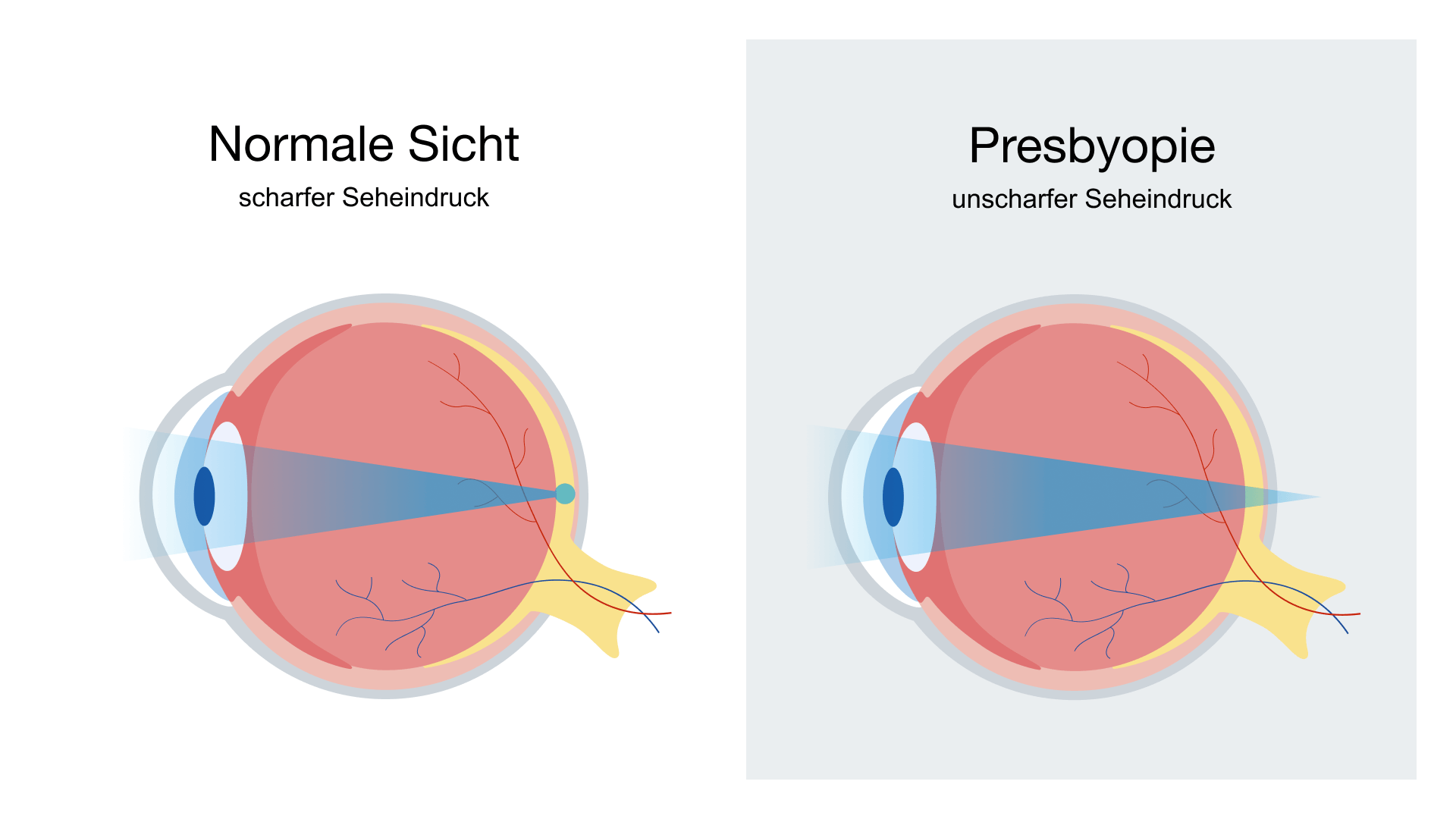
The cause of this visual impairment is the natural aging process, which does not spare the eye. From about the age of 40, it causes the lens to gradually lose flexibility. Because this elasticity—together with the ciliary muscle, which is also weakening—is responsible for switching between near and far vision (a process known as accommodation), it becomes increasingly difficult as we age to adjust our vision to different distances.
In view of this, many people wonder what they can do to counter presbyopia. The short answer is that presbyopia cannot be prevented. As already mentioned, it is a normal part of the ageing process.
You’re not entirely without hope if you know how to categorize the factors of presbyopia. The following sections will therefore focus on them.
Is lifestyle the cause? Influence of diet and other factors.
While lifestyle is considered a cause of many diseases, it is not directly related to presbyopia. A healthy diet may contribute to overall eye health, but it does not prevent presbyopia. Smoking, which is linked to numerous other health problems and risks, also has no direct effect on presbyopia.
It’s different with indirect influences. There are, in fact, certain diseases that have been linked to presbyopia. These are levers that can be adjusted through lifestyle changes to positively influence presbyopia – more on this in the next chapter.¹
¹Gesundheitsinformation.de: Presbyopia.https://www.gesundheitsinformation.de/alterssichtigkeit-presbyopie.html

Pre-existing conditions that increase the risk of vision impairment
As mentioned earlier, certain conditions have been associated with presbyopia. For example, cardiovascular diseases, diabetes, or multiple sclerosis are thought to lead to an earlier onset of presbyopia.²
In addition, certain other eye conditions can make presbyopia noticeable earlier or cause its symptoms to become more pronounced. Alongside a cataract, which worsens overall vision, this can include pre-existing farsightedness. If presbyopia is then added to this refractive error, the symptoms become noticeably more severe.
Nevertheless, we treat many patients in our practice whose medical history is unremarkable. These patients neither maintain a particularly unhealthy lifestyle nor suffer from relevant pre-existing conditions.
Presbyopia is simply part of the natural aging process for many people. That does not mean, of course, that you have to accept it!
Prevention – is it possible?
Because, aside from the natural aging process, there are no direct links between external factors and progressive visual decline, targeted prevention of presbyopia is difficult. Indirectly, however, you can try to influence how early and how severely you might be affected.
This includes treating conditions such as diabetes or cardiovascular problems, which can in turn cause presbyopia to appear earlier. Beneficial behaviors in the form of a healthy lifestyle (adequate physical activity, a healthy diet, and reducing exposure to harmful environmental factors, e.g., by not smoking) can therefore indirectly help delay the onset of presbyopia.
At the same time, many of these behaviors can prevent other eye diseases. If presbyopia does occur, its symptoms are often better tolerated in the absence of other eye diseases.
However, you don’t have to accept presbyopia. In addition to traditional visual aids, there are modern surgical procedures that can permanently relieve those affected of their distress.
² AOK: Presbyopia – what to do if reading becomes increasingly difficult?https://www.aok.de/pk/magazin/koerper-psyche/organe/alterssichtigkeit-warum-sehen-wir-im-alter-schlecht/
Treating presbyopia – from visual aids to laser eye surgery
For a long time now, those affected no longer have to accept the limitations that presbyopia brings. Established treatment methods include visual aids such as reading glasses, progressive lenses, and contact lenses. These can compensate very well for reduced visual acuity, but they are not a permanent solution.
Many people miss the independence and ease of everyday life when using visual aids, or they simply do not feel comfortable with them. They are therefore increasingly turning to laser eye centers, which offer a diverse range of treatments as a permanent solution for presbyopia.
This also includes Bányai Neue Augen, where you rely on a combination of state-of-the-art technologies, innovative methods and many years of know-how. This is reflected, among other things, in the PRESBYOND® method, in which one eye is optimised for distance vision and the other for intermediate and near vision. The brain is then able to combine these two visual inputs into a single, overall sharp image.
We rely on the SMILE® procedure, which is also considered particularly gentle.
For people for whom such laser eye treatments are not an option for presbyopia, there is also refractive lens replacement. Here, the body’s natural lenses are replaced with special artificial lenses. You will receive a clearer overview of the different procedures and clarity about which is best for you as part of a thorough preliminary examination that includes a detailed consultation.
Find answers to all your questions here – from the risks and costs of laser eye surgery to what to expect after the procedure. That way, you can start an independent life fully informed.
Learn more about presbyopia:
• Declining vision in old age: when does vision begin to decline?
• Do you become nearsighted or farsighted as you age?
• What helps with age-related vision problems?
• Symptoms of presbyopia: How can I tell if I have it?
• How does presbyopia differ from other vision problems?
• How does presbyopia affect my daily life?
• Which foods are good for eye health in old age?
• What factors affect presbyopia?
• Presbyopia vs. myopia: What are the differences?
• Presbyopia vs. Farsightedness: What’s the difference?
• Does smoking affect presbyopia?
• Differences between presbyopia and farsightedness
• Myths about presbyopia: What’s the truth?
• Prevalence of presbyopia in Germany: Does everyone become presbyopic?
• Eye problems from presbyopia — already a concern from age 40
• What are the costs of treating presbyopia? A comparison of treatment options
• The 10 most common eye diseases in old age
• Exercises to improve vision affected by presbyopia
• What to do about presbyopia and nearsightedness?
• Reading glasses – 10 things to keep in mind
• Reading glasses or progressive lenses: Which solution is most sensible in the long term?
• Which reading glasses are right for me?
• Contact lenses for presbyopia: what you need to know
• Diopter chart for presbyopia